

Lately I’ve been noticing a subtle shift in how systems are starting to work.
At first, it’s not something you immediately see.
Everything still looks the same on the surface. Platforms still hold their own data, enforce their own rules, and decide what’s valid within their environments.
But underneath all of that, something is slowly changing.
Systems are beginning to rely less on what they know internally and more on truth that exists outside of them.
For a long time, most systems worked like closed environments.
If something needed to be verified, it happened internally. The platform stored the data, defined the rules, and decided whether something was valid.
Trust lived inside the system.
And honestly, that approach made sense for a while. Everything stayed in one place. Control was centralized. Verification happened locally.
But it also created a lot of limitations.
Every system had to build its own version of truth.
Every platform had to repeat the same verification processes.
Every interaction depended on isolated datasets.
And none of it really carried over between systems.
So even if something had already been verified somewhere else, it usually had to be verified again. Not because the original proof was wrong, but simply because it wasn’t accessible.
That’s where things are starting to change.
Instead of generating truth internally, systems are beginning to reference it externally.
Not raw data — but structured, verifiable proof.
This creates a very different model.
The system no longer asks:
“Do we have this information?”
Instead it asks:
“Can this be proven?”
And even more importantly:
“Can we verify that proof without owning the data ourselves?”
That’s where external truth layers come in.
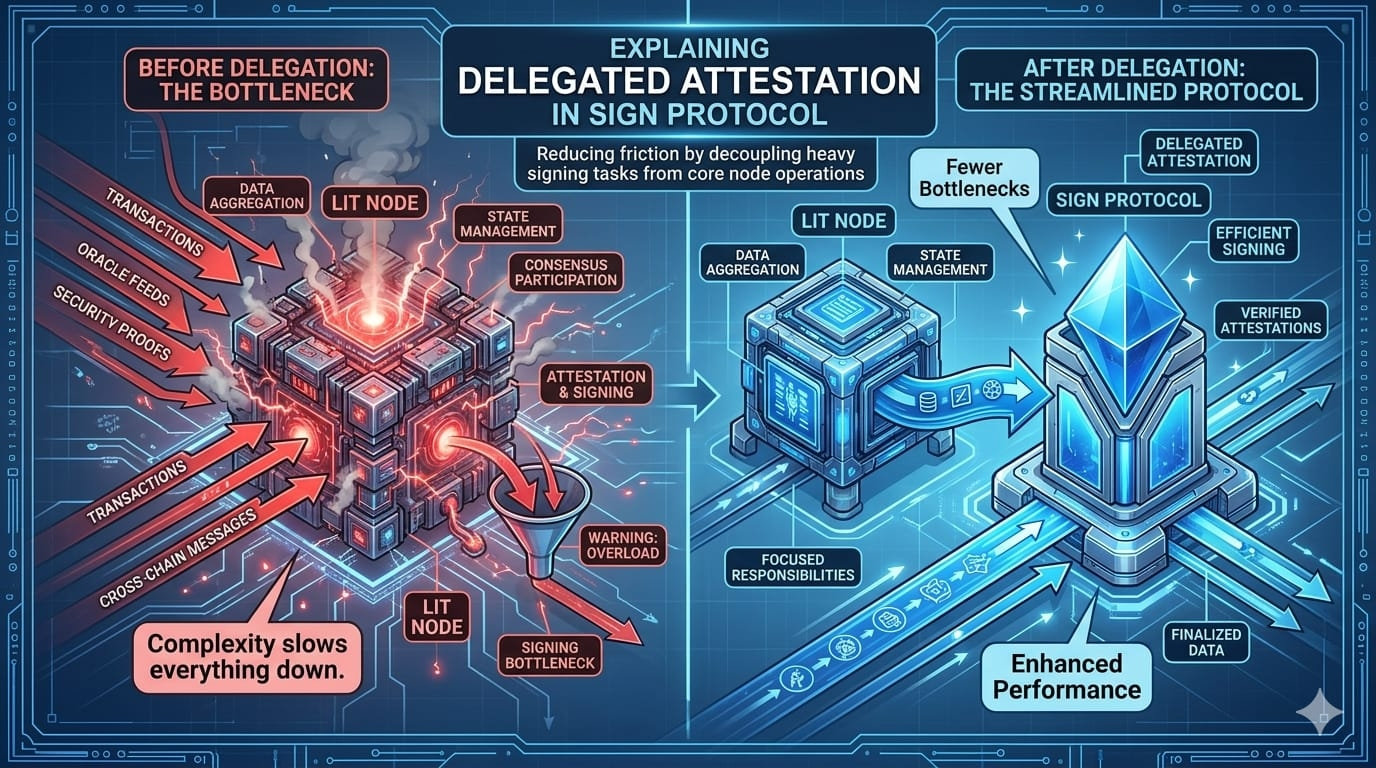 These layers act like shared sources of verifiable information. Instead of storing everything internally, systems can query these layers, check claims, and make decisions based on proof that already exists.
When that happens, the system itself becomes lighter.
It doesn’t need to duplicate data.
It doesn’t need to rebuild verification logic.
It doesn’t need to assume trust.
It only needs the ability to verify.
In some ways, this shift feels similar to how infrastructure evolved.
There was a time when every application managed its own servers. Now infrastructure is externalized through shared layers that multiple systems depend on.
Truth seems to be following a similar path.
Instead of living inside individual platforms, it’s starting to move into shared, structured layers that many systems can reference.
And once that happens, systems begin to behave differently.
They stop owning truth.
They start referencing truth.
That difference matters more than it seems.
When systems own truth, fragmentation naturally happens. Every platform defines its own standards, builds its own logic, and maintains its own datasets.
Nothing connects cleanly.
But when systems reference truth, consistency starts to appear. Multiple platforms can rely on the same proofs. Decisions can align across environments. Verification becomes something that can be reused.
And that’s where the deeper shift begins.
Trust no longer has to be rebuilt from scratch inside every system.
Instead, it becomes something that exists independently — something systems can tap into.
Not by trusting it blindly.
But by verifying it.
Once verification becomes standardized, portable, and accessible, the model suddenly makes a lot more sense.
Systems don’t have to ask users to prove the same things over and over again.
They don’t have to store massive isolated datasets.
They don’t even have to act as the ultimate source of truth.
Instead, they can become consumers of it.
That changes the role of the system itself.
It moves from being:
• a holder of data
• a gatekeeper of verification
• a source of trust
to something else entirely.
A decision layer.
A place where logic is applied to proofs that already exist.
And that actually makes systems more scalable.
Not because they do more — but because they depend less on what they control internally.
Instead, they rely on shared structures that provide consistent, verifiable truth.
Over time, that shift starts to reshape entire ecosystems.
When multiple systems depend on the same external layer, coordination becomes easier.
Data doesn’t need constant translation.
Verification doesn’t need to be repeated.
Trust doesn’t have to be rebuilt every time.
It becomes composable.
And that’s the real transformation here.
Not just better verification.
But a completely different place where truth lives.
Outside the system.
Structured. Portable. Verifiable.
Available to any system that knows how to check it.
Which means systems are no longer defined by what they know.
They’re defined by what they can prove using truth that doesn’t belong to them.