Recently I experienced something that made me rethink how trust works in Web3.
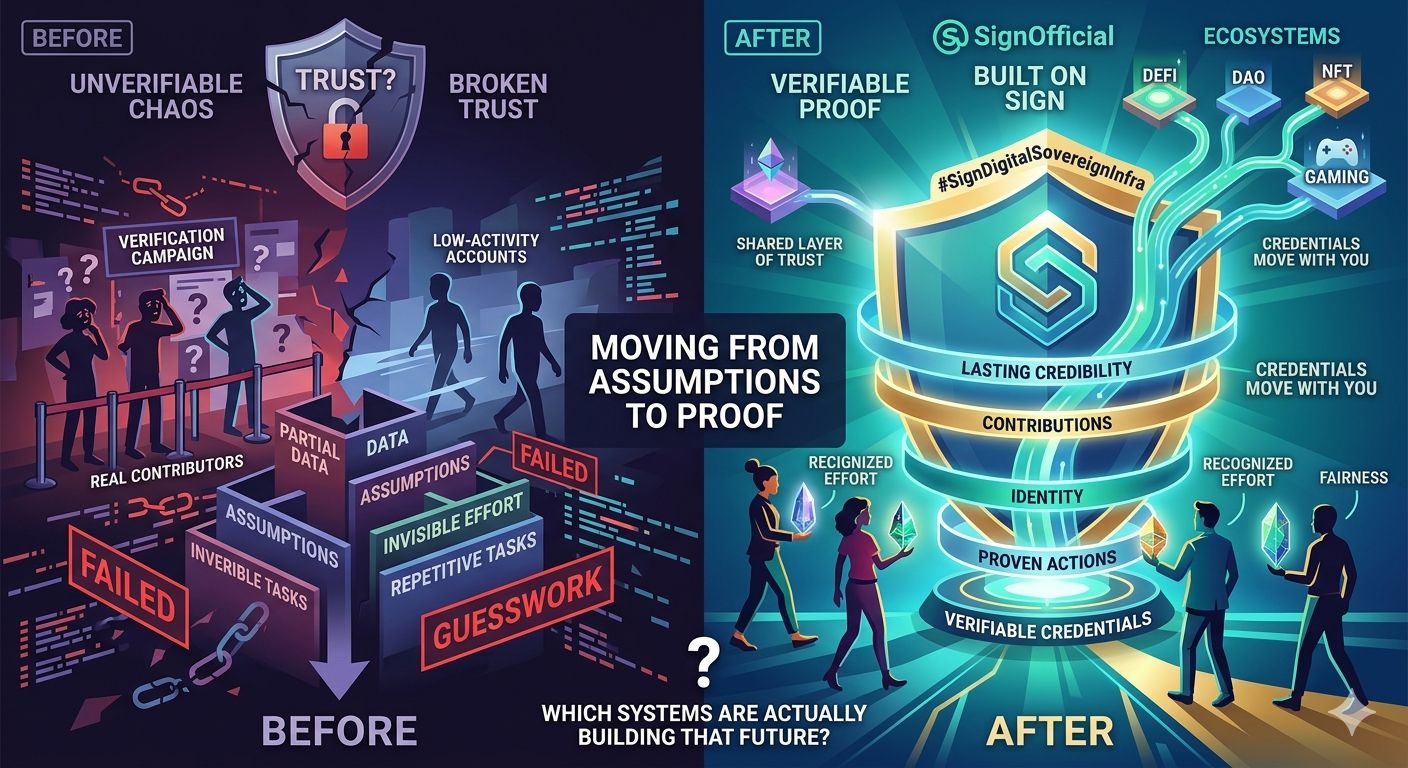
A new platform launched a verification campaign. Like many others I followed every step connected my wallet completed tasks stayed active. Everything was done properly. But when the final results came out something felt off. Some low-activity accounts made the list, while real contributors were missing.
That moment raised a simple question for me:
if participation can’t be verified properly then what exactly are we trusting?
After that I started looking deeper into how these systems work, and that’s where @SignOfficial started to make more sense to me.
I don’t see it as just another tool.
It feels more like a system trying to fix how trust is created online.
Instead of depending on surface-level signals it focuses on verifiable credentials meaning actions identity and contributions can actually be proven not just assumed.
One thing I realized is how repetitive Web3 still is.
Every platform asks for the same verification again and again. It slows everything down and creates inconsistency.
With a system like this once something is verified it doesn’t lose value after one use.
It can move with you across different platforms creating continuity instead of starting from zero each time.
Fairness is another area where this matters.
Right now rewards and recognition don’t always match real effort mostly because systems don’t have a reliable way to measure contribution.
If actions are directly linked with proof, then decisions can be based on what actually happened not just partial data or assumptions.
There’s also a shift in how it feels as a user.
When your actions are recorded and verifiable they don’t disappear. They become part of a trackable history. That changes engagementbbecause effort is no longer invisible.
I also see how this connects different ecosystems.
Instead of keeping users locked inside one platform, credentials can move across systems. That reduces friction and builds a shared layer of trust which Web3 will need as it grows.
The more I think about it the clearer it becomes:
this is not just about verification - it’s about making digital trust structured and reliable.
Moving from assumptions to proof.
From temporary activity to lasting credibility.
And it leaves me with one simple question:
If trust can be proven not guessed…
then which systems are actually building that future?
@SignOfficial #SignDigitalSovereignInfra $SIGN