
Lately, I’ve been thinking deeply about the noise around @SignOfficial’s OBI (Orange Basic Income)… and honestly, it feels misunderstood.
A lot of people are treating it like just another airdrop but that’s a shallow take.
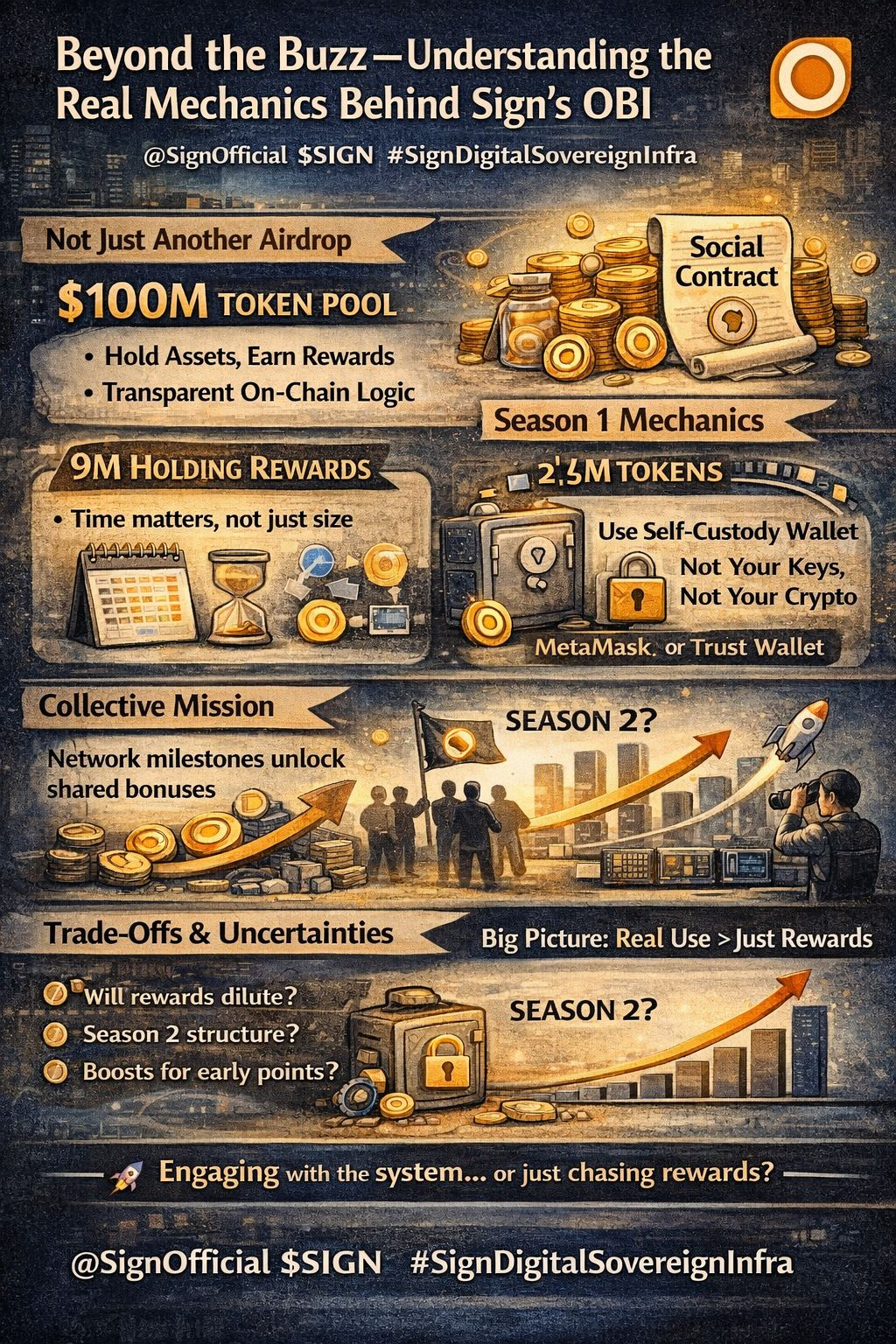
From what I’ve seen digging into their docs and the March 31st phase, this looks more like an experiment in crypto behavior design than a simple token distribution. Yes, the $100M $SIGN pool grabs attention but the real story is how it’s structured.
They frame it as a “social contract.”
Put simply: you hold assets, trust the system, and in return, you earn rewards all visible on-chain. No hidden rules, no guesswork. Just transparent logic executed through smart contracts.
Now zoom into Season 1…
Out of 25M tokens allocated, 9M are dedicated to holding rewards. But this isn’t about quick gains. It’s not a “buy now, earn instantly” setup.
Time is the real factor here.
It’s not just how many tokens you hold it’s how long you keep them untouched. That shift alone separates this from typical reward systems. Early and consistent holders naturally gain an edge.
And let’s be honest many people are still making a critical mistake…
Keeping their tokens on centralized exchanges.
There’s a reason the crypto world repeats: “Not your keys, not your crypto.”
Sign Protocol has been clear if your tokens are sitting on platforms like Binance, you’re basically excluded from OBI rewards.
Why? Because everything depends on on-chain visibility. Exchanges don’t provide that.
So unless you’re using self-custody wallets like MetaMask or Trust Wallet, you’re not truly participating. And with deadlines like March 31st, delays could cost more than people realize.
Another interesting layer is the “collective mission.”
Instead of isolated tasks, the system ties rewards to overall network activity. If the community hits certain milestones like a number of attestations everyone benefits.
It feels more like leveling up together rather than competing alone.
This approach drives real usage, not just passive farming which is a smart move for long-term sustainability.
But nothing is perfect…
Even with a 100M token pool, large participation could dilute rewards. Plus, there’s still uncertainty around how Season 2 will evolve once this phase ends.
That said, it seems likely that strong performers in Season 1 may receive boosts moving forward.
So right now, the focus should be simple: stay active, monitor your points, and actually use the protocol.
Looking at the bigger picture…
@SignOfficial isn’t just handing out tokens—they’re shaping user behavior through incentives.
They’re rewarding patience, encouraging engagement, and building habits within the ecosystem.
If this model succeeds, it could set a new standard in crypto.
If it fails, it risks becoming another short-lived hype cycle.
So the real question now is what happens after March 31st?
And more importantly…
Are you genuinely engaging with the system or just chasing rewards?
Because in the end, no model survives unless the usage behind it is real.