
What bothered me first about @SignOfficial was not the attestation layer.
That part is easy to like. Schema. Attestation. Evidence pointer. Issuer. Nice clean record. Finally something in crypto that doesn't look like a PDF got shoved through a smart contract and everybody agreed to call it infrastructure.
Fine. Good even.
What kept dragging me back.... was the thing that comes after the record already exists.
The search.
Not storage. Not issuance. Search.
Because the minute a state or quasi-state system moves onto something like Sign, the power stops living only in who can issue a record. It starts drifting toward who can pull it back up later, connect it to five other records, and decide what the pattern means.
That sounds boring. It also sounds like admin work. Usually thats where the real shift is.
Sign makes claims structured on purpose. Schemas force the format. Attestations anchor the event. Retrieval stops being guesswork. The record becomes something a machine can actually work with instead of something a clerk has to squint at for twenty minutes while pretending the uploaded file is “clear enough.”
Good.
Still not the part that should make people comfortable.
Because messy records limit power in one ugly way. They’re slow to search. Slow to connect. Slow to operationalize at scale. A bad bureaucracy is still a bureaucracy, but at least some of its incompetence is friction. Once the records get clean, queryable, and easy to aggregate, the friction starts moving somewhere else.
And on Sign, that move is the story.
I keep picturing the polite version first. A ministry, a benefits agency, maybe some digital residency desk. They issue attested records through Sign. Alright. Then later another agency, or a bank partner, or a border system, or procurement, or whoever is downstream, starts querying the layer. Not just “is this claim valid?” More like: how many of these exceptions got approved this quarter? Which issuer keeps using this schema version? Which approvals cluster around one office? Which applicants show up across multiple capital access programs with slightly different disclosure paths?
The record layer didn't change. The power around it did.
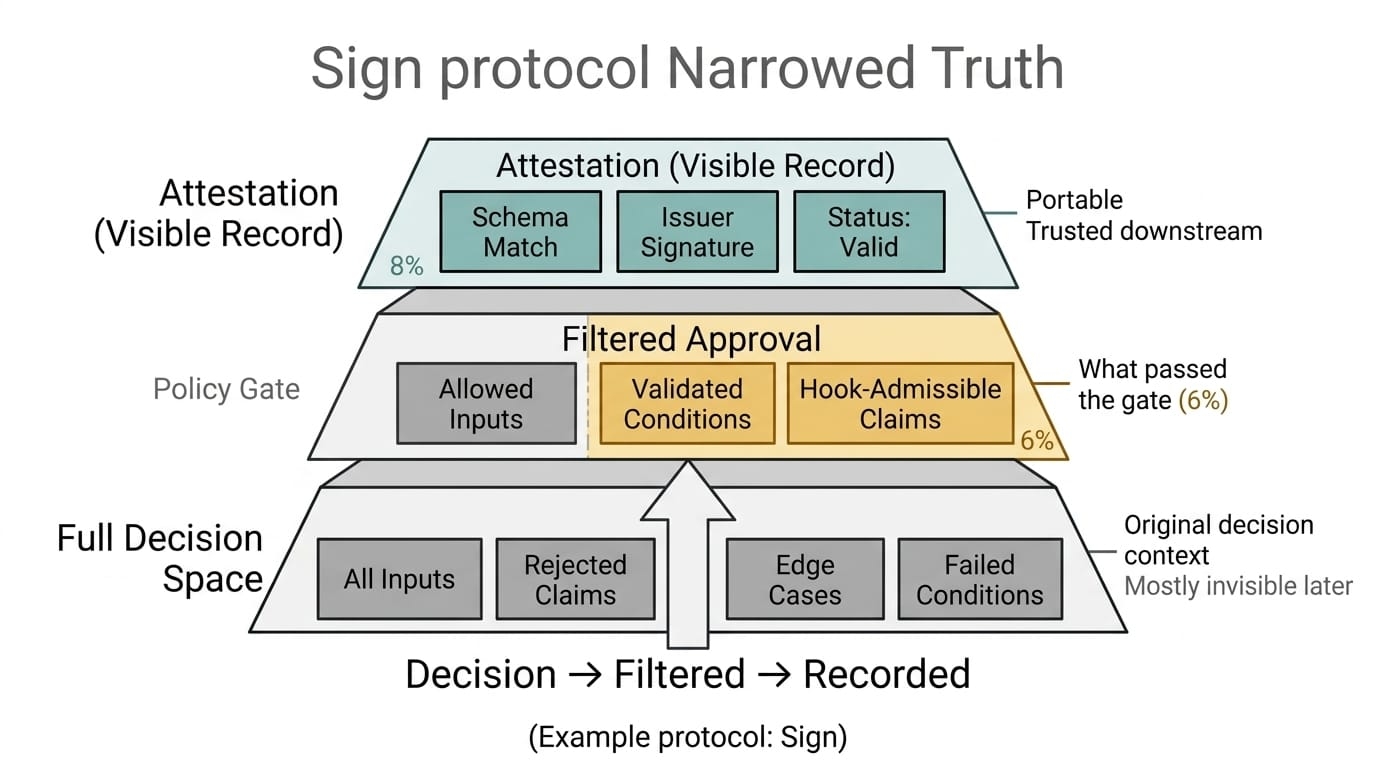 I can see how this goes wrong in a very normal way. The schema doesn't change on Sign. The attestation doesn't change. The person’s status doesn’t even change. What changes is the query logic at the relying institution. Somebody updates an internal filter, or starts clustering exception paths differently, or flags repeated evidence patterns across programs, and now the same clean record starts producing a different kind of attention than it did last month.
Thats the contradiction I can’t stop staring at.
Everybody talks like searchable records are just efficiency. As if the only thing being improved is administrative speed. But searchable evidence changes governance even if nothing else changes. Because once retrieval gets good, control starts pooling around whoever can inspect, correlate, and interpret at volume.
Not who stores the record.
Who works the query layer.
And on Sign, that’s exactly why the query layer matters more than people think. Schema discipline makes the records consistent. Attestations make them legible. Evidence pointers make them retrievable. Once those pieces line up, the hard part is no longer “can this be found?” It’s “who gets to decide what this cluster of records means?”
That is a different job. Also a different kind of authority.
I’m not even worried about the record being wrong. I’m worried about the search being too good for the wrong people.
A badly organized state can lose things. A modern one usually does something worse. It finds them too easily and starts making policy from the pattern before anybody agrees on what the pattern actually means.
And Sign is exactly the kind of stack that makes that possible. Schema discipline. Attestation formatting. Evidence paths that stop floating loose. Queryable objects that can travel between relying institutions without turning back into screenshots and “see attached” email theater. It is very obviously better than the old mess. Of course it is.
That does not mean the new power it creates is neutral.
I think people still underprice that.
Because the clean Sign pitch is about issuance and verification. Fair. But once the records are machine-readable and searchable, the fight stops being “can this be verified?” and starts becoming “who is allowed to ask better questions than everyone else?”
That’s where it gets sovereign in a way people keep smoothing over.
Maybe an attestation says a claim is valid. Fine. Then some downstream authority starts building retrieval rules around exception frequency, timing anomalies, schema drift, recurring evidence paths, regional outliers, whatever they think looks suspicious this month. Suddenly the question is no longer just whether the original claim holds. Now the question is who got to build the lens through which all these clean records get interpreted.
That’s not storage anymore.
That’s policy with better indexing.
And on Sign, I don’t think that line stays clean for long. The protocol can make the object legible. It can make the record portable. It can make retrieval efficient enough that institutions stop pretending they’re working in the dark.
Good.
But the moment evidence becomes easy to search, access policy stops being some dull backend setting and starts looking a lot more like state power with better UX.
That’s the part I can’t shake.
Not whether the record is clean.
Who gets to search it well enough to matter.