
Zero-Knowledge (ZK) Attestations represent an advanced approach to digital trust, enabling verification of information without revealing the underlying data. Within Sign Protocol, ZK attestations enhance privacy, scalability, and security by allowing users to prove claims while keeping sensitive details confidential.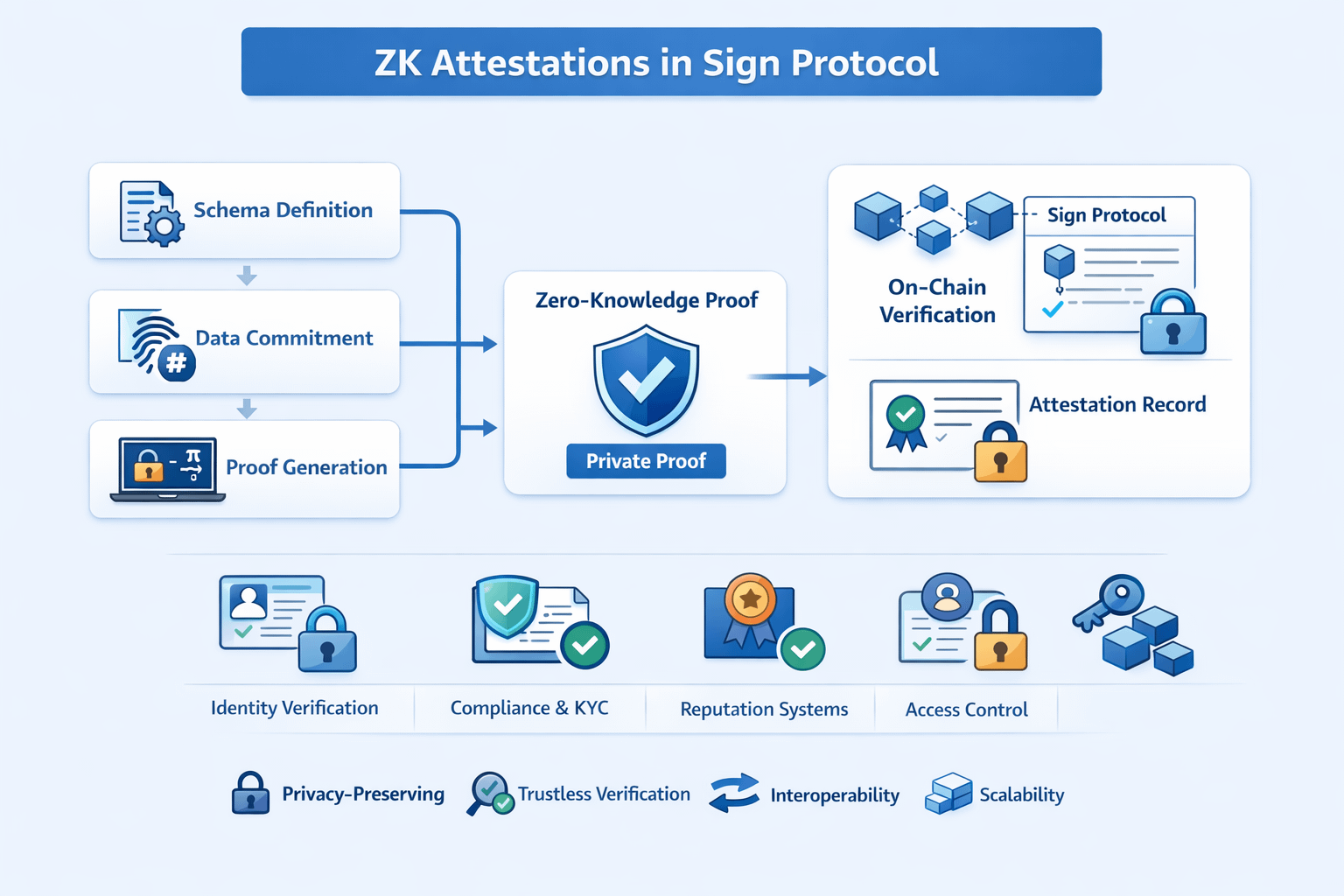
What Are ZK Attestations?
ZK attestations are cryptographic proofs that confirm the validity of a statement without exposing the actual data behind it. They rely on zero-knowledge proof systems, where a prover demonstrates to a verifier that a claim is true without revealing any additional information.
How ZK Attestations Work in Sign Protocol
Schema Definition
A schema defines the structure and rules of the attestation, including what type of data is being proven.
Data Commitment
The original data is transformed into a cryptographic commitment, ensuring it cannot be altered.
Proof Generation
A zero-knowledge proof is generated off-chain using the committed data and predefined logic.
On-Chain Verification
The proof is submitted and verified on-chain through Sign Protocol, without exposing the original data.
Attestation Record
The attestation stores only the proof and verification result, ensuring privacy while maintaining trust.
Key Features
Privacy-Preserving
Sensitive data remains hidden while still being verifiable.
Trustless Verification
Anyone can verify the proof without needing access to the original data.
Interoperability
ZK attestations can be used across different applications and ecosystems.
Scalability
Off-chain proof generation reduces on-chain data load.
Use Cases
Identity Verification
Prove eligibility without revealing personal details.
Compliance & KYC
Demonstrate compliance with requirements while preserving privacy.
Reputation Systems
Validate credentials or achievements privately.
Access Control
Grant access to services based on verified conditions without exposing user data.
Benefits in the Sign Protocol Ecosystem
ZK attestations strengthen Sign Protocol’s role as an evidence layer by combining verifiability with privacy. They enable applications where users maintain control over their data while still participating in trust-based systems.
This approach supports decentralized identity and data ownership, reducing reliance on centralized authorities while preserving confidentiality.
Conclusion
ZK attestations bring a balance between transparency and privacy to blockchain-based systems. By integrating zero-knowledge proofs, Sign Protocol enables a new class of applications where trust is established through cryptographic guarantees rather than data exposure.
They are a key component for building secure, privacy-first digital ecosystems.
#SignDigitalSovereignInfra #blockchain #Web3 #BinanceSquareFamily #Binance