
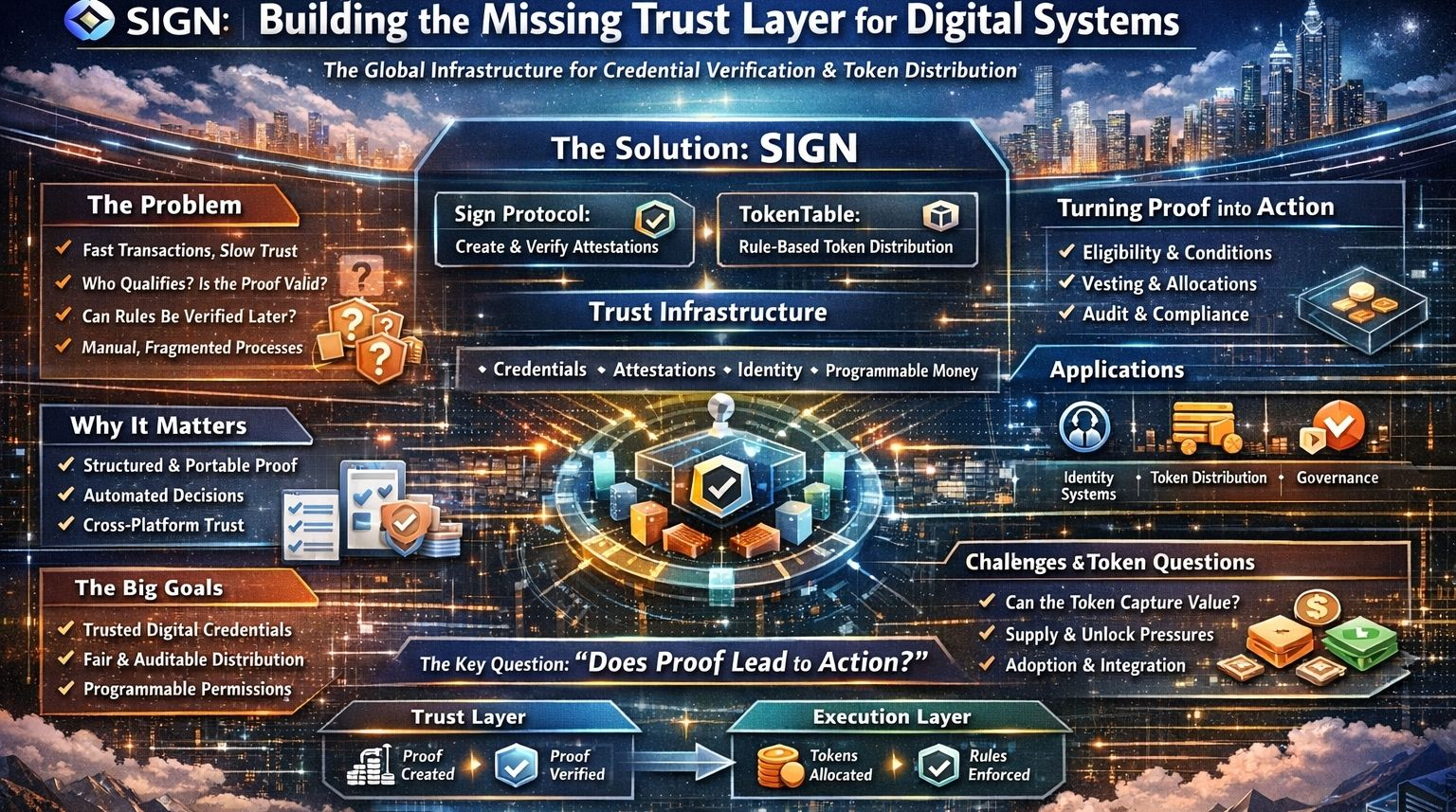
SIGN — More Than Just Another Crypto Project
I think a lot of people in crypto look at projects the wrong way.
Most start with price, listings, or supply numbers. They follow whatever is trending and then decide if something is worth attention. That’s fine if you’re just trading, but it doesn’t really tell you if a project actually matters.
SIGN is one of those projects that can be easily overlooked like that.
At first, it sounds like everything else—credentials, identity, attestations, token distribution. We’ve heard all of this before. Nothing feels new on the surface.
But when you slow down and really look at it, it’s not about the words. It’s about the problem behind them.
Right now, systems are very good at moving money and data. But they’re still bad at answering a simple question:
Who actually deserves to receive something?
That part is still messy.
Someone always has to check if a person is eligible, if the conditions are met, if the data is real, and if everything can be verified later. And honestly, that process is still slow, manual, and full of gaps.
This is where SIGN comes in.
Instead of just focusing on transactions, it’s trying to fix the decision-making layer behind those transactions. You can think of it as building a system where trust isn’t guesswork—it’s structured and usable.
And that’s a big difference.
Because having proof is one thing…
But being able to use that proof easily across systems is a completely different challenge.
That’s what SIGN is trying to solve.
Their core system (Sign Protocol) focuses on creating and verifying attestations. Then tools like TokenTable actually use those proofs to manage things like token distribution, vesting, and rules.
So it’s not just about proving something—it’s about turning that proof into action.
And honestly, that’s where most projects fall short.
The internet today can move information fast. It can move money fast.
But it still struggles with trust.
Like… can this claim be trusted?
Did this person really meet the conditions?
Should this payment actually happen?
SIGN is trying to make those answers clearer and easier.
One thing I like is how they separate things. One part handles proof. The other handles execution. That makes everything cleaner and more practical.
It also makes SIGN feel more real compared to a lot of “identity” projects that stay stuck in big ideas but never show real use.
Because at the end of the day, if proof doesn’t actually change anything… then what’s the point?
That’s why TokenTable is interesting. It’s not just theory—it’s something practical. Token distribution forces real decisions:
Who qualifies?
Who doesn’t?
Are the rules fair?
Can everything be checked later?
This is where things either work… or break.
And that’s why SIGN starts to feel less like an “identity project” and more like a system that helps different platforms make better decisions using real data.
But of course, none of this guarantees success.
A big question is whether this kind of system stays valuable or becomes something basic that everyone offers. If it becomes standard, then the real value might shift somewhere else.
So SIGN’s advantage won’t come from just having the tech.
It will come from how useful and widely adopted it becomes.
You can also see why they’re exploring bigger areas like institutions or governments. It makes sense—but it’s also much harder. Those spaces move slowly and require real trust, not just good ideas.
Then there’s the token side.
Just because a project is useful doesn’t mean the token automatically becomes valuable. That’s a mistake people make a lot in crypto.
For SIGN, the real question is simple:
Does the token actually sit at the center of the system, or just around it?
That still needs to be proven.
On top of that, supply and unlocks can affect price no matter how good the project is. That’s just reality in crypto.
So you kind of have to look at SIGN in two ways at the same time.
On one side, it’s working on a real and important problem.
On the other, it still needs to prove itself in terms of execution and token value.
Both things can be true.
Personally, I think the strongest thing about SIGN is that it’s focused on the real issue.
The problem isn’t moving data anymore.
The problem is deciding when that data should actually lead to action.
That’s a deeper challenge—and a more important one.
At the same time, the risk is clear. Turning this into something widely used won’t be easy. And connecting that success back to the token is another challenge.
Still, this is what makes it interesting.
It’s not loud. It’s not hype-driven. It’s the kind of project people might ignore… until they realize they actually need something like it.
And sometimes, those are the projects that end up mattering the most.
Because the future isn’t just about faster transactions.
It’s about trusting those transactions.
If SIGN can really make that easier, then it has a strong path ahead.
But that will depend on real adoption—not just ideas.