

I didn’t realize how much I believed in ownership until I started questioning it.
For the longest time, every system I interacted with had someone in control. A company, a founder, a board, an admin someone always owned the process.
Whether it was finance, social platforms, or even access to opportunities, there was always a gatekeeper.
And honestly, I never challenged it. It just felt… normal.
But the deeper I went into crypto, the more that assumption started to crack.
At first, I thought decentralization was just about moving money faster. Lower fees, fewer intermediaries, more control over assets.
That’s what most people focus on anyway. But over time, I started noticing something else the real friction wasn’t transactions. It was everything around them.
Who qualifies for what?
Who gets access?
Who decides eligibility?
And more importantly who do you trust to make those decisions?
That’s where things usually fall apart.
I’ve seen campaigns across different platforms and exchanges where rules keep shifting. Wallet lists get updated last minute.
criteria isn’t always transparent. Sometimes you meet all the requirements and still get excluded without a clear reason.
it creates this constant loop of verification, re verification and doubt.
And that’s when $SIGN clicked for me.
Instead of relying on centralized control or repeated manual checks, SIGN approaches things differently. It treats data not as something static,
but as proof something that can be verified, reused, and trusted across systems without needing a single owner to oversee everything.
That shift feels small on the surface, but it changes everything.
Because when proof becomes reusable, you don’t need someone constantly approving or validating you. The system doesn’t depend on trust in a person or an organization anymore it depends on verifiable truth.
And that’s powerful.
I started imagining what this means beyond just one use case. Across exchanges, campaigns, and ecosystems, a lot of inefficiencies come from the same root problem: ownership of decision making.
When one entity controls access, everything becomes slower, messier, and often biased even unintentionally.
@SignOfficial removes that pressure point.
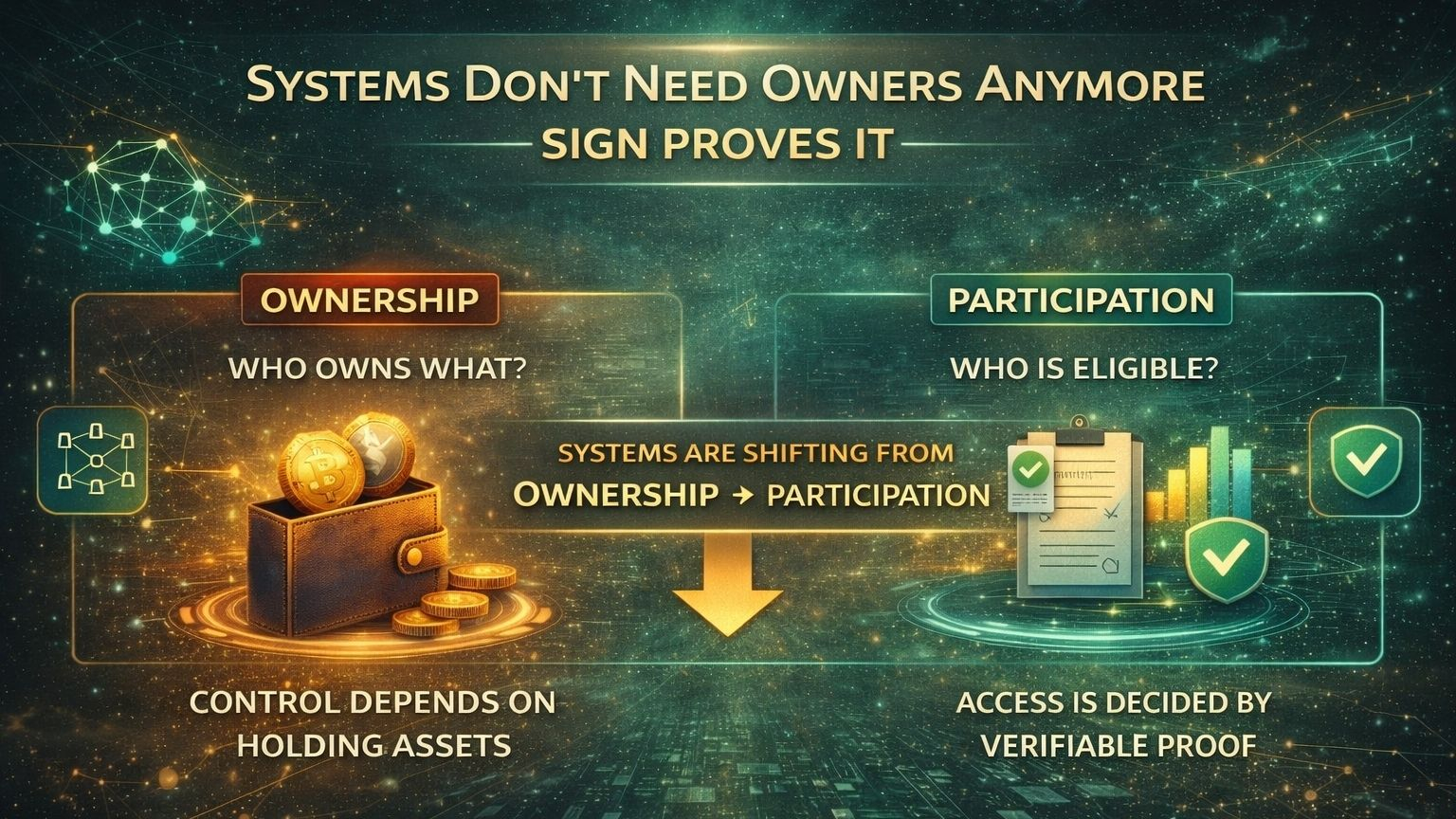
It doesn’t try to replace systems. It changes how they function at a fundamental level. Instead of asking “who owns this?”, it shifts the focus to “what can be proven?”
That’s a completely different mindset.
And once you see it, it’s hard to unsee.
We’re so used to systems needing leaders, operators, and controllers that we rarely consider the alternative. But what if systems could run on verified logic instead of authority? What if access, rewards, and participation weren’t decided behind closed doors but based on transparent, portable proof?
That’s where things start to feel less chaotic and more logical.
I’m not saying ownership disappears overnight. There will always be layers of control in some form. But what SIGN shows is that ownership doesn’t have to be the foundation anymore.
Systems can operate without constantly relying on it.
And maybe that’s the bigger shift happening right now not just decentralization of assets, but decentralization of decision making itself.
The more I think about it, the more it feels like we’re moving toward a world where systems don’t need owners to function.
They just need truth.
And SIGN might be one of the first real proofs of that.