

There’s a small detail I didn’t pay attention to before…
and now it’s starting to feel like the most important part.
When I first looked at @SignOfficial and $SIGN , I saw verification as something static.
You prove something once… and that proof just works everywhere.
Efficient. Scalable. Logical.
But the more I think about how this actually plays out across real systems… the more it feels incomplete.
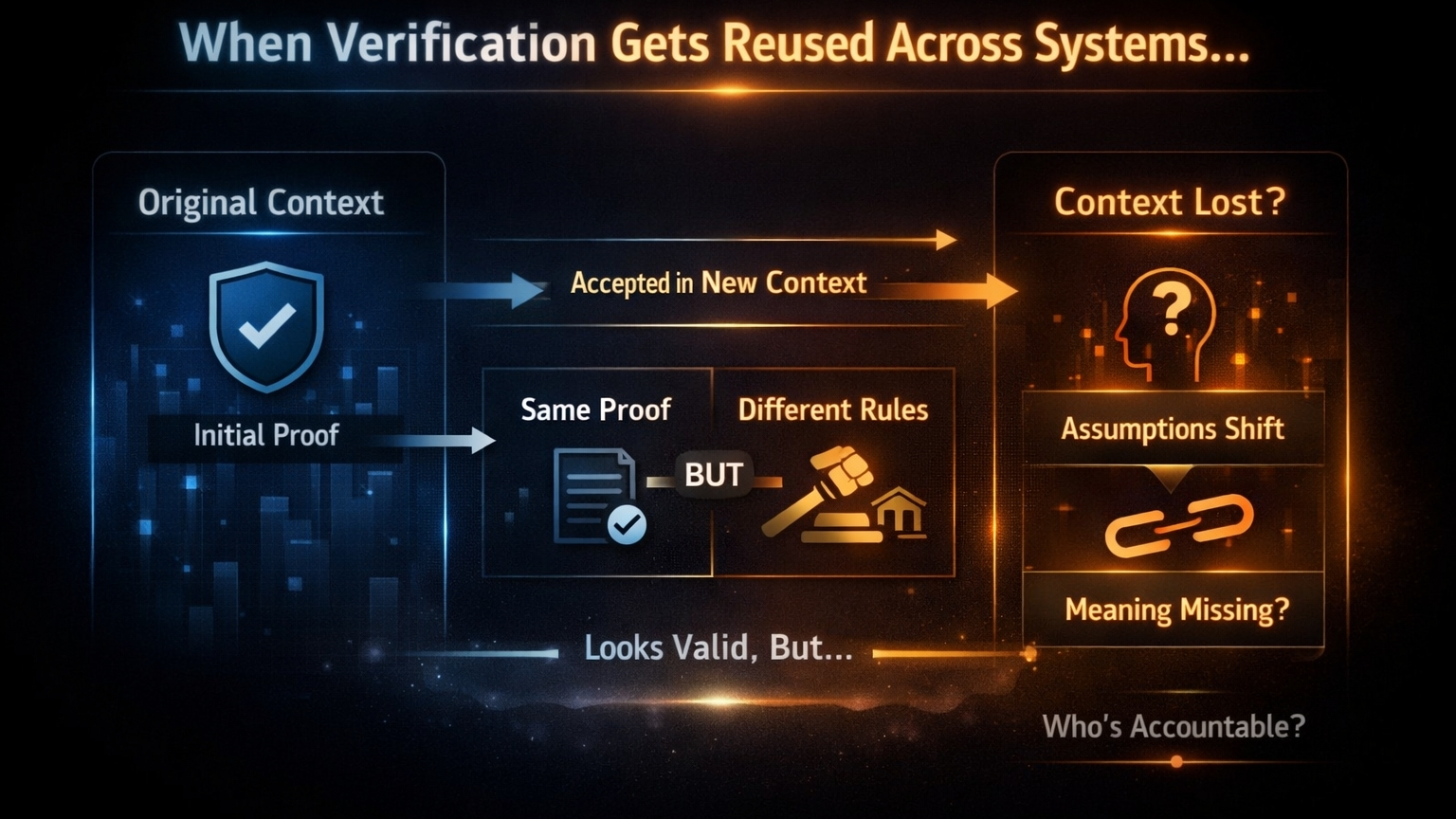
Because proofs don’t travel alone.
They carry assumptions.
A verification that made sense in one context… gets reused in another where the conditions are slightly different.
Different rules. Different incentives. Different expectations.
And yet… the system still accepts it.
That’s the part I didn’t consider before.
With something like #SignDigitalSovereignInfra expanding into complex economies like the Middle East, reuse becomes powerful.
But also… risky in a quiet way.
Because systems don’t naturally understand why something was valid… only that it was.
So over time, you don’t just scale trust…
you scale context gaps.
And no one really notices because everything still checks out technically.
Maybe I’m overthinking it,
but I keep wondering…
when verification becomes infinitely reusable…
who’s responsible for the meaning behind it?