
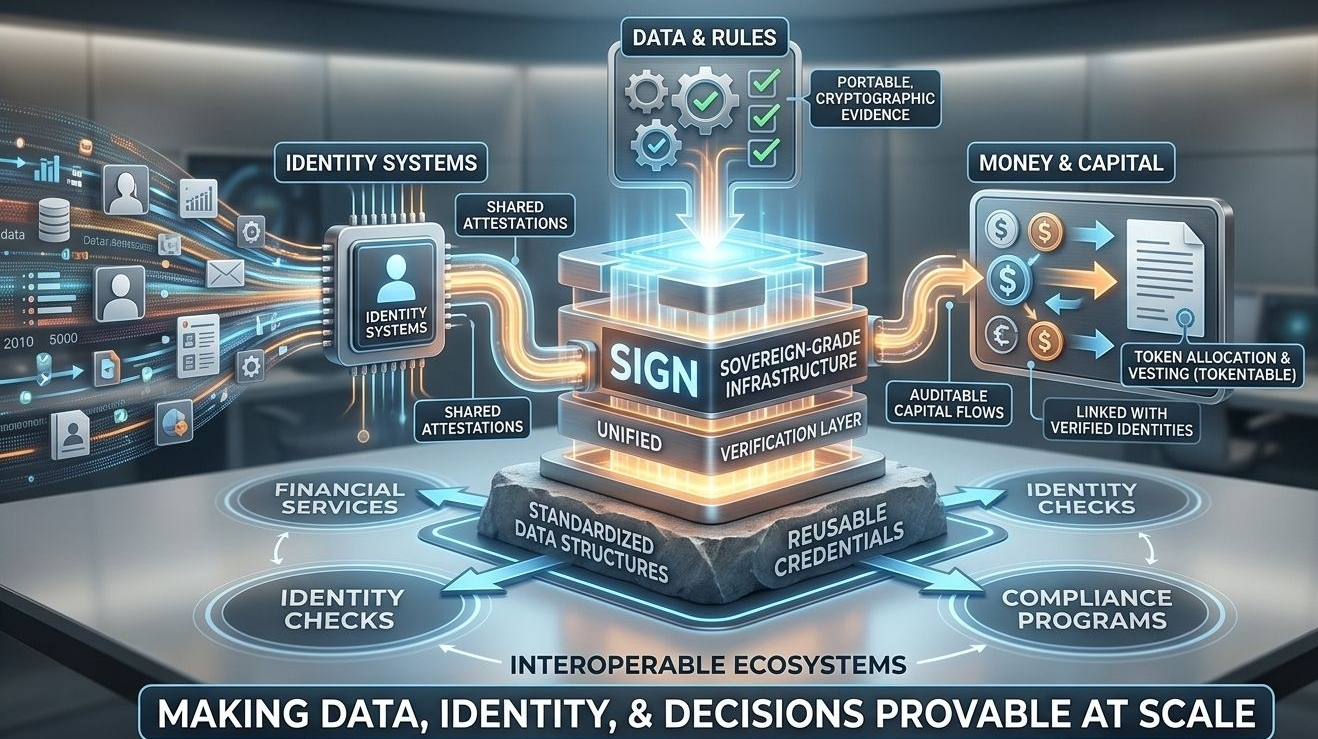
Why do I still struggle to prove something online in a way that others will trust? Not just a payment, but something more personal—like who I am, what I’ve agreed to, or whether I qualify for something. In everyday life, I rarely think about this because institutions handle it quietly in the background. But the moment I step into decentralized systems, the gap becomes obvious.
Before blockchain, I depended on centralized authorities for almost everything related to verification. Governments issued my identity, banks confirmed transactions, and legal systems enforced agreements. It wasn’t perfect, but it worked well enough because there was always a clear point of trust, even if it came with inefficiencies.
When blockchain technology appeared, I saw a shift. Suddenly, transactions could be verified without relying on a central authority. Records became transparent and difficult to alter. But as I looked closer, I realized this only solved part of the problem. It worked for payments, but not for everything else.
As decentralized applications grew, I started noticing the cracks more clearly. How do I prove who I am without exposing too much information? How do I show I’m eligible for something without revealing everything about myself? These questions didn’t have simple answers.
Most early solutions I came across were limited. Some relied heavily on tokens, while others used isolated smart contracts. They worked in controlled environments, but they didn’t feel like universal solutions. More importantly, they often ignored privacy or made systems overly complicated.
This is where I keep seeing the same tension: transparency versus privacy. If everything is public, I lose control over my data. If everything is private, then verification becomes harder. Finding a balance between the two still feels unresolved.
Within this space, Sign Global enters the conversation as one attempt to deal with this problem. I don’t see it as a perfect answer, but rather as a structured effort to rethink how verification could work more broadly.
What stands out to me is the idea of an “evidence layer.” Instead of focusing only on transactions, the system tries to capture proofs of actions, agreements, and relationships. This feels like a more realistic reflection of how interactions actually happen.
At the core of this approach is the Sign Protocol. It allows users to create attestations, which are basically verifiable claims. These claims can represent identity, actions, or permissions, and they can exist across different platforms.
One thing I find interesting is how the system handles data. Not everything has to be stored on-chain. Some information can remain off-chain, with only references recorded publicly. This gives a bit more flexibility when dealing with sensitive data.
The use of structured templates, or schemas, also seems important. From what I understand, they help standardize how information is recorded. That could make it easier for different systems to understand and use the same data.
I also notice that the project includes tools for practical use cases, like signing agreements or distributing tokens. This suggests it’s trying to move beyond theory and into real-world applications, which is often where many projects struggle.
Still, I can’t ignore the trade-offs. Systems like this need to meet regulatory and institutional requirements, especially if they aim to be widely adopted. That can introduce constraints that don’t always align with decentralization.
Trust is another issue that doesn’t go away. Even if something is verifiable, I still have to trust the source of that information. If an authority issues a claim, its reliability depends on that authority, not just the technology.
Adoption is something I remain unsure about. For this kind of infrastructure to matter, it needs broad usage. Without that, it risks becoming just another isolated system in an already crowded space.
There’s also the question of usability. As someone trying to understand these systems, I find concepts like attestations and schemas a bit complex. I imagine it could be even more challenging for non-technical users.
From where I stand, this type of system seems most useful for organizations that need structured verification—governments, enterprises, or institutions that already deal with compliance and record-keeping.
At the same time, I wonder about people who exist outside these formal systems. If verification depends on recognized entities, then access might still be limited, even in a decentralized framework.
In the end, I don’t see this as removing trust, but shifting it. The structure changes, the tools improve, but the underlying question remains the same.
So I keep asking myself: are systems like this actually redistributing trust in a meaningful way, or just reshaping who controls it?
