
I keep thinking about how much of our digital world quietly depends on trust, and how rarely we stop to question how that trust is actually formed, because most of the time it sits in the background, inside documents we sign, lists we rely on, or systems that distribute value without us ever seeing the full process, and if something goes wrong, we often realize that what we trusted was never really structured, it was just assumed to be correct.
SIGN feels like it begins from that exact realization, not as a loud attempt to change everything at once, but as a response to something that has always been slightly fragile, because when EthSign first appeared, it was simply trying to make digital signatures verifiable on-chain, and at that stage it felt small and focused, almost like a tool rather than a system, but over time it became clear that a signature alone does not carry enough meaning, because what matters is the identity behind it, the claim it represents, and whether that claim can be trusted later without going back to the same source again.
That is where the idea begins to expand naturally, because once you start thinking about verification, you realize it is not just about documents, it is about people, eligibility, decisions, and the movement of value, and all of these things depend on shared understanding, yet that understanding is often scattered across different systems that do not communicate well with each other, and this is where SIGN slowly transforms from a simple signing tool into something more like a foundation for structured trust.
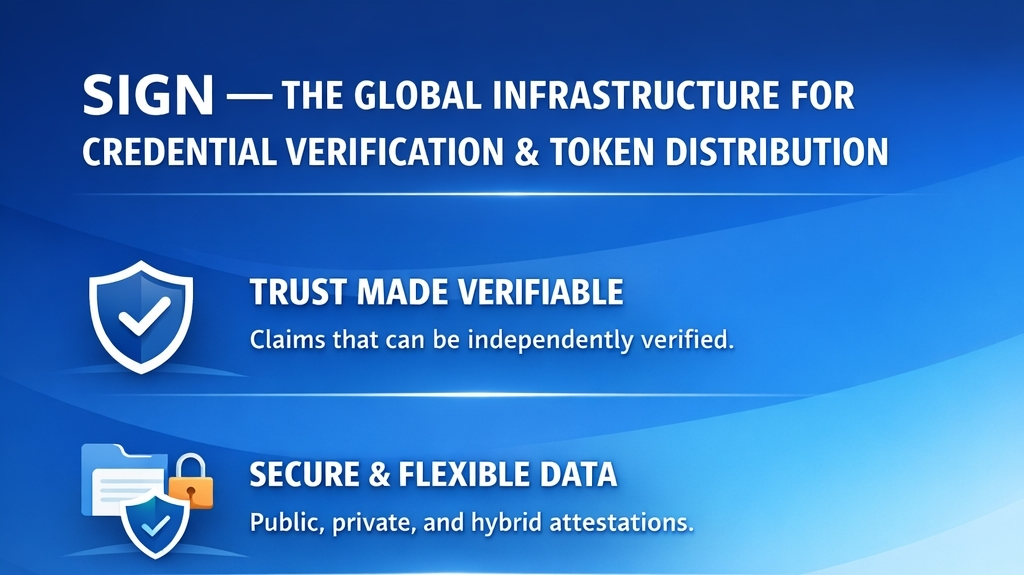
At the center of this foundation is the idea of attestations, and while the word may sound technical, it really reflects something very familiar, because an attestation is simply a statement that something is true, but in a form that can be checked independently, and when these statements follow clear schemas, they begin to form a system where information is not just stored but organized in a way that makes sense across different contexts, and that organization is what allows trust to move beyond personal belief into something that can be verified repeatedly without friction.
When I look at how SIGN works today, it feels less like a single platform and more like a quiet layer beneath many possible applications, because Sign Protocol acts as a kind of memory for claims and credentials, allowing them to exist either fully on-chain or in hybrid forms where sensitive data remains private but still verifiable, and this flexibility makes the system feel closer to real life, where not everything is public but important things can still be proven when needed.
Alongside this, TokenTable introduces a different but equally important dimension, because once eligibility is clear, the next step is distribution, and instead of relying on manual processes or scattered tools, the system allows distributions to follow predefined rules, making them predictable and transparent in a way that reduces confusion, and I find this part particularly interesting because it shows how verification and value are deeply connected, even though they are often treated as separate problems.
The architecture itself feels carefully thought through, not in a way that tries to impress, but in a way that quietly avoids common mistakes, because roles are separated, responsibilities are clearly defined, and data is handled with a balance between transparency and privacy, and this balance matters more than it first appears, because systems that expose everything can become unsafe, while systems that hide everything can become untrustworthy, and SIGN seems to move somewhere in between, where both openness and protection are treated as necessary.
As the system grows, what really begins to matter is not just what it can do, but how consistently it performs, because reliability is something that builds slowly, through repeated use, and in SIGN’s case, this shows up in the steady flow of attestations being created, verified, and used to guide distributions, and we’re seeing that the real strength of such a system lies in its ability to remain stable even as complexity increases, which is often where many systems begin to struggle.
At its core, SIGN is addressing a gap that has existed for a long time, which is the difference between saying something is true and being able to prove it in a way that others can trust without hesitation, and by creating a shared layer of verifiable evidence, it reduces the need for repeated validation and manual intervention, not by removing trust entirely, but by supporting it with structure, and that distinction feels important, because trust that is supported tends to last longer than trust that is assumed.
Of course, there are still uncertainties, because no system that deals with identity and value can be completely free of risk, and challenges like incorrect data, misuse, or slow adoption are always present, especially when the system is asking people to change how they approach familiar processes, and that kind of change does not happen instantly, it takes time, patience, and consistent performance to build confidence.
If SIGN continues to develop in the way it has so far, it may not become something people actively think about every day, but rather something they rely on without noticing, like a layer that quietly ensures things are working as they should, and there is something meaningful in that kind of invisibility, because the systems that matter most are often the ones that do their job without demanding attention.
When I step back and reflect on it, SIGN does not feel like a project trying to dominate a space, but one trying to organize it, to bring a sense of clarity to processes that have long been scattered and inconsistent, and if it succeeds, the impact may not come from a single moment, but from a gradual shift in how digital systems feel, becoming a little more reliable, a little more understandable, and a little easier to trust, not because we are told to trust them, but because we can see how they work and know that they will hold together over time.
#SignDigitalSovereignInfra @SignOfficial $SIGN
