
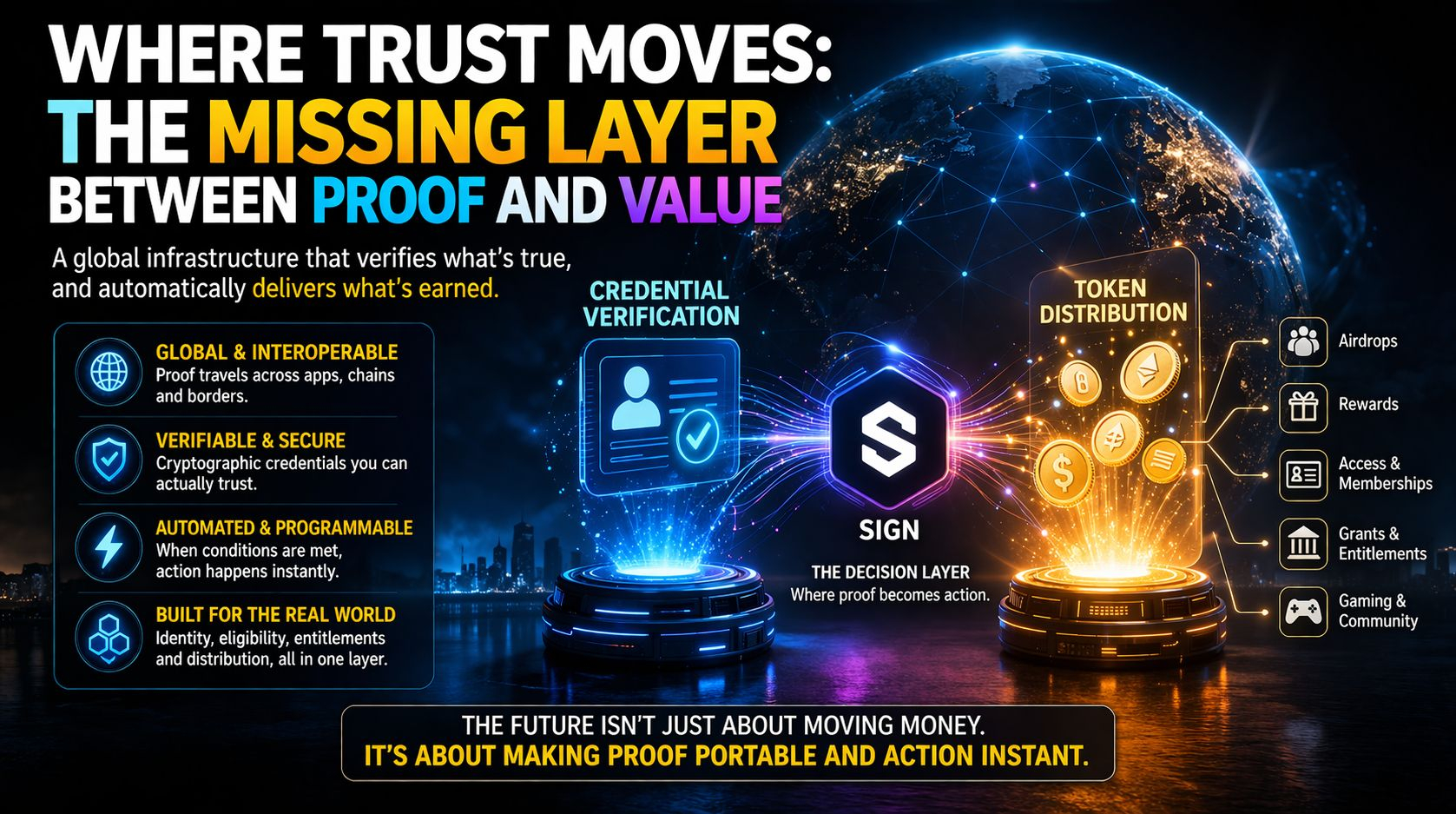
I’ve been thinking for a while that crypto didn’t really have a money problem first. It had a trust portability problem. Value can move. Tokens can settle. Wallets can connect. That part keeps improving. But the harder question usually comes right before any of that works: who qualifies, what can be verified, what conditions have been met, and can that proof travel cleanly from one system to another without getting rebuilt every single time.
That’s why Sign stands out to me more than a lot of projects with louder narratives. It isn’t just trying to prove that something is true. It’s trying to make proof usable. And honestly, that difference matters more than people first assume. A credential that sits in one app and dies there is not infrastructure. It’s just a locked file with better branding.
What I find interesting is that Sign is operating in the awkward middle layer most people skip over. Not the asset itself. Not the frontend either. The decision layer. The layer where systems decide whether you’re eligible, whether funds should unlock, whether a user belongs in a certain category, whether a distribution should happen at all. That’s where things still get messy, manual, political, and weirdly fragile.
I think that’s also why credential verification and token distribution belong in the same conversation. At first they sound like separate products. They’re not. One defines what is true or valid. The other decides what happens because of that truth. That link is powerful. If you separate proof from action too much, everything slows down and trust leaks out. If you connect them carefully, you get systems that can coordinate without asking humans to manually approve every meaningful step.
And yeah, there’s a bigger implication here. If Sign works the way it seems designed to, it doesn’t just help crypto apps run cleaner campaigns or smoother onboarding. It starts pushing toward a world where eligibility, entitlement, identity fragments, and distribution logic become programmable infrastructure. That’s a much bigger market than people realize.
I’m still cautious, obviously. Verification systems always sound clean in theory. Real life is where edge cases show up. Governance matters. Issuer quality matters. Revocation matters. Bad data can still become efficiently distributed bad decisions. That risk doesn’t disappear because the rails are better.
Still, I keep coming back to the same thought: the internet learned how to move information, then money. Trust is still clunky. If Sign is building the missing layer that lets proof travel and trigger action across systems, then it’s not filling a niche. It’s working on one of the deepest coordination gaps in digital infrastructure. And that feels a lot more important than the market is pricing in most days.
