
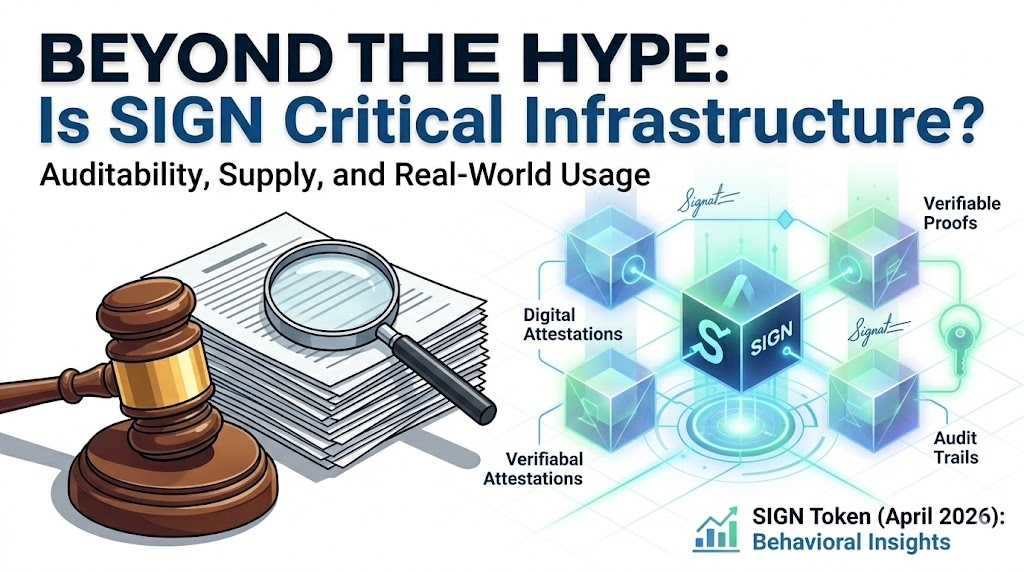
I didn’t start taking SIGN seriously because of a whitepaper. It happened when I saw people treating a clean attestation trail as if it was the decision itself. A record shows up, status updates, proof appears-and suddenly the market reads that as certainty. That never sat right with me. In real systems, records usually come after the hard decisions are made. What really matters is who had authority, which rules applied, and whether someone can come back later and verify all of that. That’s why this idea sticks with me: when decisions need to be explained, what actually remains? In SIGN’s case, it’s supposed to be evidence that can hold up over time-across audits, disputes, and real usage.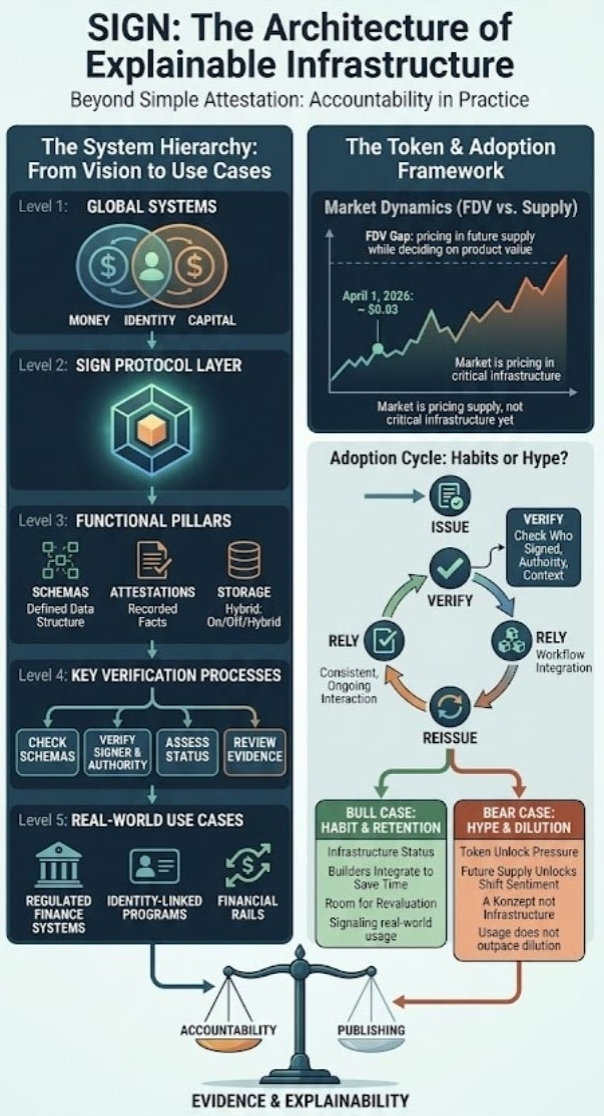
Right now (April 1, 2026), SIGN is trading around $0.03 range, with circulating supply sitting in the billions and a relatively small market cap compared to its fully diluted value. That gap is important. On the surface, it looks like a cheap token. But structurally, the market is still pricing in future supply while trying to decide if the product truly deserves long-term attention. Those are two very different perspectives, and most people don’t separate them.
Another thing I think gets overlooked-SIGN isn’t just pushing a basic attestation narrative anymore. Its own positioning is much broader: sovereign-level infrastructure for money, identity, and capital, with Sign Protocol acting as the shared evidence layer. That means schemas define how data is structured, attestations record it, and storage can be on-chain, off-chain, or hybrid. Verification isn’t just “data exists”-it’s checking who signed it, under what authority, within which context, and whether the record still holds validity. That’s a much deeper responsibility than simple data publishing.
And that’s where I see the real distinction. A lot of projects help publish information. SIGN is trying to preserve accountability around that information. Publishing is easy. Accountability is harder-slower, more complex, and usually only noticed when something breaks. That’s both the strength and the challenge here.
The upside case is clear enough. At its current valuation, the market isn’t pricing SIGN like critical infrastructure. If it actually becomes a trusted evidence layer for regulated systems, identity-linked programs, or financial rails, there’s room for revaluation. Some parts of the stack already hint at that direction-tools that make querying records easier or linking distributions back to verifiable proofs. It’s not flashy, but it’s the kind of functionality that matters over time.
But I keep coming back to one question: does usage repeat?
Not one-off hype, not temporary campaigns-but consistent, ongoing interaction. Do people keep issuing, verifying, and relying on these records because it genuinely improves their workflow? That’s the difference between a concept and real infrastructure. Repetition creates habit, and habit is what eventually supports demand.
That’s also where the risk sits. Supply dynamics are still in play, and future unlocks can shift sentiment even if they don’t immediately hit price. On top of that, the product itself requires the market to care about things like auditability and verification quality-which are important, but not always “sticky” for retail attention. You can respect the design and still question whether adoption will outpace dilution.
For me, the signals are pretty clear. If I start seeing consistent, real-world usage-builders integrating it because it saves time or reduces disputes-that’s a strong positive. If the system becomes hard to replace once integrated, that’s even stronger. On the flip side, more supply without matching usage, or a gap between the vision and actual activity, would be a concern.
So right now, I don’t see SIGN as a simple momentum play or a guaranteed long-term winner. It feels more like a bet on whether explainability itself becomes infrastructure-and whether that idea can sustain attention long enough to matter.
If you’re watching it, don’t just follow the chart. Watch behavior.
Are records becoming necessary?
Is verification turning into habit?
Is usage growing faster than dilution?
That’s where the real answer is. And if it’s still unclear, it’s better to stay honest about that than let a clean narrative decide for you.
@SignOfficial #SignDigitalSovereignInfra $SIGN
