
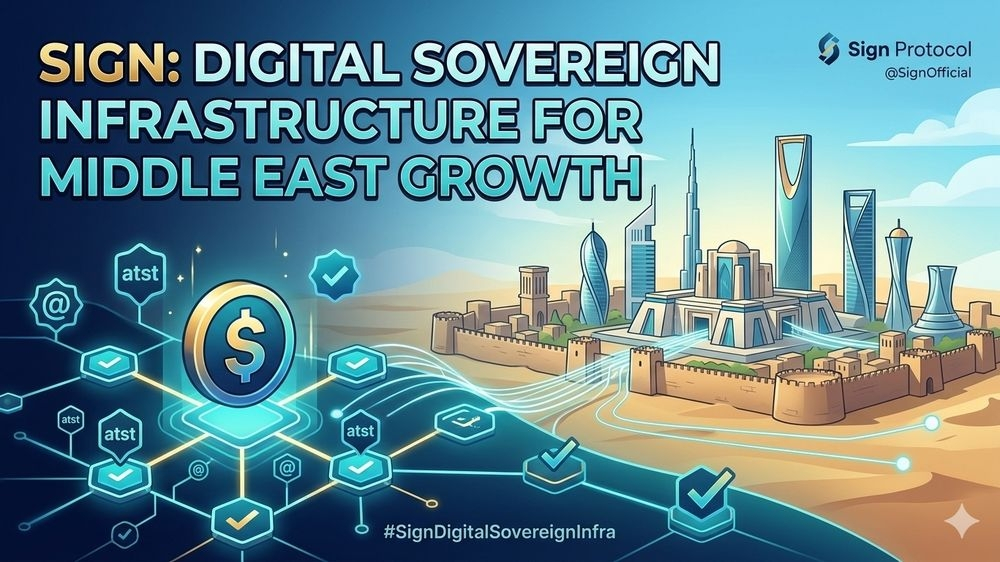

A lot of digital infrastructure is built around speed. Faster onboarding, faster payments, faster settlement, faster user growth. But speed can hide a deeper weakness. A system may move quickly and still remain fragile if nobody is fully sure how consent was given, how proof is preserved, or how a record keeps its meaning once it leaves the place where it was created. That problem becomes more serious when economies expand, institutions multiply, and digital interactions begin to shape public and commercial life at a larger scale.
This is one reason many modern economies feel more connected than coordinated. There are platforms everywhere, digital documents everywhere, and endless claims being made inside apps, dashboards, and portals. Yet much of that information lives in separate compartments. A person may complete one verification process and still have to repeat nearly the same process elsewhere. A company may hold valid records in one setting and still struggle to make them count in another. A signed action may exist, but the surrounding context of who approved it, under what terms, and with what credibility can become harder to interpret over time.
The older systems that tried to manage this problem usually depended on central gatekeepers. Banks, state agencies, enterprise vendors, and major platforms built controlled environments where records could be issued and checked under one roof. This created order, but only inside bounded spaces. The moment information needed to travel across institutions, jurisdictions, or sectors, the weakness returned. Each new connection required negotiation, integration, and repeated trust-building. The technology improved faster than the institutional logic behind it.
Crypto entered this conversation with a very different instinct. It questioned gatekeepers and tried to build open systems where proof could exist independently of any single database. That shift mattered. But open verification alone does not solve every problem. A ledger can show that something happened, yet many real-world decisions depend on more than a timestamp or a signature. They depend on whether a claim is understood, whether an issuer is recognized, and whether the surrounding context survives long enough to be useful. In other words, not every proof becomes meaningful simply because it is recorded.
That is where @SignOfficial becomes interesting to examine. Sign appears to be working on a piece of infrastructure that sits in a less glamorous but more foundational part of digital life: attestations, credentials, approvals, and the way verifiable claims move between people, institutions, and systems. Instead of asking only how to transfer value, this approach asks how to preserve significance. How can a statement, a commitment, or a permission remain usable after it crosses boundaries? How can digital systems carry not just data, but recognized meaning?
This feels especially relevant to the Middle East, not because the region lacks ambition, but because it has a great deal of it. Across the region, there is active investment in state modernization, digital services, logistics, fintech, and cross-border economic integration. That kind of growth creates a specific pressure. As more actors participate in digital systems, the cost of fragmented proof rises. It becomes harder to scale serious coordination when every institution has to keep asking the same basic questions in slightly different formats. Trust becomes repetitive. Administration becomes layered. Progress becomes more expensive than it appears from the outside.
In that setting, the language around $SIGN and #SignDigitalSovereignInfra can be read in a more grounded way. The interesting idea is not that sovereignty becomes a slogan attached to software. It is that digital systems may need to support local authority, regional coordination, and institutional memory without collapsing into either total centralization or technical chaos. Sign seems to be exploring whether attestations and verifiable records can form a kind of connective layer across digital environments. That is not a small ambition, but it is also not a magical one. It depends on adoption, governance, standards, and social legitimacy.
There are real trade-offs here. A system that makes verification easier can also increase concentration around those whose attestations carry the most weight. If only a narrow group of institutions becomes widely accepted as credible issuers, then the infrastructure may harden existing hierarchies rather than broaden participation. Portability can also create pressure toward standardization, and standardization often removes nuance. Local realities, informal practices, and context-specific judgments do not always fit neatly into structured digital claims. Something may become easier to verify while becoming less accurate in lived terms.
There is also the problem of unequal benefit. People and organizations already visible to formal systems will usually gain first. Large firms, well-documented entities, major institutions, and digitally sophisticated users can often extract value from new infrastructure faster than others. Those working informally, lacking documentation, or operating in marginal spaces may find themselves further outside the systems that increasingly define recognition. That does not make the project misguided, but it does challenge the assumption that better infrastructure automatically creates broader fairness.
Another limit is cultural rather than technical. Digital trust systems often assume that once a tool exists, institutions will naturally cooperate around it. But many institutions do not resist innovation because they hate efficiency. They resist because they are accountable in different ways, shaped by different legal traditions, political incentives, and internal risks. So even if Sign offers a compelling framework, the harder test is whether institutions use it when the stakes are real, the parties are unequal, and the record actually matters.
That is why I think @SignOfficial deserves a serious but restrained reading. Sign and $SIGN are interesting not as a perfect answer, but as one attempt to address a problem digital economies keep postponing: how to preserve credible consent, usable proof, and shared memory when interactions move faster than institutions do.
And as economies build more of their public and commercial life on digital records, the harder question may be this: who gets to decide which digital claims become part of lasting institutional memory, and which ones quietly disappear