
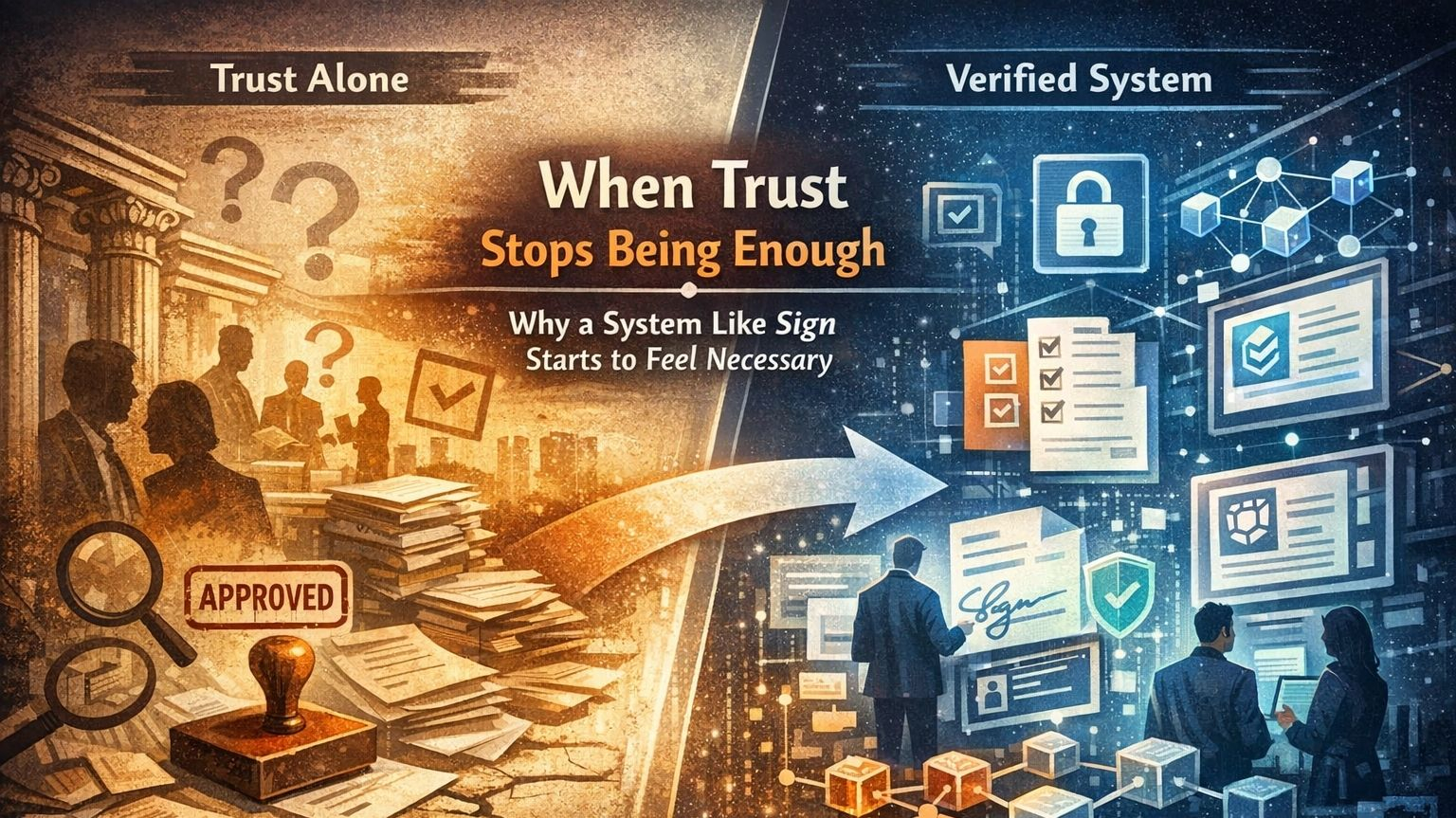
Let’s try to understand what the real story is.
Most institutions do not run on proof first. They run on habit, reputation, routine, and the quiet assumption that the people inside the system know what they are doing. For a while, that is usually enough. A form gets approved because the office looks legitimate. A payment goes through because the workflow feels established. A credential is accepted because the issuer sounds official. Nobody stops the machine every five minutes to ask whether each claim can survive a serious challenge later.
The problem begins when the system leaves its comfortable setting.
A dispute shows up. A regulator asks for evidence. An auditor wants to know who approved what and under which rule. A public controversy forces people to explain decisions that once passed without much attention. That is the moment trust starts looking thinner than it did before. Not because trust suddenly became worthless, but because it turns out trust works best when nobody is pushing hard on the weak parts.
That is the backdrop in which a project like Sign starts to make more sense. Not as some abstract crypto experiment, and not as a flashy replacement for institutions, but as a response to a more ordinary institutional stress point: too many important systems still depend on records that are difficult to inspect, difficult to replay, and awkward to defend once real scrutiny begins.
What stands out to me is that the need here does not seem to come from one dramatic failure. It feels more cumulative than that. Systems got bigger. Data got scattered. Workflows became layered across departments, vendors, chains, databases, and compliance tools. A decision made in one place no longer carries cleanly into another. A claim may be true, but if the surrounding record is weak, the truth becomes harder to prove than it should be. That is a very modern kind of institutional problem. Not total dishonesty. Not total collapse. Just too much dependence on systems that work smoothly until someone asks them to explain themselves.
That is why I do not read “trust, but verify” as a slogan of paranoia. I read it more as an admission that trust alone does not scale elegantly. Informal confidence works when the circle is small, the workflows are familiar, and the consequences are manageable. Once the environment becomes regulated, fragmented, or politically exposed, confidence starts needing structure behind it. Not because every institution is broken, but because important decisions now travel farther, get reused more often, and face more pressure from people who were not in the room when those decisions were made.
And this is where Sign becomes more interesting than the usual blockchain pitch. The real appeal is not that it says, “do not trust institutions.” It is closer to saying, “institutions still matter, but their actions need to leave behind records that can survive outside the original context.” That is a more serious claim. It is also a more believable one.
Still, there is something important not to romanticize here. Evidence-first infrastructure does not eliminate trust. It rearranges it. A schema can make a claim easier to read. A signature can bind a record to an issuer. A registry can show who is recognized. An attestation can preserve a trace. All of that helps. But none of it creates meaning from nothing. You are still trusting someone to define the schema, someone to issue the claim, someone to maintain the registry, someone to decide how disputes get resolved. The trust does not disappear. It just moves from “believe us” to “check our work.”
That shift matters. But it is not magic.
I think that is why the project feels like a response to trust fatigue more than trust failure. There is a difference. Trust failure is dramatic. Trust fatigue is quieter. It is what happens when institutions still function, but nobody is comfortable relying on their internal processes without stronger evidence behind them. It is what happens when approvals, credentials, compliance checks, and eligibility decisions need to travel across systems that no longer share the same assumptions. At that point, the old model starts to feel incomplete. Not useless. Just no longer enough.
So if Sign exists for a reason, the reason is probably not that trust disappeared. It is that trust became too fragile to carry the whole burden by itself. In a world where records move, claims get reused, and scrutiny comes late but hits hard, institutions seem to want something more durable than confidence and more legible than informal proof.
That is where a system like this enters the conversation. Not because trust is dead, but because trust without structure is starting to feel too expensive.