
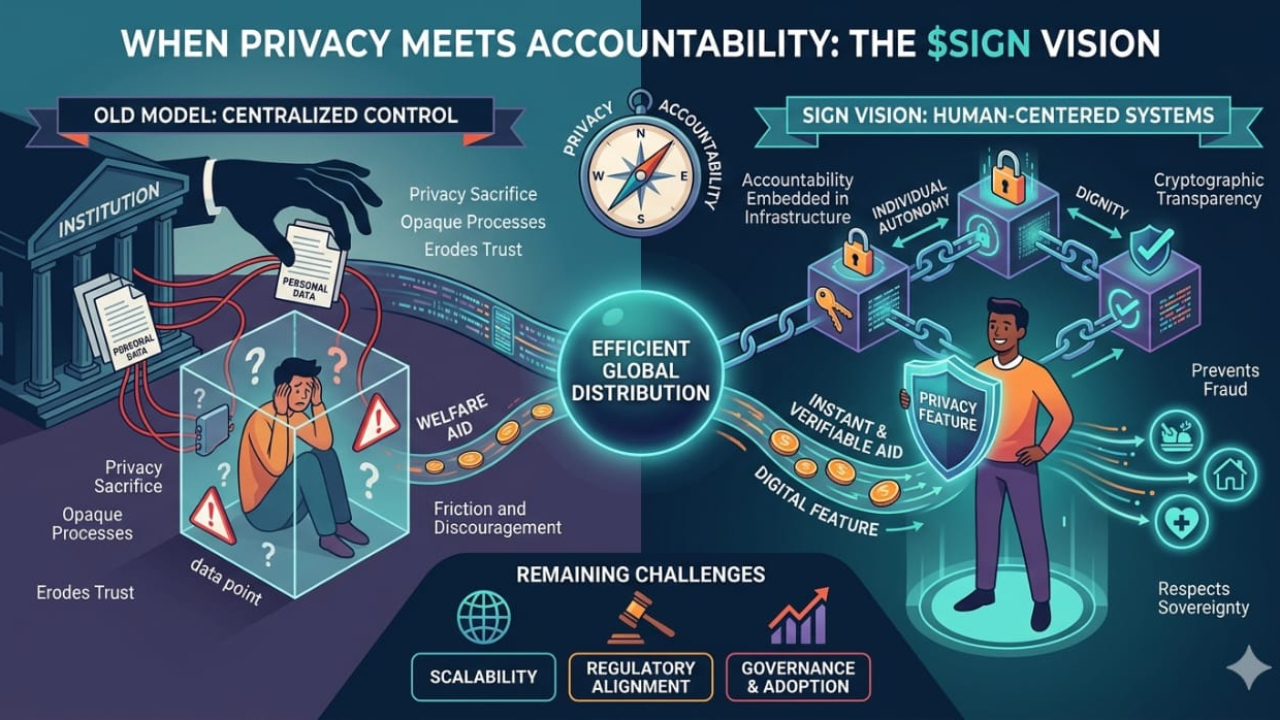
I see @SignOfficial approach as genuinely exciting progress in how we think about digital systems and public infrastructure. For a long time, privacy and welfare have been treated as if they’re fundamentally opposed. That idea didn’t come from necessity it came from centralized systems where control over data meant control over people. When institutions hold all the information, efficiency often comes at the cost of individual freedom. But that tradeoff isn’t inevitable.
What stands out to me is how the combination of blockchain, attestations, and programmable money starts to shift that balance. Instead of relying on trust in a central authority, you can build systems where accountability is embedded in the infrastructure itself transparent, verifiable, and cryptographic. At the same time, individuals don’t have to give up ownership of their personal data just to access services. Privacy becomes a feature, not a limitation.
That’s why I find this direction so compelling. It aligns with something deeper than just technology it aligns with human values. People tend to thrive in systems where they have dignity, autonomy, and a sense of trust. When welfare systems require people to expose excessive personal information or navigate opaque processes just to receive support, it creates friction and, in many cases, discouragement. A system that protects privacy while still delivering aid efficiently feels like a meaningful step forward.
In that sense, what $SIGN is aiming for feels less like a technical upgrade and more like a shift in philosophy. The idea of welfare that is fast, verifiable, resistant to fraud, and still respectful of the individual is powerful. It suggests a world where accessing support doesn’t come at the cost of personal sovereignty. That’s a big departure from how most systems operate today.
At the same time, I try to stay grounded in the reality that good ideas still need strong execution. Technology alone doesn’t solve everything. Governance matters how decisions are made, who has influence, and how the protocol evolves over time. Adoption is another major piece. For something like this to reach its full potential, it would need buy-in from governments and institutions, which historically move slowly and cautiously.
There are also open questions around scalability, regulatory alignment, and how these systems interact with existing frameworks. Even if the foundation is solid, the path to real-world implementation is rarely straightforward. That’s why I see this as promising, but still early.
What gives me confidence, though, is the core principle behind it. The idea that privacy can actually strengthen welfare delivery not weaken it feels like a necessary shift in thinking. It challenges the old assumption that transparency must come at the expense of personal boundaries.
If more projects and institutions start moving in this direction, we could see a future where public benefits are distributed globally, instantly, and without turning individuals into data points. That’s not just an improvement in efficiency it’s a step toward more human-centered systems.
So the question becomes: does this model strike the right balance between privacy and accountability, or are there still risks that need to be addressed before it can truly scale?