
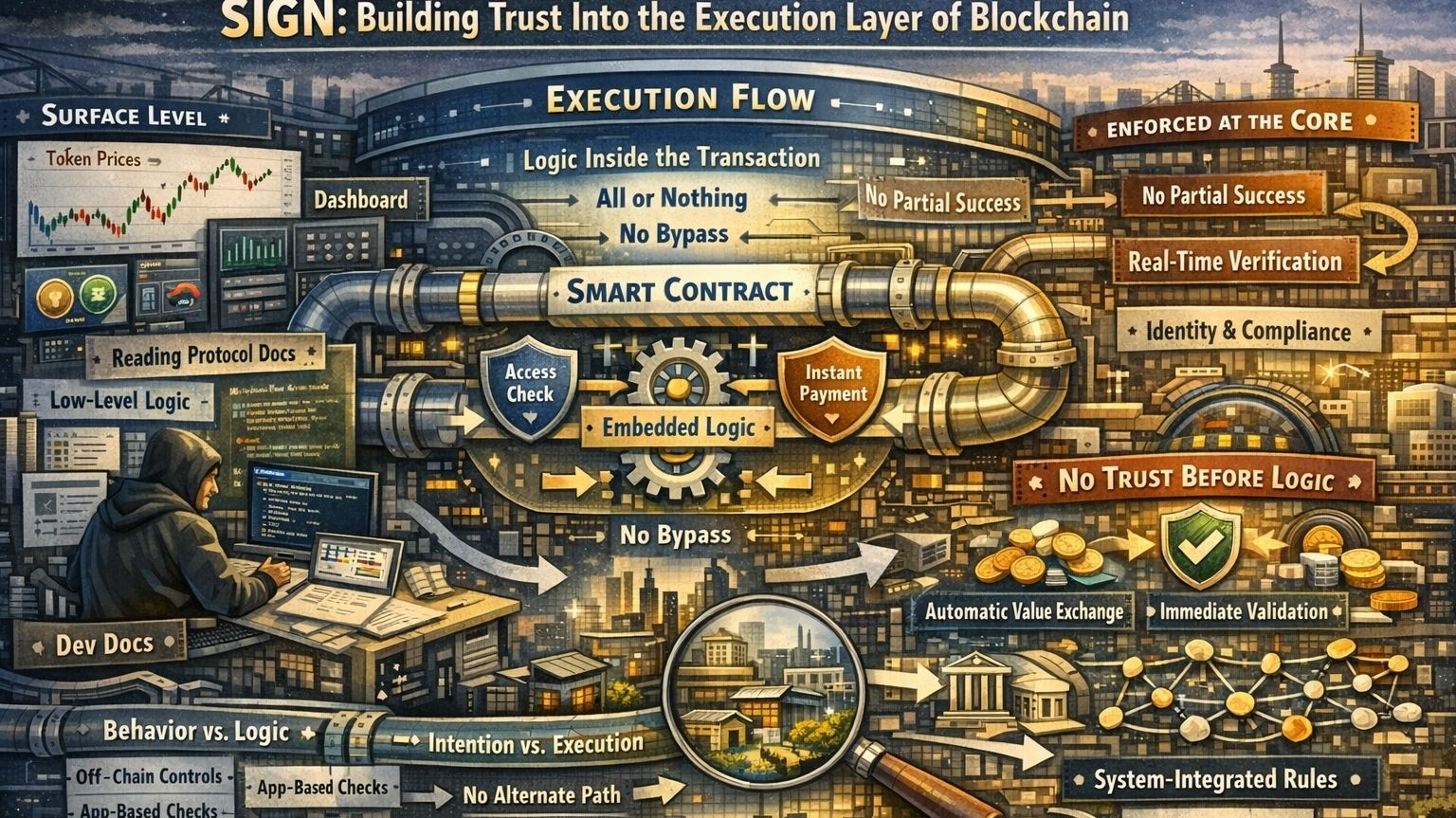
Most people approach blockchain by looking at what’s visible first—dashboards, tokens, price charts—but that’s only the surface. The real story usually sits a layer deeper, inside how things actually execute. I ran into this again while reading through more technical protocol docs, the kind developers use when they want control rather than convenience. It brought back a simple idea from general software systems: you can inject logic into a process without rebuilding everything, and the process only continues if certain conditions are met. Once you notice that pattern, you start seeing it everywhere. Not because it’s trendy, but because it solves something real—how to maintain control without breaking the system apart.
What feels different now is where this logic lives. It’s no longer sitting outside as a filter or handled later by some backend check. It’s becoming part of the transaction itself. That means if the condition fails, nothing happens. No partial success, no workaround, no quiet bypass. And that changes how you think about trust. Instead of asking whether a system allows something, you start asking whether that action can even exist unless the rules are satisfied. That’s a deeper level of enforcement because it removes the gap between intention and execution.
Take something simple like access control. Normally it lives off-chain or inside app logic, which makes it easy to copy, forget, or even bypass. But when the rule exists inside the same transaction flow, there’s no alternative path. The system simply doesn’t move forward unless the rule is met. From there, the idea expands. Imagine if every action required value exchange instantly, not as a follow-up step but as part of the action itself. Or if validation didn’t just check format, but actually proved that the data means what it claims before it ever becomes part of the system.
This is where it starts to matter for real-world systems. Most systems don’t fail because they lack features—they fail because enforcement lives in the wrong place. The rules exist, but they rely on people remembering to apply them, or trusting that others will. When enforcement becomes part of execution, the system stops depending on behavior and starts depending on logic. That shift is especially important in areas like identity or compliance, where mistakes are costly. Instead of building layers around a system to verify things later, the verification becomes part of the system itself.
Of course, there’s still a gap between what’s possible and what’s actually being used. Documentation shows capability, not reality. The real signal is in how these ideas are adopted—how contracts interact, how logic gets reused, and whether systems start relying on these patterns instead of working around them. The concept itself isn’t new, but where it’s being applied is changing. It’s moving from the edges into the core flow, and that subtle shift might end up being more important than most of the features people are focused on right now.