
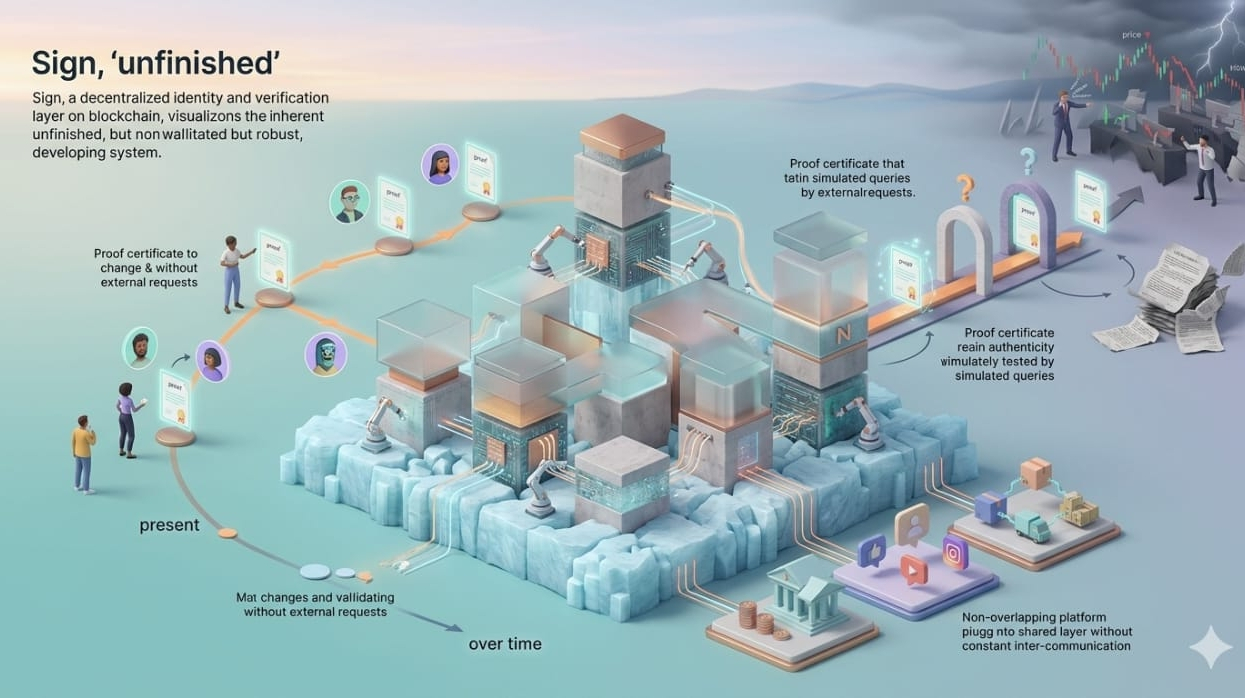

I keep circling back to this strange feeling that people are talking about Sign like it is already fully defined, like it has settled into its final shape, when honestly it does not feel that way at all. It feels unfinished in a good way, like something that is already being used while still figuring itself out. And maybe that is what pulls me in. It is not loud about what it is trying to be. It does not come across like those polished ideas that promise to fix everything in one go. It feels quieter than that, almost like it is working in the background on a problem most people have just learned to live with.
When I try to make sense of it in my own words, I do not really see it as just another tool for identity or some upgrade to verification. It feels closer to a system that is trying to change how proof itself works. Not just in the moment, but over time. That part took me a while to really sit with. Because most of the systems we use today are built on this idea that if something checks out right now then that is good enough. Nobody really thinks about what happens later when someone asks again. But that is where things usually start to fall apart. People leave, records get messy, systems stop matching each other, and suddenly something that was accepted before becomes hard to explain.
So from where I stand, Sign seems to be trying to deal with that exact problem. It is less about speed or convenience and more about making sure that something can still hold up when it is questioned later. That means it is building a layer where information is not just stored somewhere but can actually be verified again without depending on the original source. And that shift, even though it sounds subtle, feels pretty important once you really think about it.
The way it is put together also says a lot without trying too hard to say it. It uses blockchain in a way that feels practical instead of performative. Not as some flashy feature but more like a shared base that different systems can rely on without constantly checking each other. If you have multiple parties that need to agree on something, you either keep asking each other over and over or you build something neutral that they can all trust without direct coordination. That is where this approach starts to make sense. It turns pieces of verified information into something that can stand on their own instead of being locked inside one platform or controlled by one entity.
At the same time I will admit that my thoughts get a bit scattered when I try to place all of this into the bigger picture. Because the market around it feels noisy and unpredictable. Prices go up and down, new narratives show up every few days, and attention moves so quickly that it is hard to tell what actually matters. But underneath all that movement there are people building things that are slower and more structural. Sign feels like it belongs to that side of the space. It is not chasing attention. It is trying to become part of the foundation that other systems quietly depend on.
The hard part, as always, is adoption. Not because the idea is confusing but because changing infrastructure never happens overnight. People stick with what they already use until the friction becomes too obvious to ignore. And right now a lot of systems are still working just enough to avoid that breaking point. But if you look closely, the cracks are there. You see processes that cannot really explain themselves later, data that feels disconnected, decisions that rely more on trust than anything solid. None of it looks dramatic on the surface, but over time it builds into something bigger.
That is probably where Sign has its opening. Not by replacing everything at once, but by slowly fitting underneath what already exists. If it can make proof easier to create and easier to check without making things more complicated, then it might just slip into everyday use without people even thinking about it. And that is usually how real infrastructure spreads. It does not announce itself loudly. It just becomes part of how things work.
What makes this even more interesting to me is how it connects to the overall mood around blockchain right now. There is still doubt, and honestly that doubt is earned. A lot of things have been overpromised in the past. But at the same time there is this quiet shift happening where people are starting to focus less on hype and more on actual use. When you strip everything back, what remains are problems around coordination, verification, and shared understanding. Not speculation, not quick wins, just basic things that need to work properly.
Sign seems to sit right in that space. It is not trying to be everything to everyone. It is focused on a gap that shows up again and again across different systems. And maybe that is why it does not fit neatly into the usual stories people tell. It is not purely financial, it is not purely social, it is something in between. It deals with how information moves and how it holds up when it is tested.
I do not think anyone can say for sure yet how big this becomes or what it fully turns into. And that uncertainty is not really a bad thing. Infrastructure rarely looks obvious when it is still forming. It only starts to make sense later, when other things begin to rely on it without even noticing.
For now it just feels like something worth paying attention to. Not because it is being pushed everywhere, but because the problem it is trying to solve keeps showing up in different ways. And the more I think about it, the more it feels like making proof reliable over time is not some small technical detail. It is one of those things that quietly touches almost everything once you start noticing it.
