

@SignOfficial #SignDigitalSovereignInfra
I was sitting at a small chai spot near Saddar, laptop open, trying to trace how one attestation moves through different parts of Sign Protocol. It was one of those slow evenings. Traffic dragging outside, cups clinking behind me, the usual background noise. I wasn’t doing anything complex, just following a single record to understand how consistent it really is once it leaves the protocol layer.
At first, everything looked exactly how you would expect.
The attestation was clean.
Same schema, same signature, same timestamp.
Nothing changing, nothing drifting.
It felt complete. Like a finished object that should behave the same wherever it appears. That’s the natural assumption. If the data is identical, the outcome should be identical too.
But that assumption didn’t hold for long.
Instead of focusing on where the attestation was stored or how it was indexed, I started looking at where it was actually used. That shift changed everything.
Because the moment different applications picked up the same attestation, the results started to diverge.
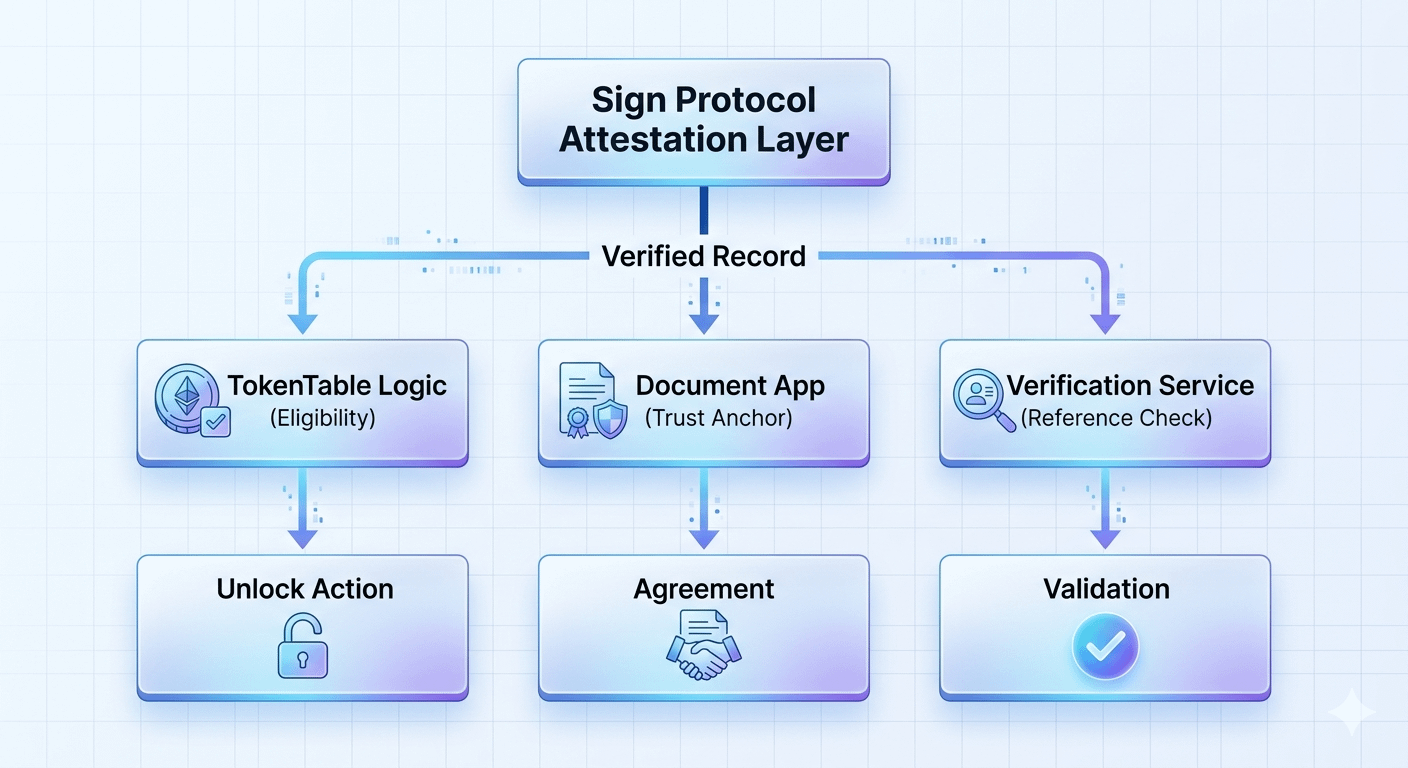
In one case, the attestation was read by TokenTable logic. It passed a condition, triggered eligibility, and led to an execution path. Something unlocked. A clear outcome.
Later, the same attestation appeared inside another application flow, this time tied to a document process. There, it wasn’t unlocking anything. It was being used as a reference point, a way to anchor trust between parties.
Same object.
Different result.
That’s where things started to feel slightly off.
Nothing inside the attestation had changed. It wasn’t edited, reissued, or revalidated. The protocol produced one stable piece of data, and every system interacting with it was receiving that same exact version.
So the difference wasn’t coming from the attestation itself.
It was coming from how each system chose to read it.
That sounds obvious at first, but it carries more weight than it seems.
We tend to think of attestations as carrying meaning on their own. As if once something is verified and recorded, it should lead to a consistent interpretation everywhere. But that’s not really how Sign works.
What Sign standardizes is the structure of the attestation, not the outcome attached to it.
Each application approaches that structure with its own logic.
One system might ask, “Does this meet the conditions to trigger an action?”
Another might ask, “Does this support a relationship or a claim?”
A third system might look at the same data and find no use for it at all.
All of them are technically correct.
They’re just solving different problems.
That realization shifts how you look at the protocol.
The attestation itself is stable. It doesn’t change as it moves across systems. It can be indexed, queried, and reused without losing its integrity.
But the consequence of that attestation lives outside of it.
It lives in the application layer.
That creates a subtle but important distinction.
The protocol guarantees that an attestation exists, that it follows a schema, and that it can be reliably retrieved.
What it does not guarantee is that every system will interpret it the same way.
At first, that feels like a limitation. We expect consistency. We expect that something verified once should behave consistently everywhere.
But forcing that kind of uniformity would come at a cost.
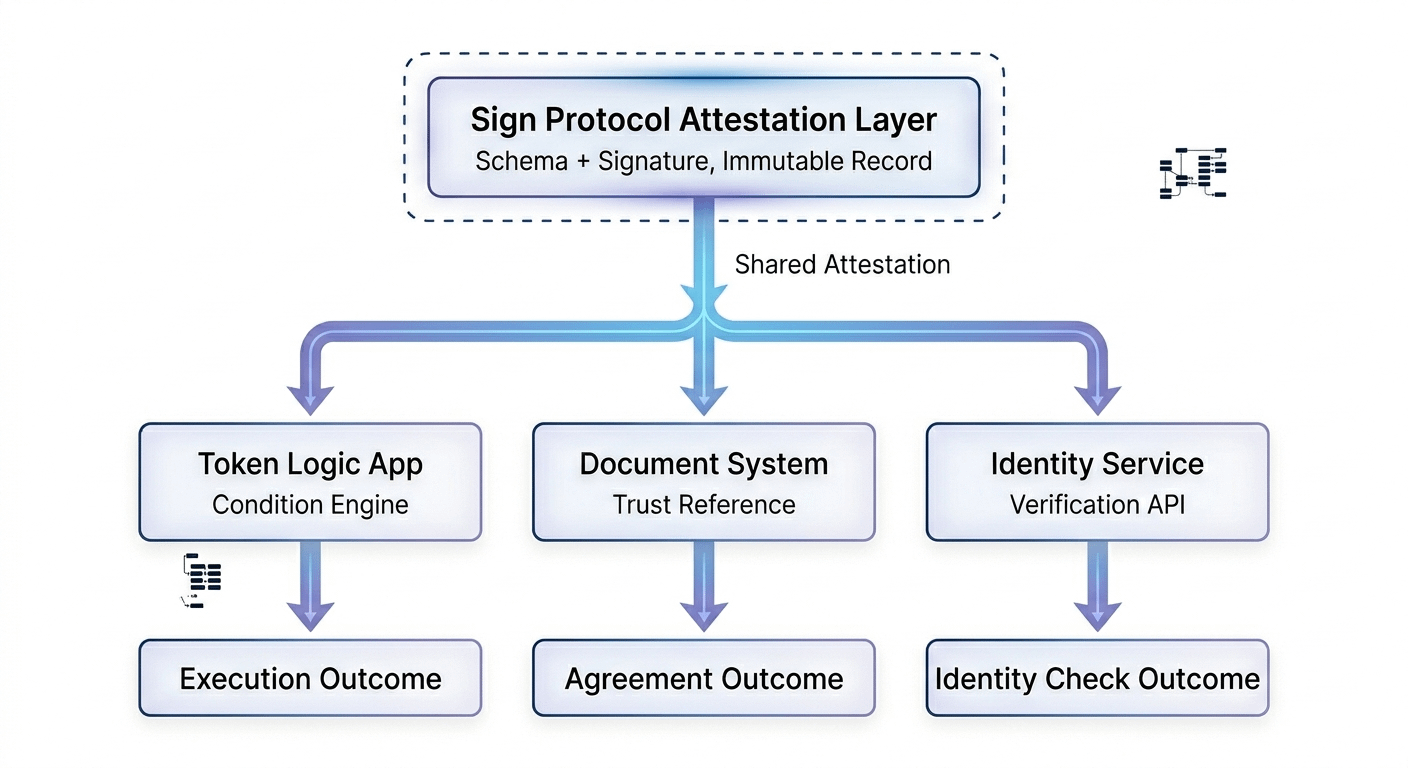
If every application had to agree on the meaning and consequence of an attestation, the system would lose flexibility. Every use case would need shared logic, shared assumptions, and constant coordination between developers.
That would slow everything down.
Instead, Sign keeps the foundation fixed and leaves the interpretation open.
The result is a system where one attestation can lead to multiple valid outcomes depending on where it is used.
In one context, it triggers execution.
In another, it supports verification.
In a third, it might not matter at all.
Same data.
Different implications.
Sitting there in that chai spot, watching the same record produce different results, I realized something that doesn’t get said often.
An attestation is not a final answer.
It’s a starting point.
It carries enough structure to move across systems without breaking, but it doesn’t carry a universal consequence. Each application layer decides what to do with it based on its own logic and purpose.
That’s not a flaw in the system. It’s a design choice.
It allows different applications to build on the same foundation without being forced into the same behavior.
But it also means we need to be careful about assumptions.
Just because something is verified once does not mean it will behave the same everywhere.
And maybe that’s the real takeaway.
Sign Protocol doesn’t standardize outcomes. It standardizes the base layer that outcomes are built on.
Everything after that depends on who is reading the data and what they are trying to do with it.
