
The market felt weirdly quiet today. No wild swings, just that flatline vibe where everyone’s refreshing feeds and pretending they’re not bored out of their minds. I was supposed to be checking my usual watchlist, but I ended up scrolling past the same old L1 narratives and clicked on a random thread about attestation stuff instead. You know how it goes— one tab leads to another.
So out of curiosity, I started looking at SIGN. The $SIGN project that keeps popping up whenever people talk about verifiable stuff on-chain. And honestly, something clicked in a way I wasn’t expecting. Everyone out there is treating it like the next shiny base infrastructure play—the foundational layer that’s supposed to sit at the bottom of everything, the bedrock everyone builds directly on top of. But wait… I think people are actually looking at this wrong. It doesn’t belong there at all. SIGN belongs as middleware. That’s where it really fits, and that’s what makes it quietly powerful.
What people assume is that it’s another one of those core stack plays, the kind that aims to become the new default chain or protocol everyone deploys straight onto. They hype it up as the big infrastructure bet that’ll underpin the next cycle’s identity plays, DeFi triggers, whatever. But what actually happens when you poke around is different. It sits in the middle of the stack—connecting apps, users, and chains without trying to own the bottom layer. It handles those signed records and verifications across whatever base you’re on, abstracts the messy cross-chain bits, and lets everything else plug in without rebuilding from zero. I thought it was going to feel heavier, more like a new foundation you have to commit to. But actually, it’s lighter, more like the layer that makes the rest of the stack work smoother.
Here’s the part that bothers me though… I’m not fully convinced this distinction is going to stick in the market’s head. If the narrative keeps pushing it as base infrastructure to chase the big valuations and hype cycles, it could end up stretching itself thin. What if adoption tests it hard and the middleware strength gets lost in the noise? Or what happens when a real crunch hits and teams realize they don’t need another bottom layer—they just need something reliable in the middle? It doesn’t sit right yet. I keep wondering if the team sees the same thing or if the pressure to sound more “foundational” will pull it off course.
It matters more than it seems at first. For the builders who are actually shipping—small teams grinding on dapps or even bigger institutional experiments—it means they can focus on their product instead of wrestling with verification plumbing every single time. It affects the people who are tired of bolted-on solutions, not the VCs hunting for the next Ethereum-killer story. And it actually kicks in when the hype fades and real usage shows up, like when those verifiable records start driving actual actions across chains without extra bridges or oracles getting in the way.
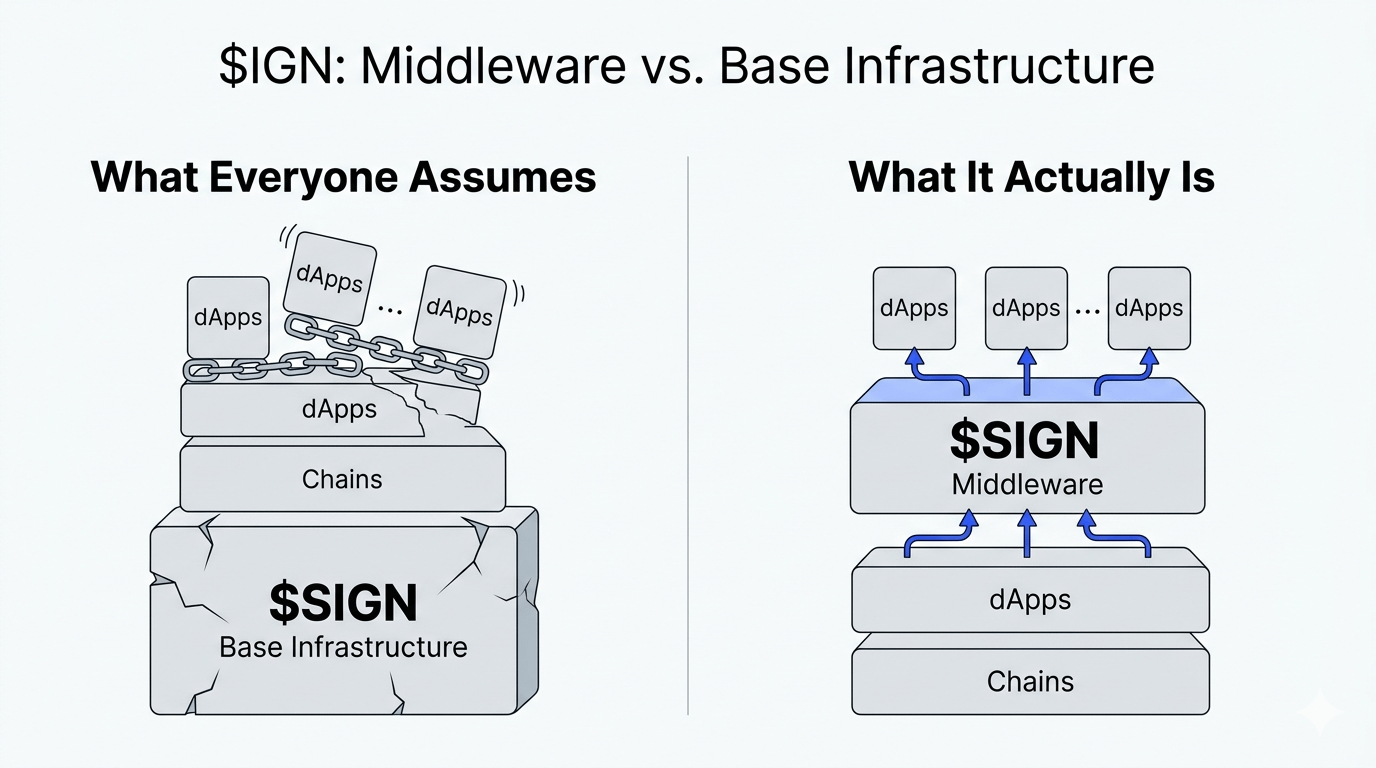
I thought back to last month when I was messing with a tiny test setup for a side thing I was tinkering with. I figured it’d be this heavy base-layer commitment that would eat up my whole afternoon. But actually it slotted in quick once I stopped thinking of it as the foundation and started seeing it as the connector. Still hesitated for a second, wondering if I was missing some grander play everyone else was chasing. Or maybe I’m overthinking it entirely—who knows.
Anyway, the market’s still sitting there looking pretty flat. I’ll probably just keep watching how SIGN plays out over the next few weeks, see if the positioning shifts or if everyone keeps forcing it into the wrong box.
@SignOfficial #SignDigitalSovereignInfra