

I used to think infrastructure only matters when something breaks.
Like… you don’t notice it when it works.
You only feel it when everything stops.
That’s how I initially looked at @SignOfficial and $SIGN
Just another backend layer.
Something governments or platforms plug in to make verification smoother.
Nothing I needed to think deeply about.
But the more I watch how digital economies are actually forming especially in places trying to move fast the more I feel like infrastructure isn’t passive at all.
It quietly shapes behavior.
Because in real-world adoption, systems don’t fail loudly.
They drift.
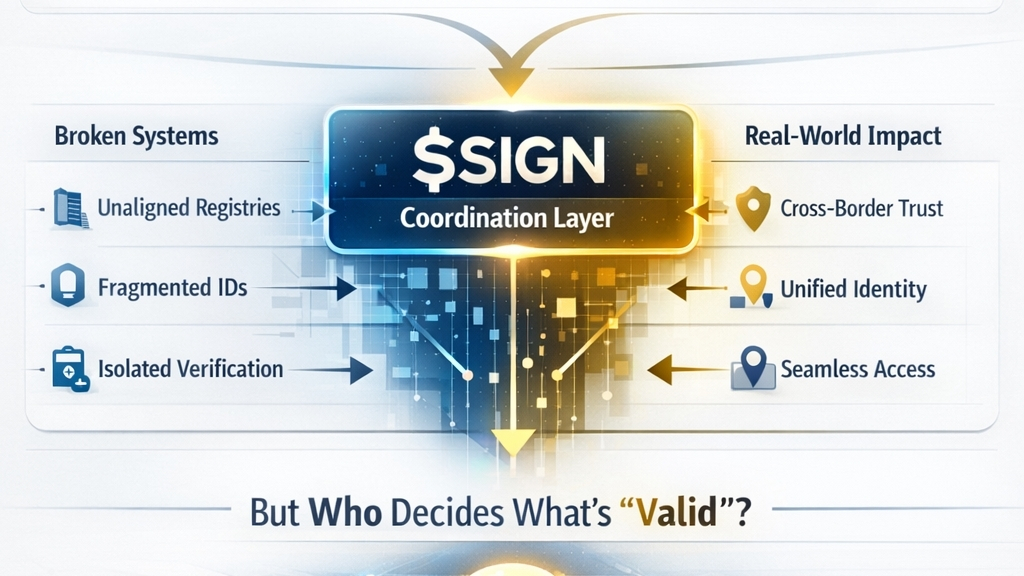
A registry here doesn’t align with another system there.
An identity is valid in one place… but not recognized somewhere else.
A business is verified once… but that proof doesn’t travel.
And suddenly, growth slows down not because of lack of technology…
but because systems can’t coordinate trust.
That’s where something like #SignDigitalSovereignInfra starts to feel different to me.
Not as a product… but as a coordination layer.
It doesn’t try to replace institutions.
It doesn’t force a new system.
It just creates a shared reference point where verification can exist across systems that were never designed to trust each other.
And maybe that’s the part most people overlook.
Because real-world adoption isn’t about building one perfect system.
It’s about making imperfect systems… work together without collapsing.
But then I keep wondering…
if infrastructure starts deciding what counts as “valid” across systems…
are we actually increasing trust?
Or just standardizing what gets accepted as truth?