

I’ve been thinking about @SignOfficial a bit differently lately.
The real issue isn’t just how tokens are distributed or whether it looks fair on paper.
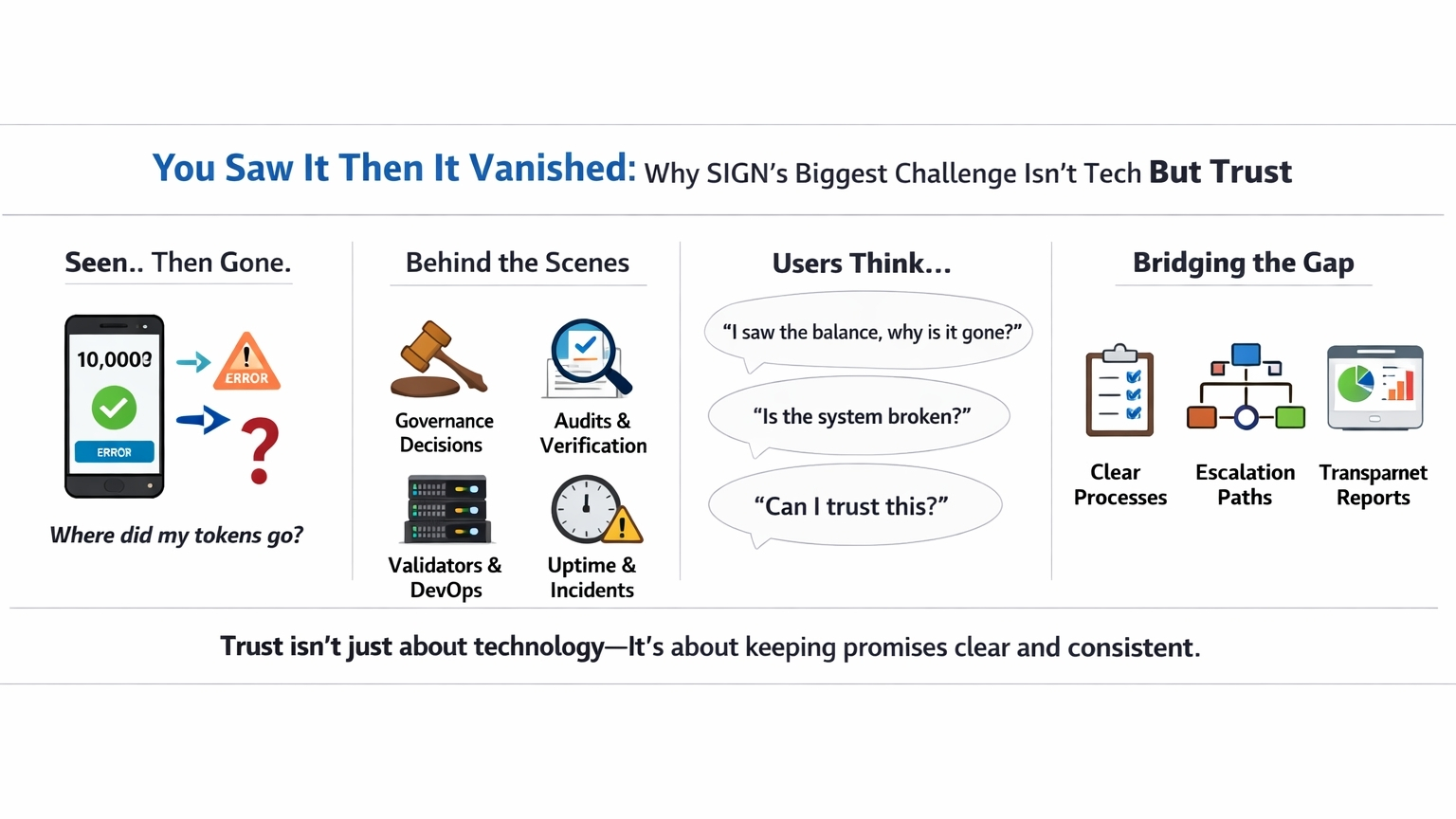
The deeper problem starts the moment a user actually sees their allocation.
Imagine this:
A wallet shows an amount.
The user checks it, maybe even takes a screenshot, and mentally locks it in.
They plan around it.
Then later… it’s gone.
Now the confusion begins.
From the system’s point of view, there might be valid reasons:
maybe a faulty batch was detected,
maybe things were paused,
maybe a rollback happened.
But the user doesn’t see any of that.
All they know is:
“It was there. I saw it myself. So why doesn’t it count anymore?”
This is where things get messy.
Because the question isn’t about eligibility anymore.
It’s about trust in what was shown vs what actually gets honored.
And if you can’t clearly explain that gap,
everything starts sounding unreliable.
What makes it harder is that $SIGN isn’t just a simple system.
Behind the scenes, it involves:
governance decisions
delayed responses
audits and data verification
operational layers like validators and DevOps
uptime, latency and incident handling
These are not visible to users,
but they directly affect outcomes.
And here’s another reality:
Even if everything is recorded on-chain,
most people especially institutions won’t read raw data.
They rely on:
dashboards
summaries
reports
Which means some level of structured control still exists, even in a decentralized setup.
That’s why things like:
runbooks
escalation paths
clear processes
become critical.
Without them, decentralization sounds good in theory,
but feels chaotic in practice.
So SIGN, in a way, is not just about trustless systems.
It’s actually about how well the system is run.
Who handles issues?
How quickly are decisions made?
What happens when something breaks?
Because if there’s delay or confusion at any step,
trust drops instantly.
There’s also another layer to this:
Rules like cooldowns, buyer checks, and country restrictions
are already being built directly into the system.
Which is powerful
because it automates compliance and reduces misuse.
But at the same time,
it adds more complexity to how everything behaves.
So yeah, SIGN looks strong.
But it’s not simple.
And the real question is:
Can all this complexity run smoothly at scale?
Or will it slow things down and create friction?
At the end of the day…
This space isn’t just about moving fast anymore.
It’s about making sure: what users see,
what the system records,
and what actually happens
all stay aligned.
Because if those three drift apart,
no amount of on chain truth can fix the confusion.