
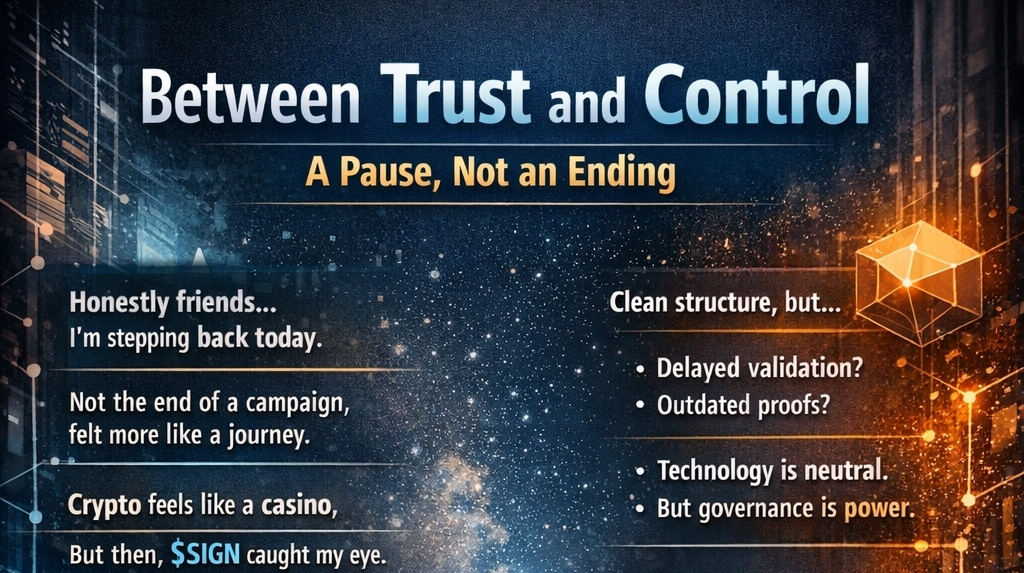

$SIGN Honestly, friends… I’m taking a step back from writing today.
Not because I’m done but because something meaningful just wrapped up. It wasn’t just a campaign… it felt like a journey.
And the truth is, I’m still trying to understand what we’re really building in this space.
Watching crypto for a long time, one thing keeps repeating. It feels like motion but not progress. Cycles of hype, speculation, meme waves… over and over again. Almost like the system feeds on attention more than value. Sometimes it genuinely feels like we’re designing a casino, not infrastructure and that’s a bit unsettling.
But every now and then, something different appears.
For me, $SIGN gave that feeling.
At first, phrases like “sovereign infrastructure” sounded like storytelling something made to attract attention. But when I looked deeper, I realized they’re actually trying to solve a very real and uncomfortable issue.
Not just “trust” in theory… but practical trust.
The kind that says: show proof, without revealing everything.
@SignOfficial is building toward something bigger a universal way to verify. A system where you prove something once, and that proof stays useful across different platforms. It sounds simple, but it challenges the way things work today.
Because right now, we repeat ourselves constantly.
Same identity checks. Same data submissions. Again and again.
And we’ve accepted that as normal behavior.
SIGN introduces a different approach:
Verify once… carry it forward.
A credential gets issued, confirmed, and then reused wherever needed. From a technical point of view, it reduces friction, lowers cost, and improves efficiency.
But still… there’s a small hesitation.
Because the real world doesn’t stand still.
A credential reflects a moment but people, context, and situations evolve.
So the real question becomes:
Is the system only checking if something is valid… or also if it still makes sense?
That’s where things feel both impressive and uncertain.
The structure is clean:
Issuance
Validation
Usage
Simple. Organized. Logical.
But reality is rarely that neat.
What happens if validation is delayed?
What if different platforms interpret the same proof differently?
What if something is valid on paper… but outdated in context?
The system might not fail instantly.
Instead, it could slowly drift creating gaps that aren’t obvious at first.
And then comes the deeper layer: governance.
When you build something called “sovereign infrastructure,” the question isn’t just about technology—it’s about authority.
Who defines the rules?
Who decides what proof counts?
And if an external force demands control will the system stand firm, or give in?
Because even if the base layer aims to stay neutral…
real-world applications rarely do.
Looking at the market side, the pattern feels familiar.
After the April 2025 TGE, sign followed a typical path—excitement, price surge, then correction.
ATH around $0.1325
ATL near $0.01223
A sharp drop of about 91%
Harsh, but not unusual in crypto.
What stands out is the recovery around 284% back toward ~$0.047. That suggests there’s still belief holding the structure.
But there’s also a clear concern:
Market cap ~ $78M
FDV ~ $476M
That gap points to potential dilution ahead. No matter how strong the narrative is, token economics still matter.
Still… beyond charts and metrics, one thing stayed with me:
@SignOfficial isn’t trying to be loud.
It doesn’t chase quick attention.
Instead, it makes you pause and think.
It keeps pulling you back to one core idea:
Are we just storing information… or redefining how decisions get made?
We often say blockchain removes friction.
But what if it’s just shifting it
from visible layers to hidden ones?
To areas we haven’t fully learned to evaluate yet.
So today might feel like an ending on the surface.
But honestly… it feels more like a beginning.
A point where the real questions start:
Can this system scale without breaking?
Can different systems stay aligned over time?
Can proofs remain meaningful as reality keeps changing?
And one thought keeps coming back…
Is sign truly making trust portable?
Or are we simply reorganizing trust. making it look cleaner while complexity still exists underneath?
I don’t have a clear answer yet.
So for now… I’m just observing. Quietly. @SignOfficial #SignDigitalSovereignInfra $SIGN