
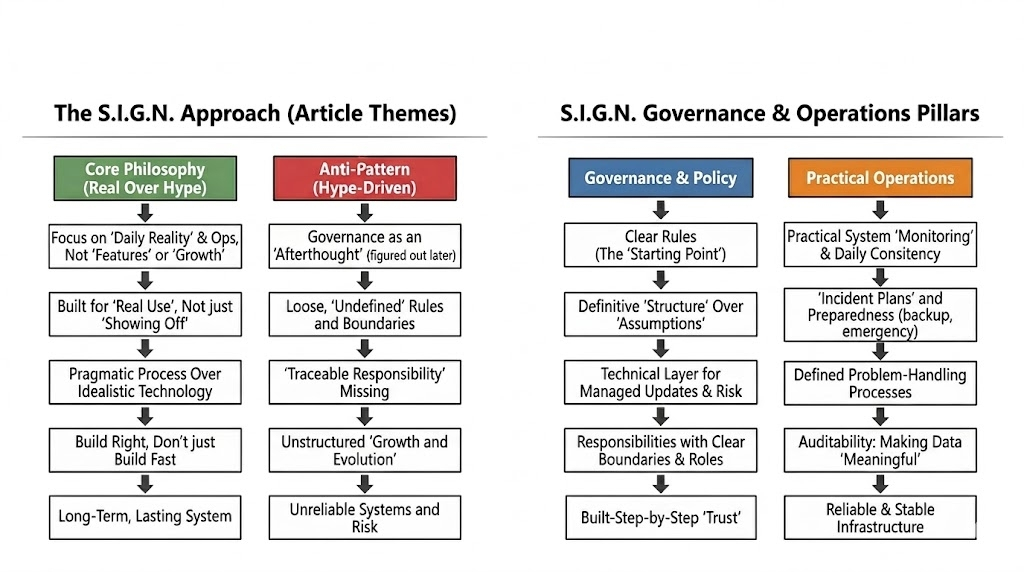
I was just going through the S.I.G.N. Governance and Operations docs, not expecting much at first, but something about it stayed with me. Usually, when I read about systems, it’s all about features, speed, or growth. This felt different. It wasn’t trying to impress on the surface. It was focused on how things actually run behind the scenes.
What really caught my attention is how S.I.G.N. treats governance. In most projects, governance feels like an afterthought. Something they figure out later. Here, it’s clearly the starting point. Before anything runs, the rules are already defined. Who can do what, under which conditions, and how everything is supposed to behave. It removes a lot of guesswork.
The policy side of it is simple but strong. Everything starts with clear rules. Not assumptions, not vague ideas. Proper structure. It decides how programs run, who qualifies, what limits exist, and even what should stay private or public. That clarity matters more than people realize.
Then there’s the operational side, which honestly feels like the part most systems ignore. It’s easy to launch something. It’s much harder to keep it running smoothly every day. S.I.G.N. focuses on that daily reality. How the system is monitored, how issues are handled, and how consistency is maintained over time.
I liked how it doesn’t pretend everything will always go perfectly. There are plans for incidents, clear processes for handling problems, and defined ways to keep things stable. It feels practical, not idealistic. Like it’s built for real use, not just for showing off.
The technical governance layer adds another level of control. Changes don’t just happen randomly. There’s a process. Updates are managed, risks are considered, and everything is tracked. That kind of structure makes a big difference, especially in systems that are expected to grow and evolve.
One thing I kept thinking about is accountability. In many systems, actions happen but it’s hard to trace responsibility clearly. Here, every action is tied to rules and roles. You can actually understand what happened and why it happened. That makes the system feel more reliable.
Auditability is another strong point. It’s not just about showing data. It’s about making that data meaningful. Being able to review actions in a clear and structured way adds a layer of confidence that most systems lack.
What I find interesting is the balance. It’s not overly rigid, but it’s not loose either. There’s room to evolve, but within a defined structure. That balance is important if something is meant to last.
For me, the biggest takeaway is simple. Most systems focus on building fast. Very few focus on building right. S.I.G.N. is clearly trying to do the second one.
It also changed how I look at trust. Usually, trust is treated like a feeling. Either you believe in a system or you don’t. Here, trust feels more like something that is built step by step. Through rules, processes, and clear accountability.
Another thing that stands out is how responsibilities are handled. It’s not all controlled by one side. Different roles exist, with clear boundaries. That reduces confusion and makes things easier to manage.
There’s also a sense of preparedness in the design. It doesn’t assume everything will go smoothly. There are backup plans, controls for emergencies, and ways to handle unexpected situations. That kind of thinking makes a system stronger.
The more I think about it, the more it feels like governance is not just one part of the system. It’s the foundation. Everything else depends on it. Without it, even strong technology can become unreliable.
What S.I.G.N. is doing doesn’t feel loud or flashy, but it feels important. It’s focusing on something most people overlook. And sometimes, that’s where the real value is.
In the end, this isn’t just about one project. It’s about a different way of building systems. One where structure matters as much as innovation. One where accountability is not optional.
That’s why this stood out to me. Not because it promises something big, but because it focuses on getting the basics right. And in the long run, that’s what actually lasts.
@SignOfficial #SignDigitalSovereignInfra $SIGN
