
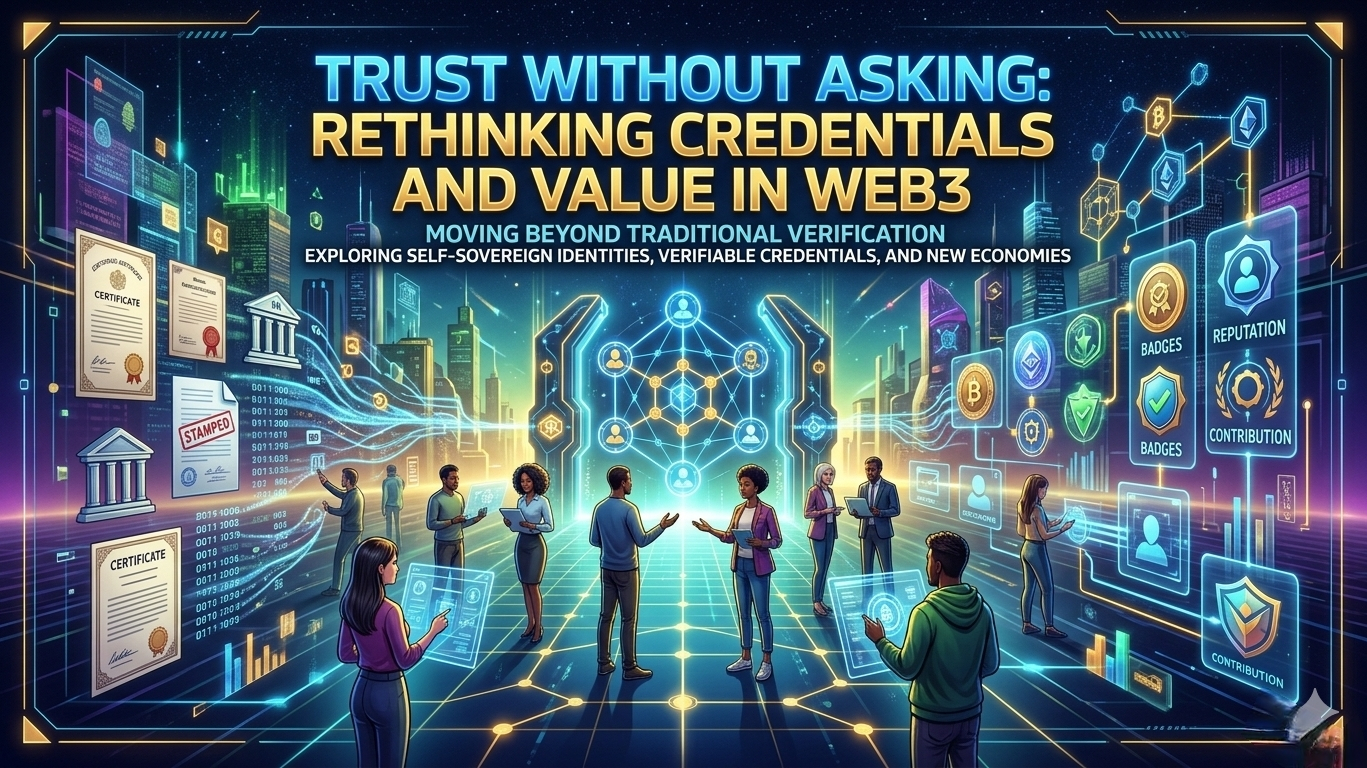

I keep coming back to a quiet question that sits underneath a lot of Web3 conversations: how do we actually know who or what we’re dealing with online without rebuilding the same fragile trust systems we’ve been trying to move away from?
It sounds simple at first. We already have credentials. We already verify identity. But the moment you step outside familiar systems government IDs centralized logins, institutional databases you realize how dependent everything still is on intermediaries that quietly hold the keys. And once you notice that it’s hard to unsee.
The idea of a global infrastructure for credential verification and token distribution feels like an attempt to rebuild that layer from scratch, but in a way that doesn’t rely on any single authority. Not a replacement for identity exactly but something adjacent to it. A way to prove claims, distribute access and coordinate value without constantly asking, “who is issuing this, and can I trust them?”
At a practical level, the concept tends to revolve around credentials that are cryptographically signed and portable. Instead of logging into a platform and letting it vouch for you you carry proofs education participation reputation maybe even compliance that can be verified independently. The verification step doesn’t require calling back to the issuer every time. It just checks the signature like verifying a sealed letter without needing to contact the sender.
That part is elegant, at least in theory. But then things get more interesting when tokens enter the picture.
Token distribution has always been a messy process. Airdrops, rewards, governance rights—these often rely on crude heuristics. Wallet balances, transaction history, sometimes social signals scraped from elsewhere. It’s an approximation of fairness more than a reliable system. And it’s easy to game.
If credentials become more meaningful and harder to fake, they start to reshape how tokens can be distributed. Instead of guessing who deserves access or influence, systems could tie distribution to verified attributes. Not just “this wallet did something,” but “this entity has demonstrated X under Y conditions.”
But that raises another question: who decides what counts as a valid credential?
Even in a decentralized setup, someone has to issue credentials. A university, a DAO, a protocol, maybe even an algorithm. And suddenly we’re back to trust again, just in a more fragmented form. Instead of one authority, there are many. That’s arguably better, but it’s also more complex. You don’t eliminate trust—you redistribute it.
There’s also the problem of interpretation. A credential might be valid cryptographically, but what does it actually mean? If someone holds a token because they were “verified” in some way, what exactly are they verified for? The nuance doesn’t always translate cleanly into code.
And then there’s privacy, which never really goes away. The more credentials you carry, the more you risk exposing patterns about yourself. Even if the system uses zero-knowledge proofs or selective disclosure, the edges can still leak. It’s one thing to prove you meet a condition; it’s another to ensure that proof can’t be stitched together with others to form a clearer picture than intended.
I’ve also wondered how this kind of infrastructure behaves at scale, not just technically but socially. It’s easy to imagine a world where credentials become a kind of currency themselves—collected, traded, optimized for. People might start shaping behavior not around genuine participation, but around earning the right credentials to unlock future opportunities.
That’s not entirely new. We already do this with degrees, certifications, social proof. But encoding it into a global, programmable system changes the dynamics. It becomes faster, more granular, and potentially harder to step outside of.
Still, there’s something compelling about the direction. The current internet doesn’t really have a native way to express trust beyond platform boundaries. You build reputation inside systems, but it rarely travels well. Every new environment resets you to zero, or worse, forces you to re-verify yourself through the same centralized channels.
A shared infrastructure for credentials and token distribution hints at continuity. Not perfect, not universal, but at least more composable. You could imagine moving through different ecosystems without constantly rebuilding your identity from scratch.
Whether that actually leads to a more open or more constrained digital world is still unclear. It probably depends less on the technology itself and more on how it’s used, who adopts it, and what incentives shape its evolution.
There’s a tension here that doesn’t seem easy to resolve. On one hand, we want systems that reduce reliance on centralized authorities. On the other, we still need signals that are meaningful, scarce, and hard to fake. Credentials try to bridge that gap, but they don’t eliminate the underlying trade-offs.
Maybe the real shift isn’t about removing trust, but making it more visible, more inspectable, and a little less taken for granted.
And maybe that’s enough to change how we think about it. Or maybe it just moves the problem somewhere harder to see.
@SignOfficial #SignDigitalSovereignInfra $SIGN
