
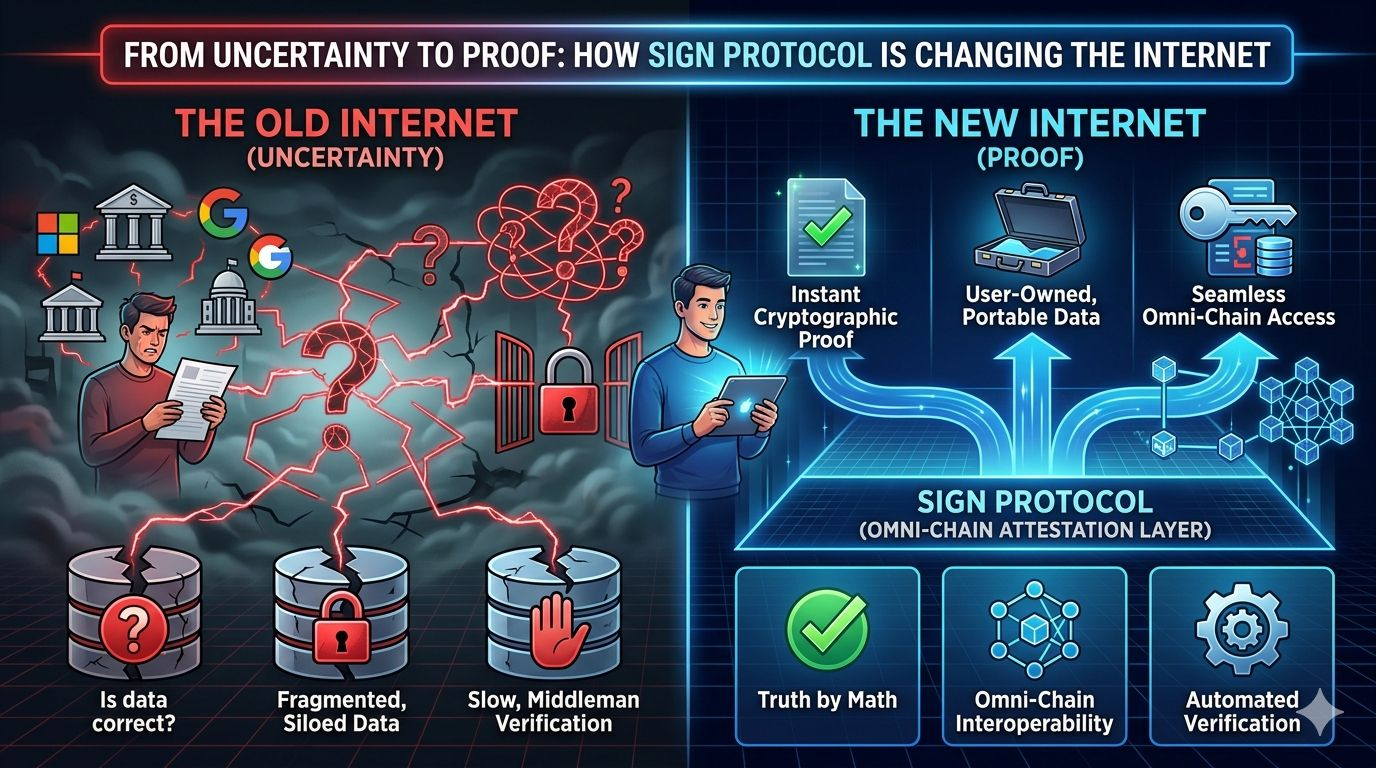

Sometimes a technology appears that doesn’t feel loud or overhyped. It doesn’t try to overwhelm you with complicated terms or big promises. It simply feels… real.
That’s the feeling many people get when they start looking into @SignOfficial and the SIGN Protocol. The more you think about it, the more one idea keeps returning to your mind: this isn’t just a technology story. It’s really a story about how our mindset about digital trust is starting to change.
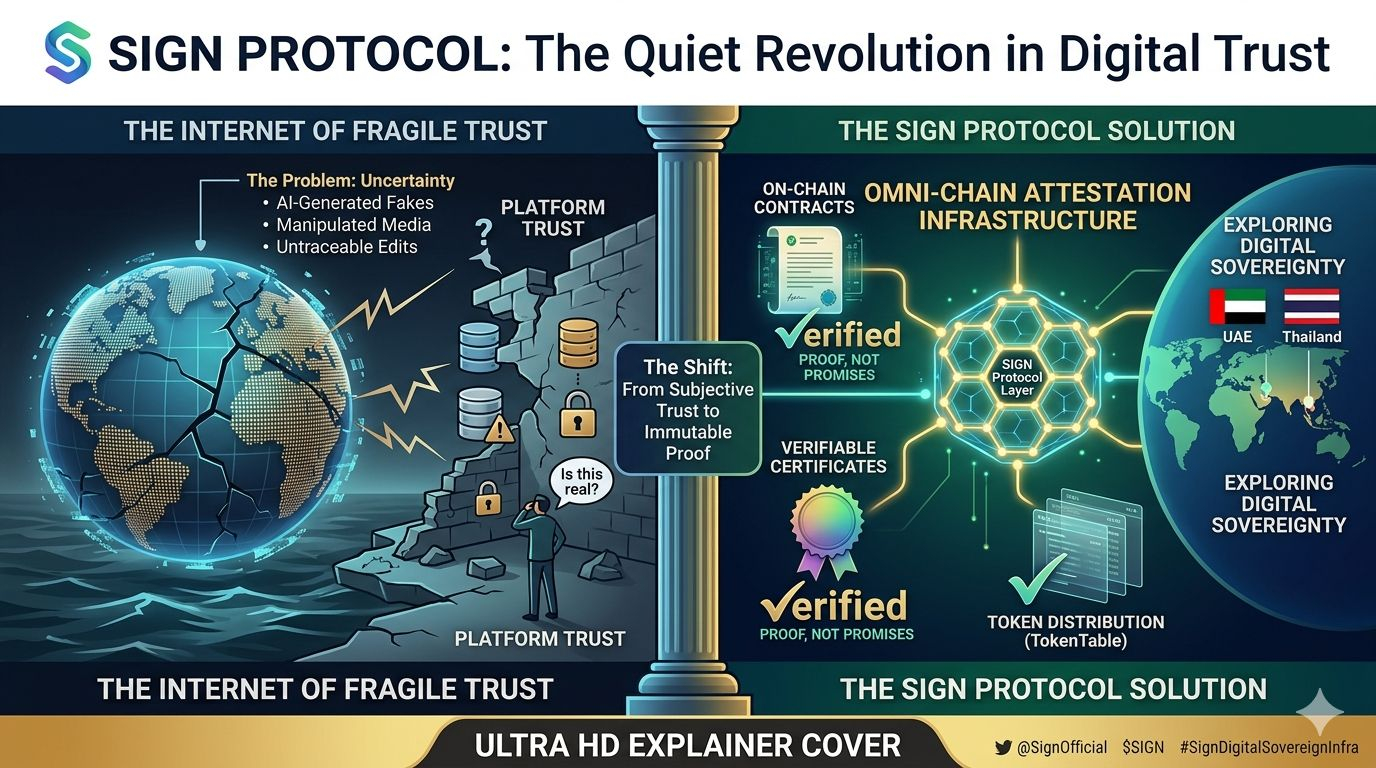
The Internet Runs on Fragile Trust
Our entire online life runs on trust.
When we send money online, sign documents digitally, or store our data on platforms, we are basically trusting someone else’s system. We assume the company behind that server will keep our information safe and unchanged.
But deep down, there is always a small doubt.
Because the truth is simple: digital information can be changed.
Today we live in a world where:
AI can create fake videos
Images can be manipulated easily
Documents can be edited without leaving obvious traces
Sometimes it becomes very hard to tell what is real and what isn’t.
This quiet uncertainty has become one of the biggest problems of the digital age.
Why SIGN Protocol Feels Different
This is where something like SIGN Protocol starts to make sense.
Instead of asking people to simply trust a platform, it focuses on creating proof.
Proof that a piece of information existed.
Proof that it hasn’t been secretly changed.
Proof that can be verified across different blockchains.
In simple terms, SIGN is trying to do something very basic but very important:
bring back trust to the internet.
Not by promises, but by evidence.
Transparency That Actually Matters
Big numbers like 40 million users sound impressive. But numbers alone don’t really change people’s lives.
What matters more is how the technology is used.
One interesting example is TokenTable.
In the crypto world, token distributions often raise questions:
Who received how many tokens?
Were insiders favored?
Was the process truly fair?
Most of the time, people just have to trust what the project says.
With TokenTable, those distributions can be recorded and verified openly, making the process much more transparent.
Instead of speculation, there is clear proof.
A Change Most People Won’t Notice
If this technology becomes widely adopted, the funny thing is that most people may never notice it.
Someone might sign a digital contract online.
A student might verify a certificate.
A buyer might confirm the authenticity of an online document.
And they might never even realize that a blockchain attestation system is working quietly in the background.
All they will notice is one thing:
the information can’t be faked anymore.
And that alone changes everything.
Why Some Governments Are Interested
When countries like the UAE or Thailand start exploring these systems, it shows something bigger is happening.
They are not just experimenting with blockchain technology.
They are thinking about digital sovereignty — the ability to control and verify their own data without depending entirely on foreign companies or centralized servers.
In the future, attestation systems like SIGN could become part of the core infrastructure of digital nations.
But It’s Not All Simpl
Of course, the journey isn’t easy.
Omni-chain systems are complex. Coordinating multiple blockchains is still technically challenging. Handling thousands of verifications every second without slowing networks down is not a small task.
SIGN Protocol is still evolving. It is still being tested in real-world situations.
It’s not a finished solution yet.
It’s more like a powerful idea that is still being built and refined.
A Small But Important Question
There’s also a deeper question we should think about:
Are we ready for a world where everything can be proven?
Blockchain records are permanent. Once something is recorded, it’s very hard to erase.
This permanence brings security, but it also removes the comfort of uncertainty that sometimes exists online.
The internet has always allowed things to disappear or be forgotten.
An on-chain world remembers everything.
That can feel both reassuring and slightly uncomfortable.
From EthSign to Something Bigger
The transition from EthSign to SIGN Protocol reflects a bigger vision.
EthSign focused on digital signatures.
SIGN Protocol goes much further. It aims to become an attestation infrastructure that other applications and systems can build on.
It’s like moving from building a single product to building the foundation for many future products.
The Real Test Ahead
For SIGN Protocol to truly succeed, one thing must happen.
It needs to become simple and invisible.
When people send emails, they never think about the protocols working behind the scenes. The same thing should happen with digital verification.
If one day people can verify identities, documents, or agreements without even thinking about blockchain, then SIGN will have truly reached its goal.
A Quiet Step Toward a More Trustworthy Internet
The digital world today often feels uncertain. Fake content spreads easily, and verifying truth becomes harder every year.
Systems like SIGN Protocol are an attempt to rebuild something that the internet slowly lost: reliable trust.
It won’t change everything overnight.
But it might slowly move us toward a future where we no longer have to wonder:
"Is this real, or is it fake?"
And honestly, that certainty might become one of the most valuable things in the digital world.
Time will tell. 👀