
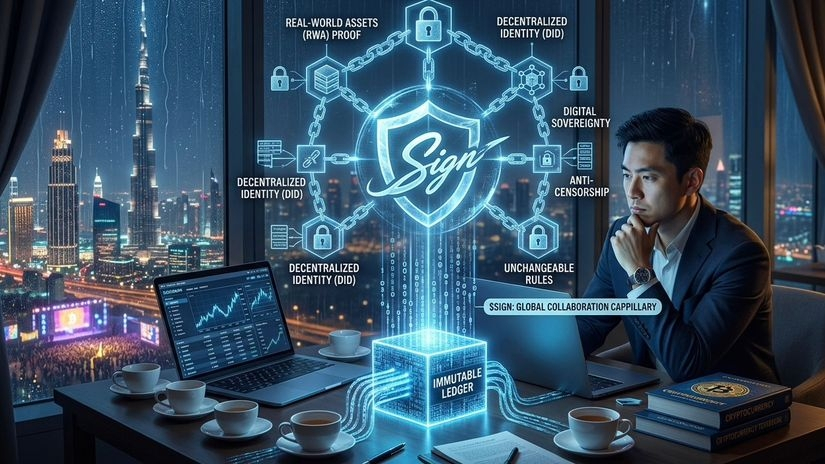

Most people talk about growth in the Middle East in a very visible way. They point to giant towers, new business zones, billion-dollar funds, smart city plans, and flashy headlines about innovation. And to be fair, those things do matter. They show ambition. They show momentum. They show that the region is not sitting still.
But I think the more interesting story is happening underneath all of that.
Real growth is not only about what people can see. It is also about the systems working quietly in the background. The parts nobody takes pictures of. The rails that help people trust each other, do business faster, verify information, and build things that can actually scale. That is where the conversation gets a lot more interesting, and honestly, that is where Sign starts to stand out to me.
When I look at @SignOfficial, I do not see just another crypto project trying to ride attention for a few weeks. I see a project working on something that feels increasingly important: digital trust infrastructure. That may sound a little technical at first, but the idea is actually simple. As more of our lives, businesses, agreements, and identities move online, we need better ways to prove what is real, who is involved, what rights people have, and what can be trusted.
That is a big deal anywhere. In the Middle East, it could be even bigger.
#SignDigitalSovereignInfra $SIGN
The region is moving fast. You can feel it almost everywhere now. Governments are pushing digital transformation. Startups are getting more ambitious. Founders are building with a global mindset from day one. Capital is moving more quickly. More people are thinking seriously about blockchain, digital assets, and online-first business models. There is energy here, and it does not feel temporary.
But speed creates a strange problem. The faster things move, the more trust starts to matter.
A founder might be working with investors in one country, developers in another, contributors somewhere else, and users spread across different markets. An institution might want to explore digital assets but still needs clear verification and accountability. A community might want to coordinate onchain, but without a real trust layer, everything can start feeling loose, messy, or easy to manipulate.
That is the part people often ignore. Everyone likes talking about growth. Fewer people talk about the infrastructure needed to support that growth in a way that feels reliable.
And that is why I keep coming back to Sign.
At a basic level, Sign feels connected to a simple but important question: how do digital systems create trust without making everything slow, fragmented, and dependent on outdated processes? That question is going to matter more over time, not less. It matters for startups. It matters for institutions. It matters for communities. It matters for digital economies that want to grow up without carrying unnecessary friction forever.
I think the phrase “digital sovereign infrastructure” works here because it captures something deeper than a product feature. It suggests a real foundation. Not just another app people use for a while, but a layer that helps support identity, verification, credentials, agreements, and legitimacy in digital environments. Those things might sound abstract until you think about how often modern business depends on them.
A lot of online coordination is still surprisingly primitive. People are still proving things through screenshots, scattered documents, email trails, spreadsheets, and disconnected platforms. People rebuild trust from scratch over and over again. Teams repeat the same verification steps in every new relationship. Communities rely on vague signals instead of structured proof. Businesses move fast on the surface but still drag hidden friction behind them.
That gets expensive. Not always in obvious ways, but in wasted time, slower decisions, weaker confidence, and messier scaling.
The Middle East is exactly the kind of place where solving that problem could have real impact. This is a region that understands infrastructure. It has seen firsthand how strong infrastructure can change everything. Ports changed trade. Airlines changed connectivity. Financial hubs changed capital flows. Digital infrastructure can do the same thing for the next phase of growth, even if it looks less dramatic from the outside.
That is one reason I find Sign interesting. It feels more like infrastructure than noise.
And I think that distinction matters a lot right now, especially in crypto. There are always projects that get attention because they are loud, trendy, or easy to package into a quick narrative. But the projects that tend to matter longer are usually solving problems that become more important as adoption grows. Trust is one of those problems. Verification is one of those problems. Digital legitimacy is one of those problems.
Those are not temporary needs.
Imagine a startup ecosystem in the Gulf where founders, contributors, mentors, partners, and investors can rely on stronger digital attestations instead of endless back-and-forth proof. Imagine regional business networks where credentials and roles are easier to verify. Imagine onchain communities that are not just built on hype, but on clearer structures of participation and accountability. Imagine institutions stepping into digital environments with more confidence because the trust layer feels more usable and more serious.
That is where the value starts to feel real.
What makes this even more relevant in the Middle East is the way the region approaches modernization. It is not just chasing speed for the sake of speed. In many places, there is a strong desire to modernize in a way that still feels structured, credible, and durable. That is important. It means the winning digital systems may not be the ones that are simply the most open or the most chaotic. They may be the ones that help innovation happen with more trust built into the process.
That feels very aligned with what Sign is trying to represent.
I also think people sometimes underestimate how important this becomes once growth gets more international. The Middle East is deeply connected across borders. Talent moves. Capital moves. Partnerships stretch across jurisdictions. Founders build across multiple markets almost by default. That kind of environment creates huge opportunity, but it also creates a lot of complexity. The more cross-border activity you have, the more valuable it becomes to have reliable digital systems for proving roles, rights, credentials, and relationships.
Without that, people end up patching together trust with old tools in new environments. It works for a while, then starts breaking under pressure.
That is why I do not think Sign should be looked at only through the lens of short-term token attention. If the project succeeds in becoming useful trust infrastructure, then the long-term conversation around $SIGN becomes much more interesting. It stops being just about speculation and starts becoming about relevance within a growing digital system.
That is always a healthier foundation for a token narrative.
Of course, none of this means outcomes are guaranteed. That is not how serious analysis works. A strong idea still needs execution. Adoption still matters. Real usage still matters. But I would much rather watch a project that is tied to a problem with real long-term weight than one built entirely on borrowed hype.
And honestly, this problem has weight.
We are moving into a world where more value lives online. More identity lives online. More agreements, access rights, memberships, and proofs live online. That means trust itself has to become more digital, more portable, and more verifiable. If it does not, then the rest of the system stays clunky no matter how modern it looks from the outside.
That is why Sign feels timely to me.
It reminds me of something I have noticed in a lot of high-growth environments: people often celebrate the visible layer first and only later realize how much the invisible layer mattered all along. You notice the app, but not the rails behind it. You notice the market activity, but not the systems making confidence possible. You notice the expansion, but not the infrastructure absorbing the complexity.
Maybe that is where Sign fits.
Not as the loudest name in every conversation, but as a project working on the kind of layer that becomes more valuable as serious users enter the space. Builders, institutions, ecosystems, communities, all of them eventually run into the same issue. At some point, trust needs structure.
The Middle East may end up being one of the strongest places for that idea to matter. Not only because the region is growing, but because it is growing with intent. There is a real effort to shape the future here, not just react to it. And whenever a region starts building seriously for the future, it eventually has to think about foundations.
That is where digital sovereign infrastructure starts to make sense.
To me, @SignOfficial is interesting because it speaks to that foundational layer. It fits a version of the future where economies need more than digital activity. They need digital credibility. They need systems that help people prove, verify, coordinate, and participate with more confidence. If that layer becomes stronger, the whole environment gets better for everyone building on top of it.
That is also why $SIGN feels worth paying attention to. Not because it is loud. Not because it is easy to shill. But because it is connected to an idea that could age well if adoption keeps moving in this direction.
And I think it will.
The next chapter of Middle East growth will not be built only with concrete, capital, and headlines. A big part of it will be built with trust layers people rarely see but rely on every day. The systems that quietly make digital economies smoother, safer, and more credible. The infrastructure behind the momentum.