
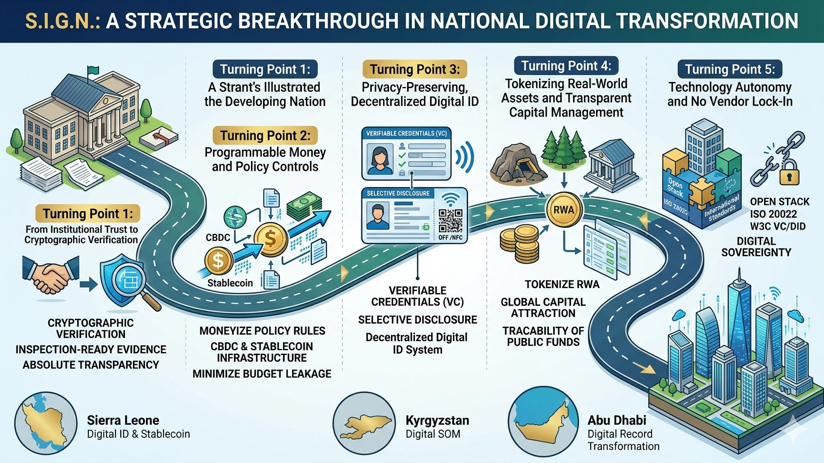
If a nation chooses to implement S.I.G.N. (Sovereign Infrastructure for Global Nations), its digital transformation journey could experience a structural shift—changing not only how governments manage money, but also how identity, capital, and public infrastructure operate.
From Institutional Trust to Cryptographic Verification
The most fundamental shift is moving away from declarations based on institutional authority toward repeatable and verifiable cryptographic proofs at a national scale. Every critical action can generate inspection-ready evidence, making audits, transparency, and accountability far more reliable within public institutions.
Programmable Money and Policy Enforcement
With a new digital monetary infrastructure, governments can operate CBDCs and stablecoins on the same financial rails. The real breakthrough lies in encoding policy rules directly into the flow of money - including eligibility, spending limits, and permitted use cases. This approach significantly reduces fiscal leakage while enabling automatic and transparent policy execution.
Privacy-Preserving Digital Identity
Instead of relying on vulnerable centralized identity APIs, nations can adopt a next-generation digital identity system based on Verifiable Credentials (VCs) and Decentralized Identifiers (DIDs). Citizens can prove their rights or eligibility without exposing full personal data through selective disclosure, and credentials can even be presented offline via QR codes or NFC, ensuring accessibility and resilience.
Tokenization of Real-World Assets and Transparent Capital Systems
A modern capital infrastructure enables governments to tokenize real-world assets (RWA) such as gold, energy resources, or land. This opens the door to global capital markets while ensuring transparent management of national resources. At the same time, subsidies, grants, and public funding programs can be distributed based on predefined conditions and schedules, creating deterministic reconciliation and traceable public spending.
Technological Sovereignty Through an Open Stack
Because S.I.G.N. is built on an open technology stack and global standards such as ISO 20022 and W3C VC/DID, nations retain technological sovereignty. Governments can build digital infrastructure without being locked into a single vendor, platform, or blockchain network.
Early examples are already emerging. Countries such as Sierra Leone, Kyrgyzstan, and Abu Dhabi are exploring digital identity systems, sovereign digital currencies, and programmable financial infrastructure - demonstrating how sovereign digital infrastructure could reshape the delivery of public services.
As global economies accelerate toward digital governance, S.I.G.N. infrastructure may become a foundational layer for sovereign digital states, redefining how trust, identity, and capital operate in the internet era.