
I didn’t expect to think about it this way, but something about systems like @SignOfficial and $SIGN has started to feel less neutral to me over time.
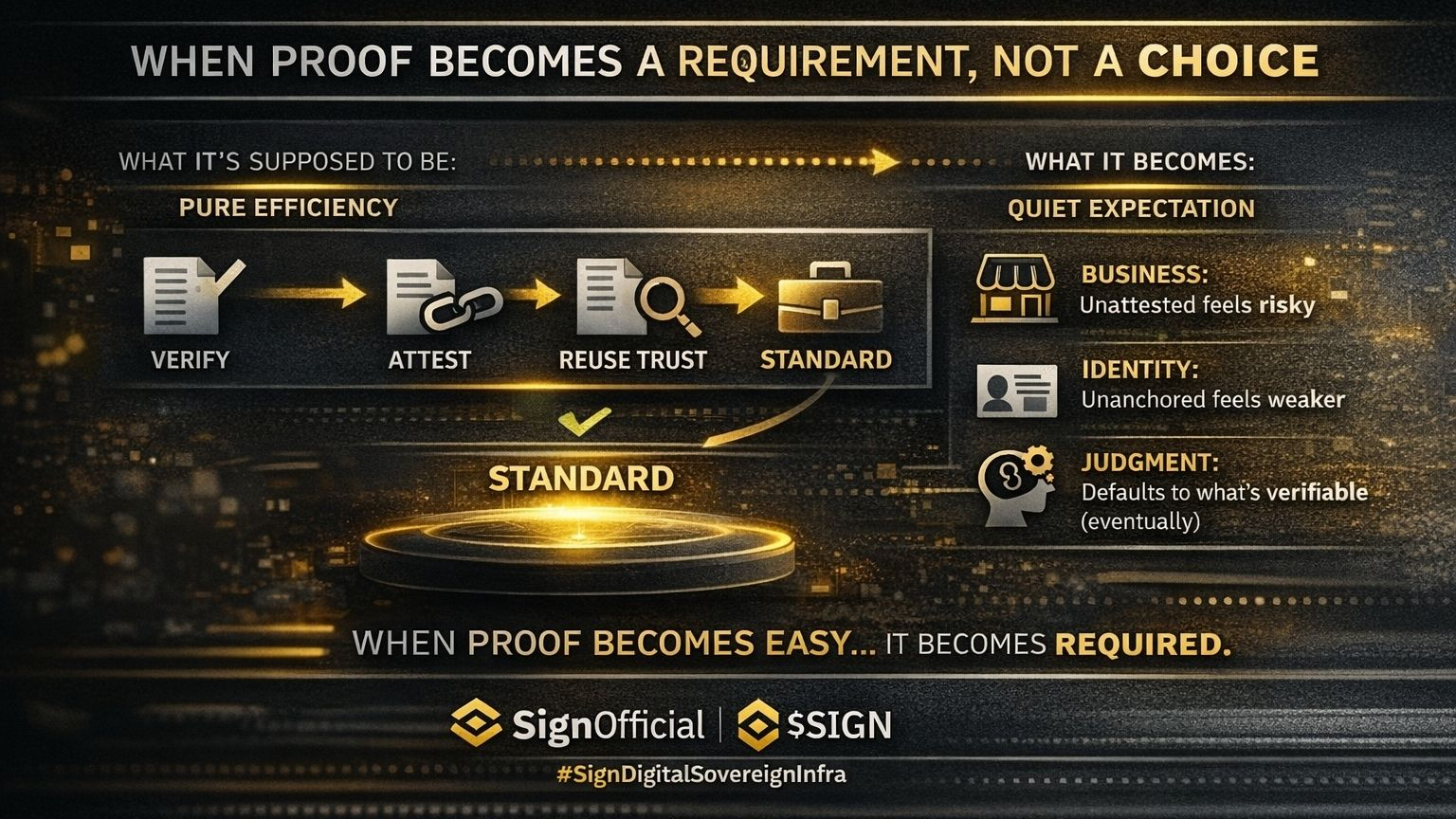
At first, I saw it as pure efficiency.
You verify something once, anchor it, and reuse that trust everywhere.
Cleaner processes. Faster coordination. Less friction.
But now I keep coming back to what happens after that system becomes standard.
Because once proof becomes easy… it slowly becomes expected.
And then, without anyone explicitly saying it,
anything that isn’t provable inside the system starts to feel incomplete.
Not invalid… just harder to accept.
A business might be legitimate, but if it’s not attested, it feels riskier.
An identity might be real, but if it’s not anchored, it feels weaker.
Decisions don’t stop relying on judgment… they just start defaulting to what’s verifiable.
That’s where the shift feels deeper than infrastructure.
With #SignDigitalSovereignInfra , it’s not just about making trust portable.
It’s about quietly setting the standard for what qualifies as trust in the first place.
And in regions like the Middle East, where digital systems are scaling fast,
that standard doesn’t just support growth… it shapes behavior at scale.
I’m still trying to understand if this makes systems more reliable…
or just makes everything outside them harder to trust over time.