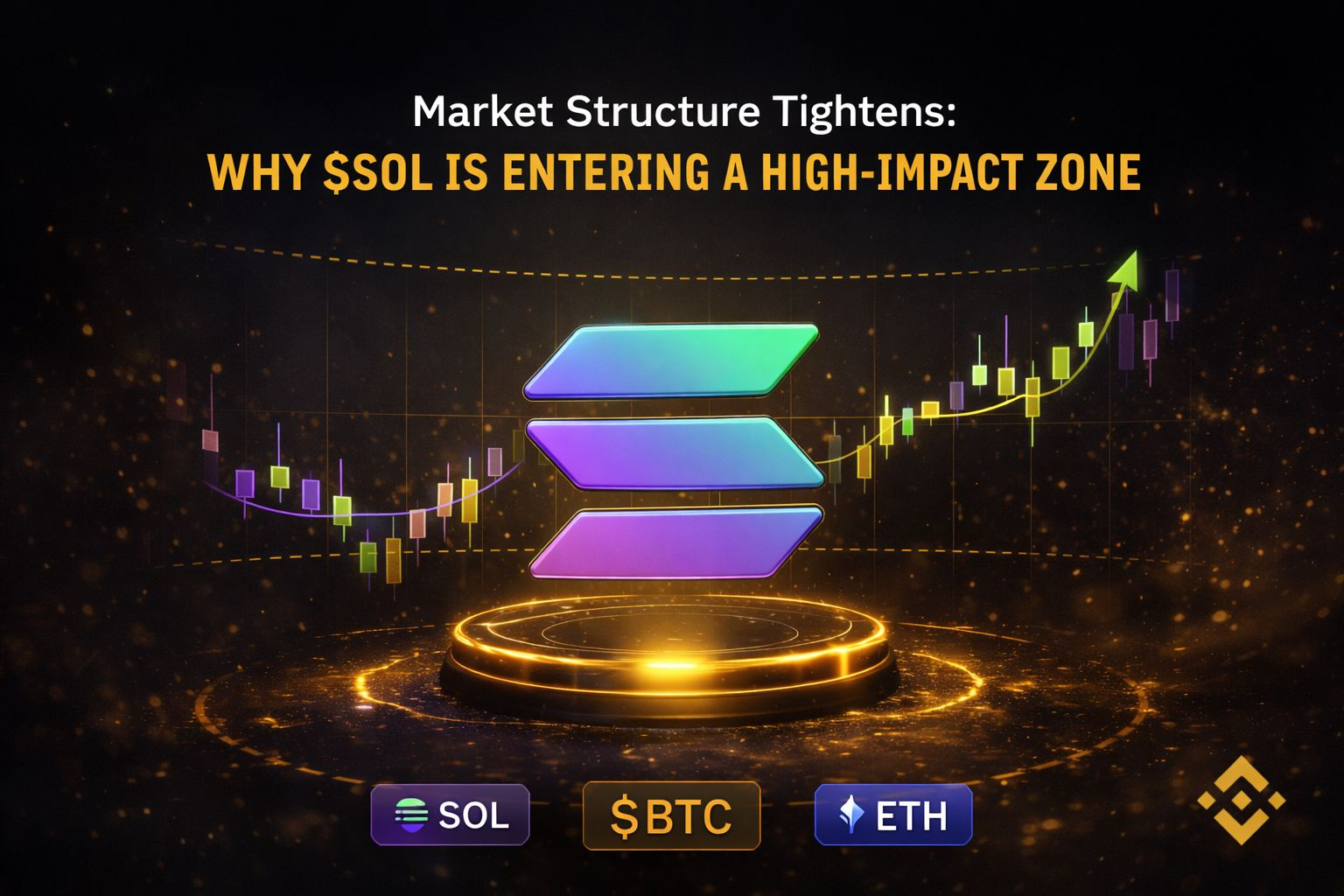
The current behavior of Solana is shifting from random volatility into structured compression. Historically, this type of price action precedes directional expansion, especially when liquidity builds on both sides of the range.
Right now, $SOL is not moving aggressively. That’s the signal.
When volatility contracts while participation remains steady, it usually indicates positioning rather than indecision. Larger traders tend to accumulate during these quiet phases, allowing liquidity to form before momentum returns.
This creates a high-probability scenario:
A breakout attracts momentum traders
A rejection traps early entrants
The real move follows after liquidity is collected
What makes this setup particularly compelling is the alignment with broader market stability. While Bitcoin holds structure and Ethereum consolidates, capital often rotates into high-beta assets like $SOL. That rotation typically accelerates volatility once direction is confirmed.
This is not a hype-driven condition.
It’s a structural setup.
The key observation is how price behaves near the current range boundary. Sustained acceptance above resistance often leads to momentum continuation. Failure to hold above that zone tends to produce sharp liquidity sweeps before direction becomes clear.
In both cases, movement expands quickly after compression.
The market is effectively coiling.
And when assets like $SOL coil under stable macro conditions, the release is rarely slow.
This is the kind of environment where positioning matters more than reaction.
Not because the move is guaranteed…
But because the probability of expansion is increasing.
$SOL $BTC $ETH.