
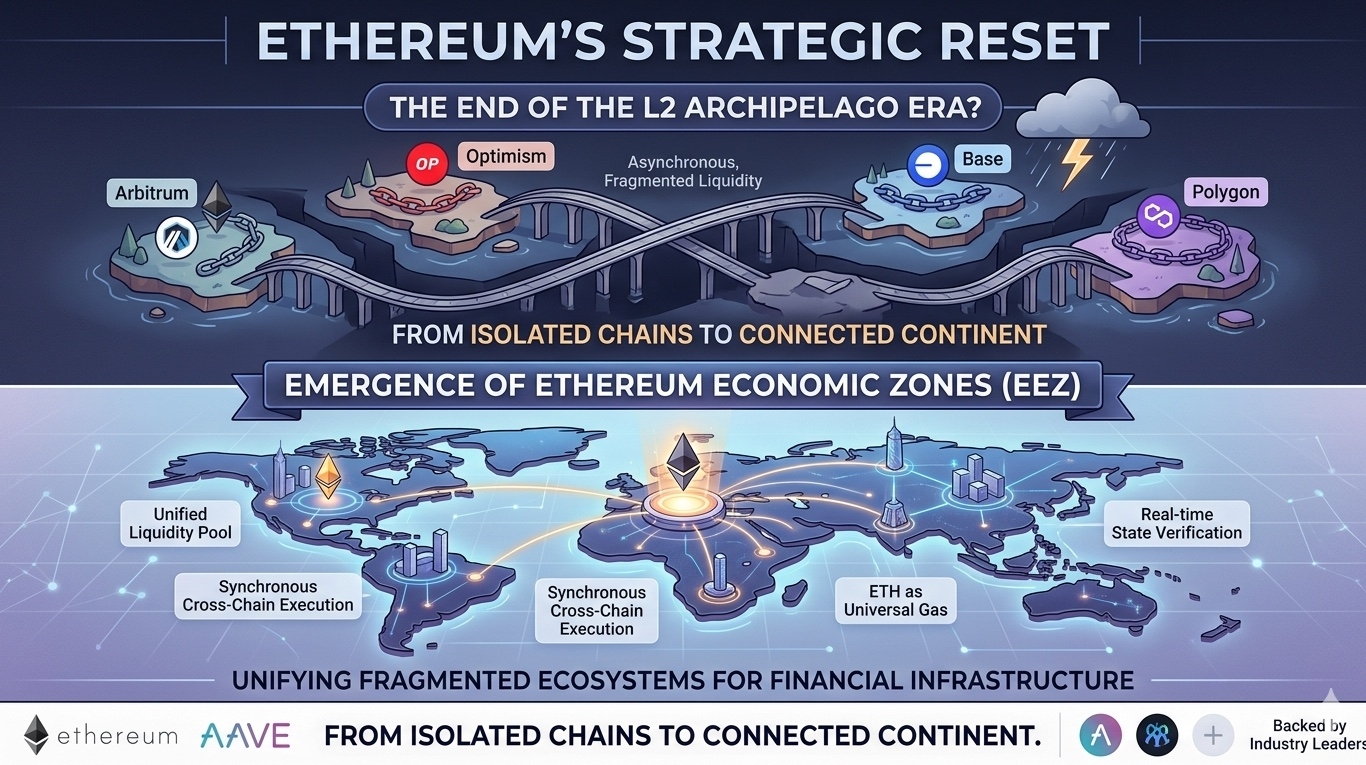
Introduction: A Strategic Reset for Ethereum
Ethereum is entering a new phase. What was once a clear roadmap—scaling through Layer 2 (L2) ecosystems—is now being questioned by its own creator, Vitalik Buterin.
The emergence of Ethereum Economic Zones (EEZ) signals a strategic pivot: from fragmented scalability toward unified liquidity and synchronous execution.
This shift raises a deeper question:
Is Ethereum evolving into a global financial backbone—or losing its investment appeal?
From L2 Archipelago to Unified Economic Zones
For years, Ethereum scaled through an “archipelago model”:
▪ Mainnet → security + settlement
▪ L2s → execution + user activity
▪ Bridges → cross-chain connectivity
This created a fragmented ecosystem where each L2 functioned like an independent economy.
The Problem: Fragmentation
Users faced:
▪ Complex bridging processes
▪ Delays and security risks
▪ Liquidity silos across chains
Protocols like LayerZero and Wormhole attempted solutions—but remained asynchronous, meaning transactions weren’t instant or atomic.
What is EEZ (Ethereum Economic Zone)?
EEZ introduces a new paradigm:
▪ Unified liquidity across L2s
▪ Synchronous cross-chain execution
▪ ETH as the universal gas currency
▪ Real-time state verification between chains
Backed by the Ethereum Foundation and supported by protocols like Aave, EEZ aims to transform isolated chains into a connected financial continent.
Key Innovation: Synchronous Execution
Unlike traditional bridging:
▪ Transactions execute simultaneously across chains
▪ Either all succeed or all fail (atomicity)
▪ Reduced exploit risk (bridges are common attack targets)
This is made possible by advances in real-time block verification and zero-knowledge proofs.
The Bigger Shift: Ethereum as Infrastructure
Despite declining retail interest, Ethereum’s fundamentals tell a different story:
▪ ~$163B stablecoins on-chain
▪ ~58% share of real-world assets (RWA)
▪ ~$53B DeFi TVL
▪ Strong institutional ETF inflows
Ethereum is no longer just a “platform”—it’s becoming financial infrastructure.
Analogy: The Water Pipeline
Ethereum is evolving into something users don’t think about:
▪ Invisible
▪ Essential
▪ Trusted by institutions
Like global systems such as SWIFT, its value lies in reliability, not hype.
The Economic Problem: Revenue Leakage
Here lies Ethereum’s biggest challenge.
The Old Model (EIP-1559 Era)
▪ High mainnet activity
▪ Significant gas fees
▪ ETH burn → deflationary supply
The New Reality (L2 Dominance)
▪ Transactions shift to L2s
▪ Mainnet revenue drops (~75%)
▪ Minimal blob fees (~3 ETH/week at times)
▪ ETH supply turns inflationary (~0.7%)
The “ultrasound money” narrative is weakening.
EEZ Solves Fragmentation—Not Monetization
EEZ improves:
✔ Liquidity flow
✔ User experience
✔ Capital efficiency
But it does not solve:
✘ Revenue generation
✘ ETH value capture
✘ Fee redistribution from L2s
In simple terms:
Ethereum connects the economy—but doesn’t tax it effectively.
Institutional Shift: From Growth to Treasury
Ethereum’s behavior signals a shift:
▪ Reduced grant spending
▪ Increased staking (treasury mindset)
▪ Focus on stability over expansion
This suggests Ethereum is becoming:
➡ A store of institutional capital
➡ A settlement vault
➡ A low-volatility infrastructure layer
Valuation Reset: Growth Asset vs Infrastructure Asset
The market is repricing Ethereum:
Old Narrative
▪ High-growth ecosystem
▪ Expanding user base
▪ Bullish token economics
New Narrative
▪ Settlement layer
▪ Infrastructure utility
▪ Lower growth premium
Like SWIFT or clearinghouses:
▪ High importance
▪ Low speculation appeal
Ethereum vs Solana: A Narrative Contrast
While Ethereum becomes infrastructure, chains like Solana focus on:
▪ Retail adoption
▪ Speed and UX
▪ Active narratives (memes, AI, trading)
This creates a divergence:
▪ Ethereum → institutional backbone
▪ Solana → retail-driven ecosystem
Key Investor Question
Every ETH holder now faces a critical question:
Are you investing in:
▪ A high-growth digital city?
OR
▪ A global financial pipeline?
Because the valuation logic for each is fundamentally different.
Conclusion: Important but Unexciting?
Ethereum’s future may look like this:
✔ Deep institutional integration
✔ Dominant settlement layer
✔ Massive capital concentration
But also:
✘ Lower speculative upside
✘ Reduced retail excitement
✘ Slower narrative cycles
Ethereum isn’t disappearing—it’s maturing.
And in doing so, it may become both indispensable and underappreciated.
Final Insight
EEZ marks a technical evolution—but the real transformation is economic:
➡ From ecosystem growth
➡ To financial infrastructure dominance
The market is no longer asking:
"How big can Ethereum grow?"
It’s asking:
"How much value can Ethereum actually capture?"