
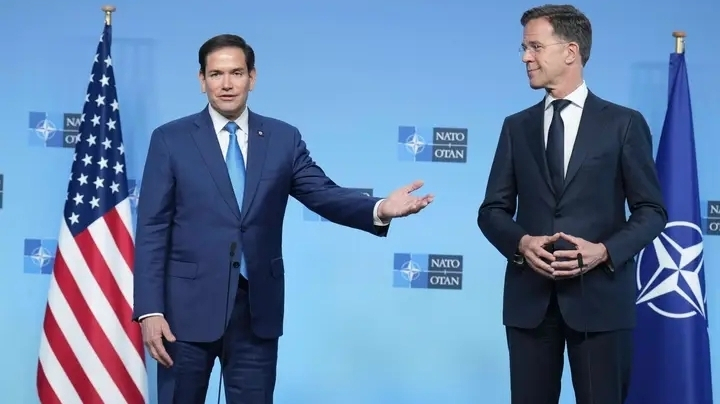
🚨 Rubio Just Said the Part That Usually Stays Behind Closed Doors
Marco Rubio did not merely criticize NATO burden-sharing. He threatened the logic of the entire alliance. When the U.S. asked European allies for access to bases and airspace for Iran war operations, key partners either denied or restricted it. That matters because these are not marginal outposts. These are bases America funds, mans, and treats as part of the architecture of Western security. Rubio’s message was simple: if Europe will not let the United States use that infrastructure when Washington decides it needs it, then Washington should reconsider why those troops are there at all.
This Is Not About Leaving NATO Tomorrow. It Is About Breaking the Political Assumption That NATO Is Automatic
Rubio knows he cannot just pull the United States out on his own. He helped shape the legal framework that makes unilateral withdrawal harder. But that is exactly why the statement matters. It was not an operational announcement. It was a political signal. The real message is that the alliance is no longer being framed in Washington as a permanent strategic inheritance. It is being reframed as a transactional arrangement that can be challenged, reduced, or repurposed if allies refuse support in a major conflict. Once that shift happens publicly, every capital in Europe has to start recalculating what American protection is actually worth and how conditional it may become.
The Real Break Is Not Iran. It Is What Europe Thinks This War Has Become
This is where the fracture gets deeper. Europe is not simply saying no to helping America. Europe is saying no to a type of war it does not want attached to its governments, its territory, or its legal exposure. Escorting shipping later is one thing. Mine-clearing after a ceasefire is one thing. Letting American assets launch strikes on bridges, power plants, and civilian-linked infrastructure is something else entirely. That is the dividing line. Europe will support maritime security after the flames go down. It does not want ownership of escalation while the fire is still spreading. So the alliance is splitting not over whether Iran is a problem, but over what methods are still considered legitimate.
That Creates A Dangerous Strategic Contradiction
The same countries whose economies depend on Gulf energy flows are delaying involvement until after the chokepoint is stabilized. In other words, they are preparing to secure the Strait after the disruption has already hit prices, supply chains, inflation, and political stability. Trump’s answer to that hesitation was basically: buy American oil and handle it yourselves. That is not alliance management. That is a warning that the U.S. may stop distinguishing between allies who disagree and allies who free-ride. Once Washington starts using access to protection as leverage in real time, NATO stops feeling like a unified bloc and starts looking like a collection of states with diverging risk tolerances.
And While NATO Debates Limits, Russia Is Exploiting The Gap
That is the darkest part of this. The alliance built to contain Russia is now hesitating in a war where Russia is reportedly helping the other side shape target priorities. NATO allies are drawing red lines around what America can launch from European soil, while Moscow is helping Iran and watching the Western coalition strain itself from within. That asymmetry is the real story. It shows how the next security order may not break because NATO is formally dissolved. It may break because the alliance keeps existing on paper while losing the ability to act together in the wars that actually matter.
This is bigger than headlines. Follow if you want to understand what comes next.