
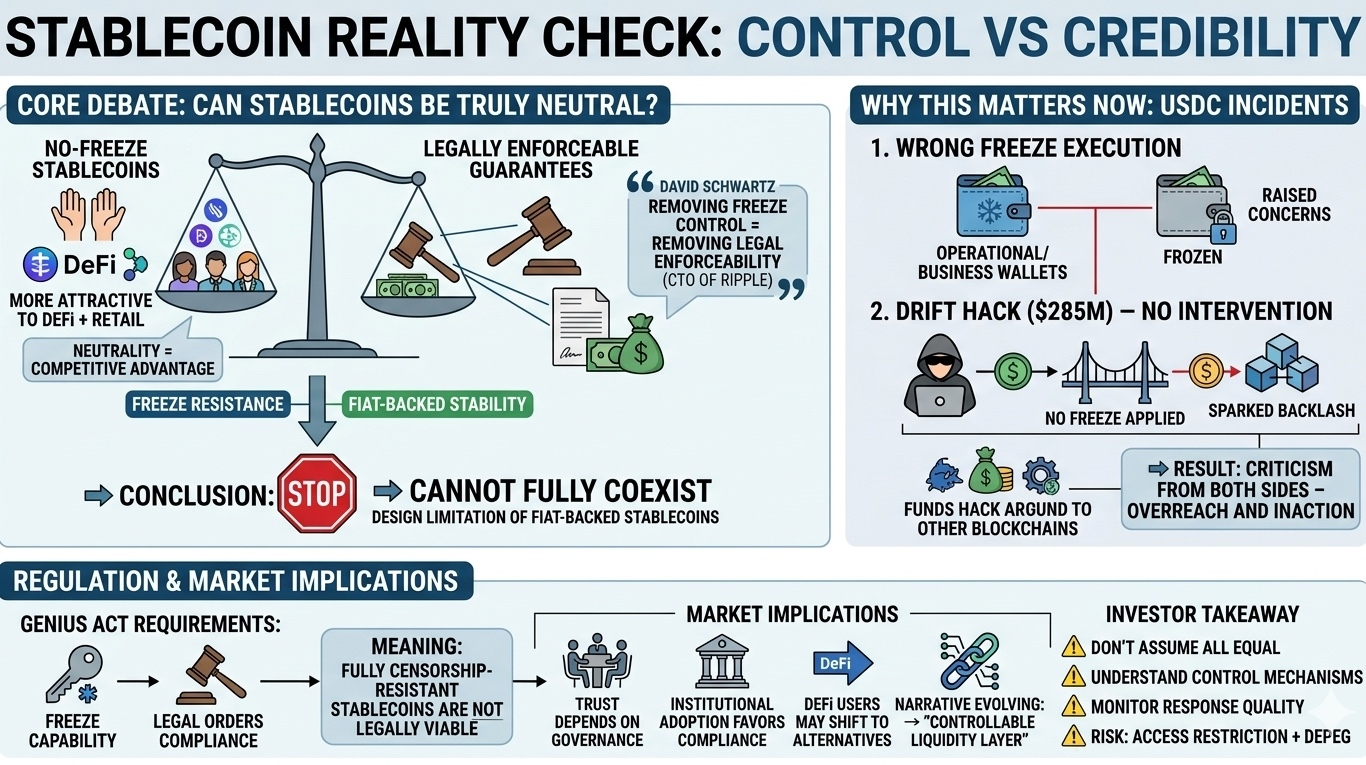
A major debate is unfolding after David Schwartz (CTO of Ripple) challenged the idea of “freeze-proof” stablecoins — right as Circle faces criticism from both sides of the spectrum.
◻ Core Debate: Can Stablecoins Be Truly Neutral?
The argument:
◻ No-freeze stablecoins = More attractive to DeFi + retail users
◻ Neutrality = Competitive advantage
But Schwartz highlights a fundamental contradiction:
◻ Stablecoins rely on legal redemption guarantees
◻ Courts can override those guarantees
◻ Removing freeze control = Removing legal enforceability
➡️ Conclusion:
“Freeze resistance” and “fiat-backed stability” cannot fully coexist
◻ Why This Matters Now (Real-World Events)
Two recent incidents involving USDC exposed system weaknesses:
1. Wrong Freeze Execution
◻ Multiple wallets frozen under court order
◻ Later criticized as operational/business wallets
◻ Raised concerns about accuracy + governance
2. Drift Hack ($285M) — No Intervention
◻ Funds moved via cross-chain infrastructure
◻ No freeze applied in real-time
◻ Sparked backlash for lack of response
➡️ Result:
Criticism from both sides — overreach AND inaction
◻ Regulation Has Already Set the Direction
The GENIUS Act requires:
◻ Issuers must have freeze capability
◻ Compliance with legal orders is mandatory
➡️ Meaning:
Fully censorship-resistant fiat stablecoins are not legally viable (for now)
◻ Market Implications
◻ Trust in stablecoins now depends on governance quality, not just backing
◻ Institutional adoption favors compliant issuers
◻ DeFi users may shift toward crypto-native alternatives
◻ Stablecoin narrative is evolving from “stable” → “controllable liquidity layer”
◻ Investor Takeaway
◻ Don’t assume all stablecoins are equal
◻ Understand issuer control mechanisms
◻ Monitor regulatory alignment + incident response quality
◻ Risk is no longer just depeg — it’s also access restriction
Conclusion:
This isn’t just a technical debate — it’s a design limitation of fiat-backed stablecoins.
The real battleground now is not whether funds can be frozen, but how responsibly and effectively that power is used.