
I remember the first time I actually felt what “social gaming on-chain” could mean. It wasn’t some polished demo or a whitepaper. It was messy. I was sitting late at night, trying out a Ronin-based game, half expecting another overhyped Web3 experience. But then something small happened, I noticed players weren’t just grinding, they were coordinating. Sharing resources. Timing actions. Acting like a real in-game society. That moment stuck with me.
That’s where PIXEL and Ronin start to make more sense not as buzzwords, but as infrastructure quietly shaping behavior.
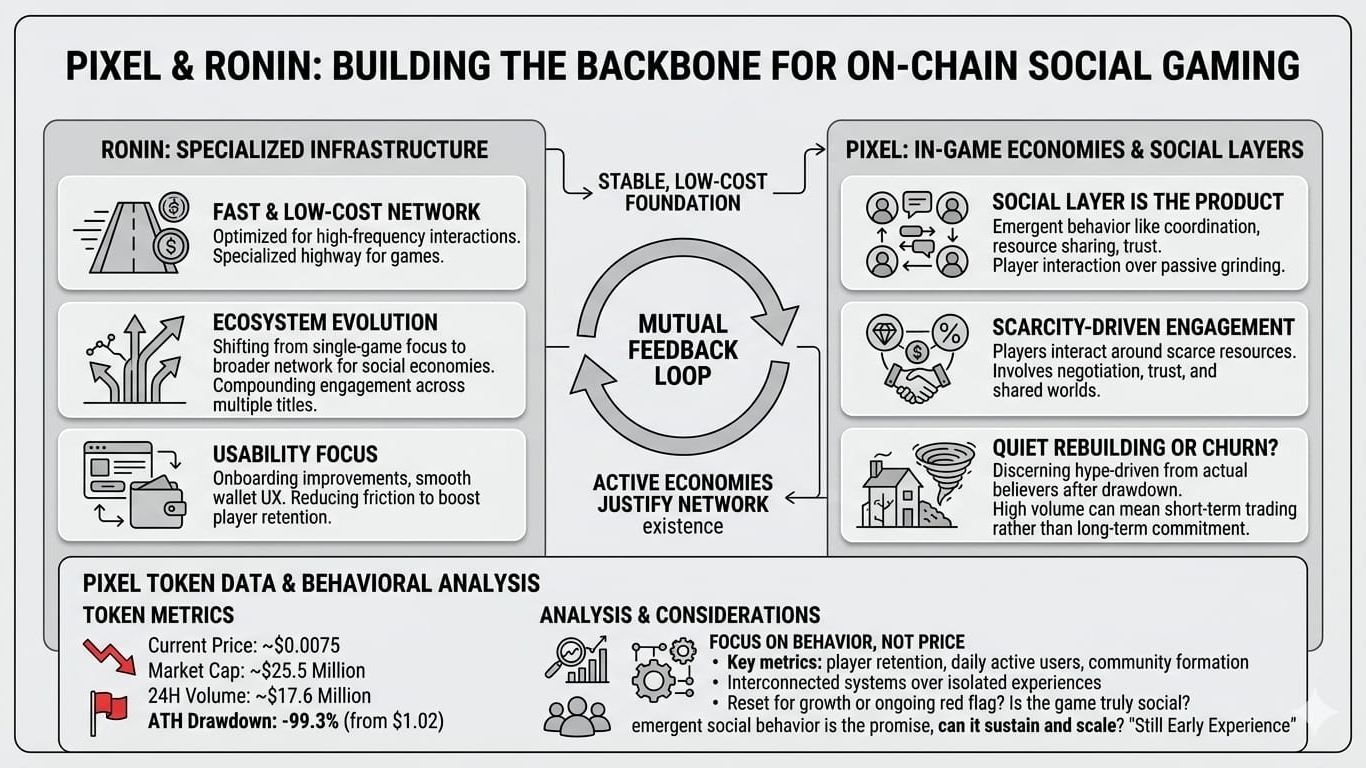
Ronin, originally built to support Axie Infinity, has evolved into something more like a specialized highway for games. It’s fast, relatively cheap, and optimized for high-frequency interactions exactly what games need. But what I’ve noticed recently is that Ronin is shifting from a single-game ecosystem into a broader network for social gaming economies. That’s a subtle but important transition. It’s no longer just about one hit title carrying the chain. It’s about enabling multiple smaller, socially-driven games to coexist and compound engagement.
PIXEL sits inside that narrative, but not without friction.
At the time of writing, PIXEL is trading at around $0.0075, with a market cap near $25.5 million and a 24-hour trading volume hovering around $17.6 million. Those numbers tell a very specific story. The token is down roughly 99.3% from its all-time high of $1.02, which immediately raises a red flag for anyone paying attention. I noticed this kind of drawdown tends to separate hype-driven participation from actual believers. When something falls that far, what remains is either abandonment—or quiet rebuilding.
And I’ve been trying to figure out which side PIXEL falls on.
The interesting part is how PIXEL aligns with Ronin’s infrastructure. Think of Ronin as a digital city’s road system, and PIXEL as one of the local economies trying to thrive inside it. If the roads are efficient but no one’s building meaningful businesses, the system stagnates. But if small economies start forming games with actual player retention, social loops, and resource exchange then suddenly the infrastructure matters.
I tested this idea myself. I spent a few days actively engaging in a PIXEL-integrated game environment, not just passively observing. What stood out wasn’t the token mechanics it was how players interacted around scarcity. There were moments where I needed a resource, and instead of grinding solo, I reached out in chat. Someone responded, but not for free. There was negotiation, timing, even a bit of trust involved. That’s when it clicked: the “social” layer isn’t a feature, it’s the product.
Still, I’m skeptical.
A low token price combined with relatively high daily volume suggests something else might be happening possibly short-term trading activity dominating over long-term holding. When volume stays high while price remains suppressed, I usually interpret that as churn. People are moving in and out quickly, not necessarily committing to the ecosystem. I’ve seen this pattern before, and it doesn’t always end well unless there’s a strong underlying reason for users to stay.
Ronin, on the other hand, has been making quieter but more consistent progress. Recent updates around onboarding improvements, wallet UX, and developer support suggest the team understands that the next phase isn’t about speculation it’s about usability. I noticed that setting up and interacting with Ronin-based apps has become noticeably smoother compared to a year ago. That matters more than most people think. Friction kills retention faster than bad tokenomics.
What’s interesting is how these two layers PIXEL as an economy and Ronin as infrastructure depend on each other in a non-obvious way. PIXEL needs a stable, low-cost environment to enable frequent interactions, while Ronin needs active economies to justify its existence. It’s a feedback loop, but not a guaranteed one. If one side weakens, the other feels it.
From an investment perspective, this is where things get tricky. I’ve learned the hard way that not every “good idea” translates into a good investment. The data here is mixed. On one hand, a $25.5 million market cap leaves room for upside if adoption genuinely increases. On the other hand, a 99% drawdown isn’t something you ignore it’s something you investigate deeply. Was it purely market conditions, or did user interest collapse?
If I were approaching this purely pragmatically, I’d focus less on price and more on behavior. Are players returning daily? Are they forming communities? Are in-game economies self-sustaining without constant external incentives? These are harder questions to answer, but they matter more than any chart.
I also think there’s a broader shift happening. Social games are moving away from isolated experiences toward interconnected systems where players, assets, and actions carry meaning across sessions and even across games. Ronin seems positioned to support that, but execution will be everything. PIXEL could either become a key piece of that puzzle or just another token that briefly rode the narrative.
One thing I did notice while testing everything is that the experience still feels early. Not broken, but not seamless either. And that’s probably the most honest signal. If this space were truly mature, the opportunity wouldn’t look like this.
So now I’m left thinking about that late-night moment again the one where players were coordinating, negotiating, actually behaving like participants in a shared world. That’s the promise here. Not token prices, not hype cycles, but emergent behavior.
The question is whether PIXEL and Ronin can sustain and scale that behavior before attention moves elsewhere.
Would you trust a gaming ecosystem where the token has already dropped 99%? Or do you see that as the kind of reset that sometimes precedes real growth? And more importantly when you play these games, do you feel like you’re part of something social, or just another user passing through?
