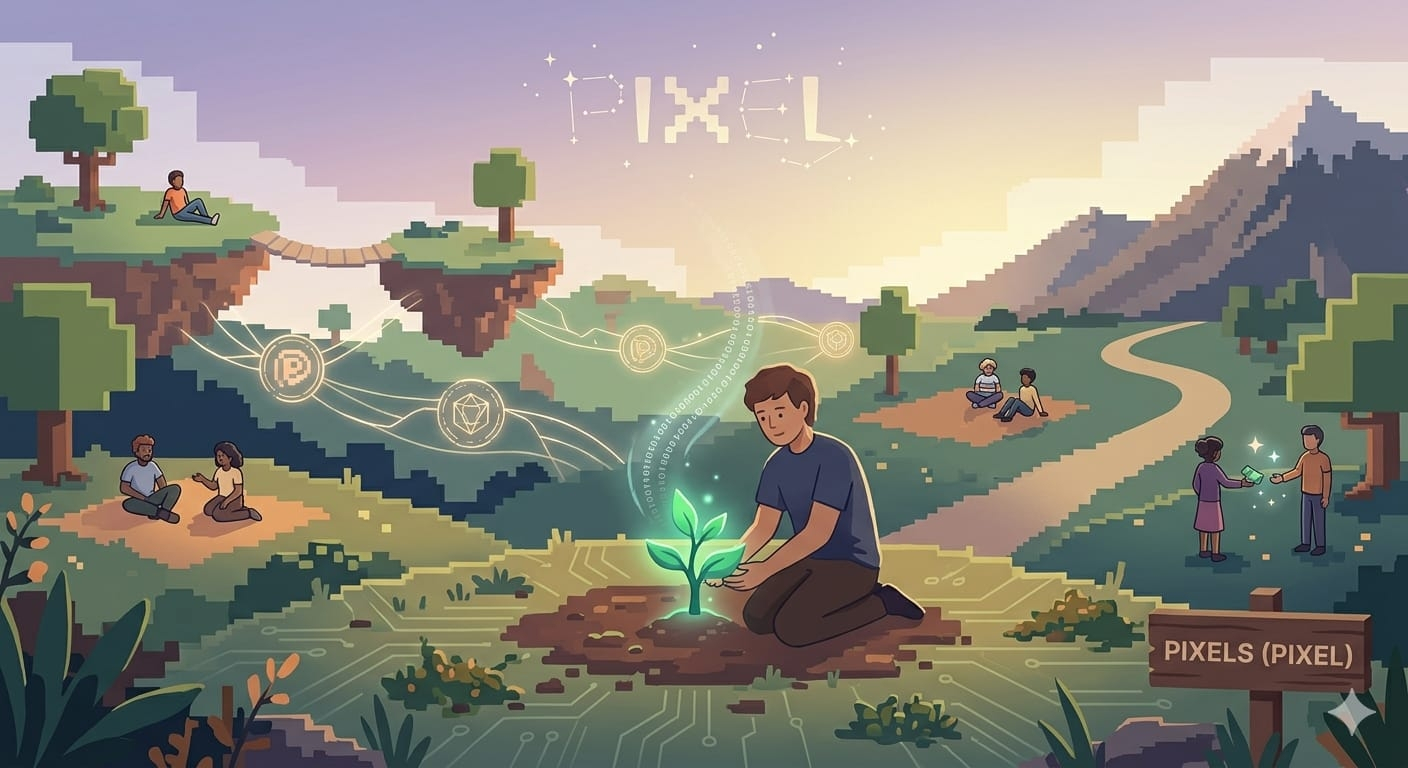
You don’t really jump into Pixels—it feels more like you drift into it.
At first, it’s just a small patch of land and a few basic actions. Nothing flashy. No loud introduction trying to convince you that this is the next big thing. And honestly, that’s what makes it stick. It doesn’t try to impress you right away. It just hands you space and lets you figure out what to do with it.
You plant something. Wait a bit. Come back. Maybe wander off in a direction you didn’t plan. That loop sounds simple when you say it out loud, almost too simple—but when you’re actually in it, time moves differently. You’re not chasing anything urgent. You’re just… there, adjusting things as you go.
The world itself doesn’t feel like it’s performing for you either. It’s not screaming for attention with constant events or distractions. Instead, it unfolds in a quieter way. You notice little things by accident—a corner you hadn’t seen before, someone passing by doing their own thing, a small change in your land that you didn’t think would matter but somehow does. It builds slowly, almost without asking for your focus.
And then there’s that strange in-between feeling with other players. You see them, you cross paths, maybe interact—or maybe not. There’s no pressure to engage, but there’s also this subtle awareness that you’re part of something shared. It’s not loud or competitive. More like a background presence that makes the world feel alive without overwhelming it.
The Web3 part is there, sure. You know it’s there. But it doesn’t constantly wave itself in your face. It’s more like something humming underneath everything. If you want to lean into it—trading, optimizing, thinking strategically—you can. If you don’t, the game doesn’t punish you for it. That choice, that freedom to decide how deep you go, makes a bigger difference than it seems at first.
What’s interesting is how different people seem to approach it. Some treat it like a quiet routine, almost like checking in on something they’ve grown attached to. Others dig into the systems, trying to figure out the best way forward. Neither feels wrong. The game doesn’t push you into one path or the other.
There’s also no sense of being rushed toward some grand end. No looming finish line constantly reminding you that you’re behind. Progress feels… personal. A little uneven at times, maybe even messy—but in a way that feels real. Like you’re shaping something slowly instead of completing a checklist.
And maybe that’s why it lingers.
Not because it overwhelms you or demands your attention, but because it leaves space. Space to think, to pause, to come back later and pick up where you left off without feeling lost. It doesn’t try to be everything at once. It just stays consistent in what it is.
Pixels isn’t loud. It doesn’t need to be. It settles in quietly, and before you really notice it, you find yourself returning—not out of habit exactly, but because there’s something unfinished in a way that feels personal.
And that’s a different kind of pull