
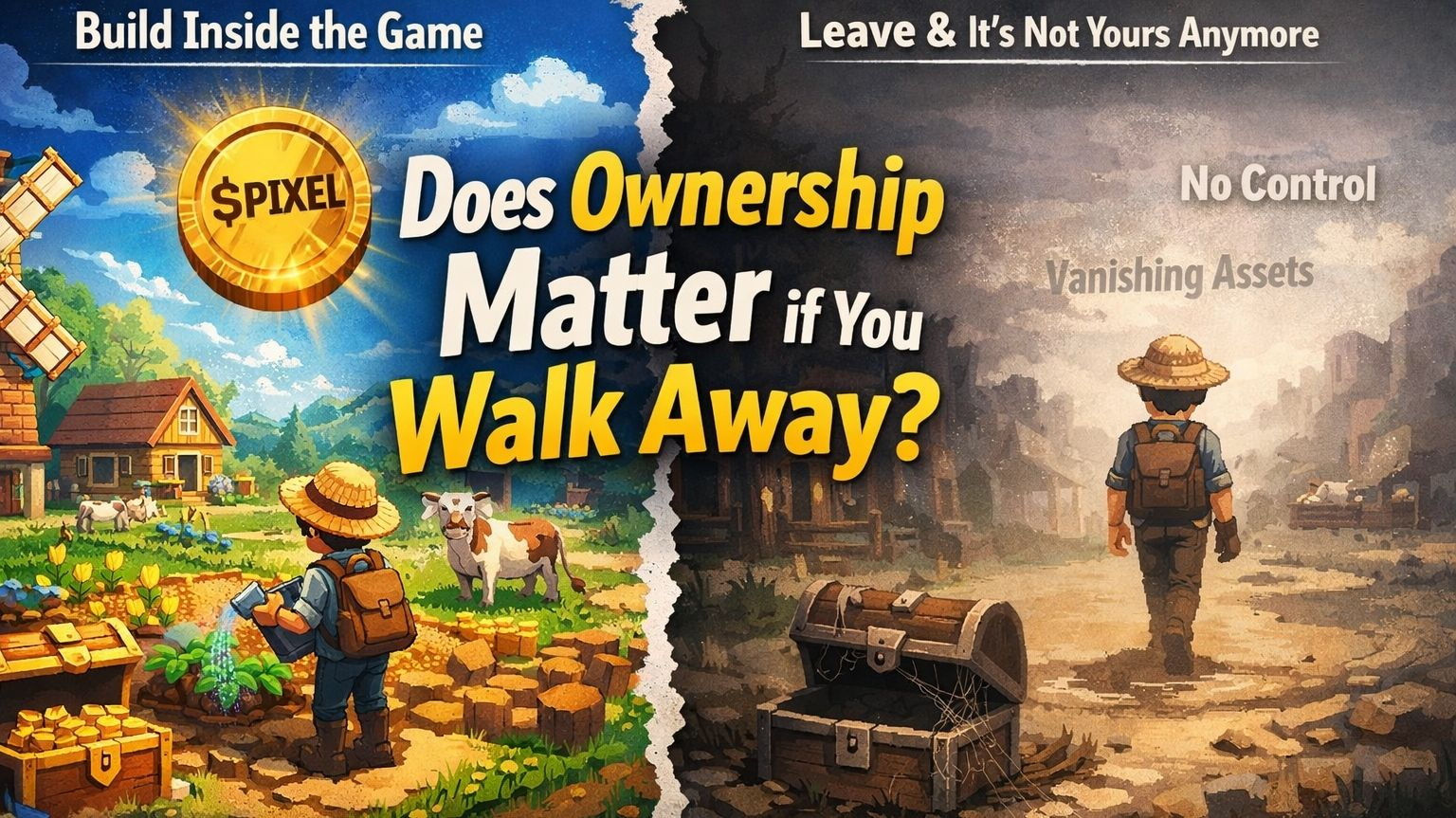
It’s easy to assume that digital worlds are expanding, but a closer look suggests something else—they are repeating themselves. New platforms appear, new mechanics are introduced, yet the underlying structure often stays the same: users arrive, contribute, and eventually leave without carrying much of that experience forward.
This repetition is not accidental. For a long time, digital ecosystems have been designed with controlled lifecycles. Progress is meaningful only within a closed loop, and once that loop breaks, so does the sense of value. Even with the arrival of blockchain-based systems, which aimed to extend ownership beyond these limits, the results have been mixed. The technology changed the format of assets, but not always their significance.
What remained unresolved was a deeper issue: continuity. Not just whether something can be owned, but whether it continues to matter over time.
In this context, @Pixels introduces an approach that feels less like a disruption and more like a quiet adjustment. Instead of focusing on the idea of breaking boundaries, it leans into building a contained but persistent environment where activity accumulates gradually. The emphasis is not on rapid change, but on slow construction—of land, of routines, and of relationships between participants.
The role of $PIXEL within this structure reflects that mindset. It does not immediately present itself as the defining feature, but rather as a supporting element that connects different layers of interaction. This design choice suggests an attempt to avoid the imbalance seen in earlier systems, where tokens overshadowed the experience itself.
However, this raises an important tension. When a system avoids emphasizing its economic layer, it may become more approachable, but it can also become less transparent. Users might engage without fully understanding what gives their activity lasting weight. In such cases, the sense of ownership may exist, but remain abstract rather than tangible.
There is also the question of pace. A slower, more deliberate environment can encourage deeper engagement, but it may struggle to maintain attention in a space where users are constantly exposed to faster, more dynamic alternatives. This creates a challenge: can stability compete with stimulation, or does it risk being overlooked?
Another point worth examining is how value is distributed over time. Systems that reward early participation often create long-term imbalances, even if unintentionally. If progression is tied to consistency, those who arrive later may find it difficult to reach the same level of influence or presence. While this is common across many platforms, it becomes more noticeable in environments that emphasize persistence.
At the same time, accessibility remains a double-edged factor. By reducing complexity, @Pixels opens the door to a wider audience, including those unfamiliar with blockchain systems. Yet this simplicity may limit how much control users actually exercise over the underlying structure. The experience becomes easier to enter, but not necessarily easier to question.
Looking at the broader picture, the project seems to explore a different idea of digital space—not as something to conquer or optimize, but as something to inhabit. This shift may appear subtle, but it changes how participation is perceived. Instead of chasing outcomes, users are encouraged to maintain presence. Whether this approach can sustain long-term interest is still uncertain.
There is also an implicit assumption that users want continuity—that they value the idea of building something that persists. But this may not apply universally. Some users prefer experiences that are temporary, self-contained, and free from long-term commitment. For them, persistence may feel less like an advantage and more like a responsibility.
What ultimately brings into focus is not a solution, but a different interpretation of the problem. It suggests that the future of digital ownership might depend less on technology itself and more on how people choose to engage with time, effort, and shared environments.
And that leads to a more complicated question—if a digital world is designed to persist, but its meaning depends entirely on those who participate in it, is ownership really something you hold, or is it something that only exists as long as you remain involved?