
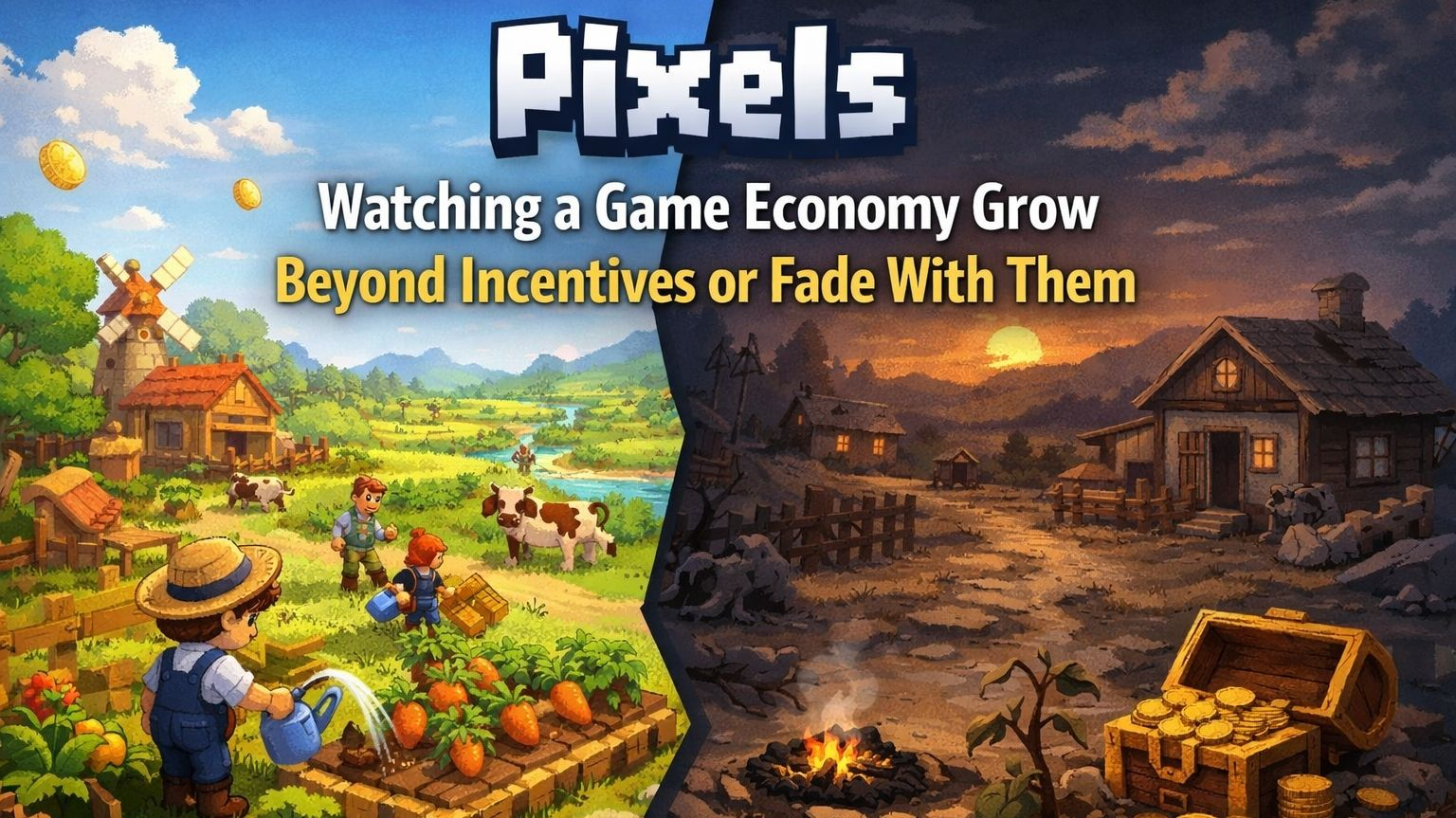
I’m watching Pixels more closely now, not because of the hype around it, but because I’m trying to understand what’s actually happening inside it. I’m waiting to see if this is just another short cycle of attention or something that can hold up over time. I’ve noticed that with Pixels, it’s easy to get pulled into the surface activity, but I’ve learned to slow down and look deeper. I focus on what people are really doing in the game. I stopped looking at narratives and I started paying attention to real usage. I remember when I thought differently, when I believed that if a project looked active, it automatically meant it was strong.
Pixels being built on Ronin Network gives it a certain advantage. The infrastructure is already tested, especially after what we saw with Axie Infinity. But that history also makes me cautious. We’ve seen how fast things can grow in these ecosystems, and how quickly they can slow down when the reward structure changes. So I’m not just looking at Pixels as a game, I’m looking at it as part of a bigger pattern.
When I spend time thinking about Pixels, I try to simplify it in my head. It’s a farming and social game at its core, but wrapped in an economy. People log in, plant crops, gather resources, interact, and earn. On paper, it sounds straightforward. But the real question for me is why they’re doing it. Are they playing because they enjoy the experience, or because there’s something to gain from it financially? That one question keeps coming back to me because it defines everything else.
I can see there is real activity. Players are moving around, assets are being used, and the in-game economy is alive. But I’ve learned that activity doesn’t always mean sustainability. I start wondering who these players are. Are they long-term users who actually like the game, or are they people passing through, looking for an opportunity? In many Web3 systems, especially in regions where income opportunities are limited, people join because it makes economic sense, not because they feel connected to the product. That creates growth, but it doesn’t always create stability.
Then I look at the token, PIXEL, because that’s where behavior becomes visible. I ask myself how it’s being used. Are players spending it inside the game, reinvesting into their progress, or are they mostly selling it as soon as they earn it? If most of it is being sold, then the system depends heavily on new buyers coming in. That’s not a comfortable position for any project to be in long term.
Liquidity is something I keep in the back of my mind as well. If there isn’t enough of it, small changes can create big price swings, and that affects confidence. If there is liquidity but it’s driven by speculation, it can disappear quickly. I’ve seen both situations before, and neither one feels stable unless there’s real demand behind it.
What I’m really trying to understand is whether Pixels can build something deeper than just an earning loop. Does it create a sense of identity for players? Do people feel like they belong in that world, or are they just interacting with it because it’s profitable for now? Because when identity is missing, everything becomes temporary. People come, participate, and leave without forming any real connection.
There’s also the question of how players interact with each other. Pixels is designed in a way that suggests cooperation and shared activity, but real coordination doesn’t come from features alone. It comes from people choosing to stay and engage over time. I’m still watching to see if those relationships are forming or if everything is still mostly individual and transactional.
On the development side, I’m paying attention quietly. Is the team focused on making the game better for players, or are they mostly trying to keep the economy active? The difference is important. A strong product keeps people because it’s enjoyable. A weak product relies on incentives to hold attention. And incentives can only do so much.
Trust is another layer that I think about a lot. For something like Pixels to work long term, players need to feel that the system is fair and predictable. If rewards change too quickly, or if the balance shifts in favor of a small group, that trust can disappear. And once it’s gone, it’s very hard to bring back.
I also can’t ignore the outside world. Crypto is slowly becoming more visible to regulators, especially systems that involve earning and trading. If Pixels continues to grow, it won’t exist in isolation. Policies, regulations, and even regional economic conditions could start influencing how people interact with it.
And then there’s the bigger question of money flow. Right now, part of the growth likely comes from new capital entering the system. But what happens later? Can Pixels sustain itself through internal activity, or will it always need new participants to keep things moving? That’s something I don’t have a clear answer to yet.
I keep coming back to one simple thought. If the rewards were reduced tomorrow, would people still show up? Would they still farm, trade, and interact? Or would the world feel empty overnight?
Pixels has something going for it. It’s simple, approachable, and easy to get into. That gives it a real chance. But at the same time, that simplicity means there’s nothing to hide behind. The core experience has to be strong enough on its own.
So I’m not rushing. I’m just watching Pixels carefully, trying to understand what’s real and what’s temporary. Because in this space, things can look very convincing in the beginning. What matters is what’s still there when the easy rewards are gone.