
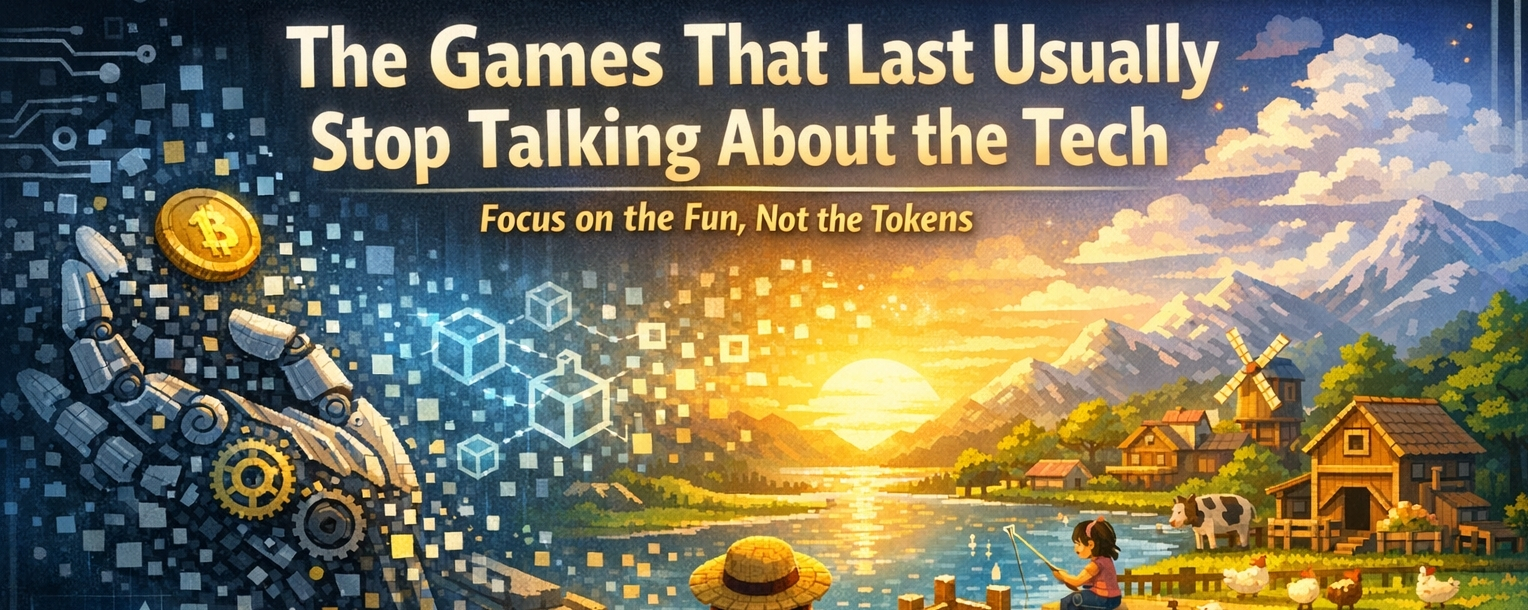
There is a certain kind of Web3 game that tells on itself almost immediately.
You can usually feel it in the first few minutes. Too much attention is being pushed toward the token. Too much meaning is being assigned to ownership before the player has even found a reason to care. The whole thing arrives with its logic exposed, like a machine that wants to be admired for having gears. And maybe that was enough for an earlier phase of crypto gaming, when novelty could do some of the work. It does not feel like enough now.
That is part of why Pixels stands out.
Not because it has solved everything. Not because it represents some clean victory for blockchain gaming. But because it seems to understand a point that a lot of projects either missed or learned too late: most players do not wake up hoping to interact with infrastructure. They want something that feels alive, readable, and easy to stay inside. If the technology helps, good. If it interrupts, they leave.
For years, Web3 games were built with a kind of upside-down confidence. Teams assumed that if players were given tradable assets, visible ownership, and enough financial motion, engagement would take care of itself. What actually happened was less flattering. A lot of players were not forming loyalty. They were responding to temporary advantage. The systems looked active, but the activity was often conditional. Once the upside thinned out, so did the audience.
That distinction matters more than people like to admit. Retention and extraction can look similar for a while. So can community and speculation. A project can misread its own numbers for months if it wants to. Crypto has done that often.
Pixels, at least from the outside, looks a little less confused about the difference.
The appeal is not only that it runs smoothly or that the underlying chain can handle gaming volume without turning every action into a minor financial decision. That part matters, obviously. Friction has killed more curiosity in this space than most teams ever wanted to admit. But low fees and fast transactions are not, by themselves, a reason for people to stay. They simply remove excuses to leave early.
What becomes more interesting is what happens after that.
If a player enters easily, plays without being constantly reminded that they are standing on blockchain rails, and begins to discover value through use rather than explanation, the whole relationship changes. Ownership starts to feel less like a pitch and more like a background condition. The game gets the chance to be a game first. Strange that this still feels notable in Web3, but it does.
That said, smoother onboarding is the easy part of the argument. The harder part is the economy. It usually is.
This is where most projects become painfully predictable. They say they are building sustainability, but what they often mean is a more complicated reward structure. They say they understand player behavior, but what they often mean is they have found new ways to direct it. And sometimes that works for a while. But once a system becomes too obviously optimized around keeping people circulating, the player can feel the intention underneath it. At that point, even smart design starts to feel needy.
Pixels seems to be pushing toward something more adaptive than the old play-to-earn formula. That is promising. It suggests a system that tries to notice differences in how people play, what they respond to, and what actually keeps them involved. In theory, that is healthier than flattening everyone into the same reward loop. A farming-heavy player, a trader, a social player, a collector — these are not the same person, and games usually get stronger when they stop pretending they are.
Still, there is a quiet risk inside that kind of sophistication.
A system can become so responsive that it stops feeling playful and starts feeling managerial. The player may not say it that way, but they notice. They notice when every reward has been tuned too carefully. They notice when the game seems to be studying them a little too hard. They notice when what looks like freedom is actually a very polished form of steering. This is one of those problems that does not arrive loudly. It arrives as a subtle thinning of magic.
That is the tension I keep coming back to with Pixels.
Not whether the model is smarter than older Web3 games. It probably is. Not whether the infrastructure is better aligned with actual gaming needs. It clearly is. The more interesting question is whether all this intelligence remains in service of the experience, or whether the experience eventually begins to serve the intelligence.
Because that line matters.
A good game can have a strong economy inside it. A game built around its economy usually feels different. More efficient, maybe. More measurable, definitely. But often a little less human. And once players start sensing optimization where they wanted atmosphere, the relationship changes. They may still play. They may still spend. But something softer and harder to rebuild begins to disappear.
That is why Pixels is worth watching with a little more care than hype usually allows. It may be part of a real shift in Web3 gaming, one where the technology finally stops demanding the spotlight and starts acting like infrastructure should. Quiet. Useful. Out of the way. But the deeper test is not whether blockchain can become invisible. It is whether design can become intelligent without becoming overbearing.
That is not a technical challenge. It is a creative one.
And the projects that survive this next phase probably will not be the ones that make crypto louder, faster, or more legible. They will be the ones that learn how to let the player forget about it long enough to care about something else.