
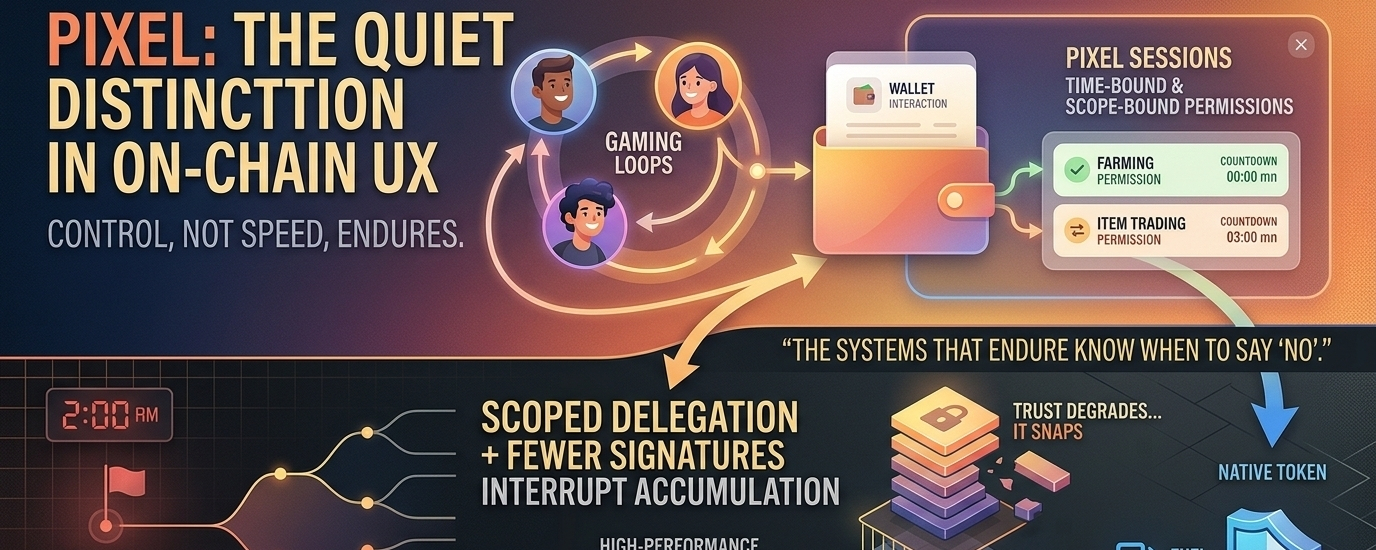
i remember the first alert because it wasn’t loud. no cascade, no meltdown, no obvious breach. just a quiet flag at 2 a.m.—a wallet approval that didn’t match the expected scope. nothing broke. nothing drained. but something had drifted. and in systems like these, drift is the precondition to failure.
PIXEL doesn’t present itself as a system under tension. it looks like a game—farming loops, soft economies, idle interactions stretched across an open world. but underneath that surface sits a structure that has clearly been argued over in risk committees, audited in layers, and questioned in those long internal threads where nobody trusts convenience unless it survives scrutiny. the conversations aren’t about speed. they’re about exposure.
there’s a persistent industry instinct to measure safety in throughput. transactions per second becomes a proxy for competence, as if faster confirmation somehow neutralizes bad assumptions. but the incidents never start there. they start at the edge—permissions granted too broadly, keys reused too casually, signatures requested too often until users stop reading them. failure isn’t a function of slow blocks. it’s a function of who is allowed to act, and for how long.
PIXEL approaches this differently. it behaves like a high-performance L1, but not one that confuses velocity with control. its execution environment is modular, sitting above a more conservative settlement layer that does not rush to accommodate every demand. this separation matters. it creates space for systems to be fast where they can be, and strict where they must be. not every action deserves immediacy. some deserve friction.
the design choice that stands out most, though, is PIXEL Sessions. they are not a feature layered on top; they are a constraint system disguised as convenience. instead of persistent, open-ended approvals, sessions enforce delegation that is both time-bound and scope-bound. permissions expire. actions are limited. the system assumes that trust, once granted, should decay automatically.
this is where the tone of the system changes. what looks like user experience optimization is actually risk containment. fewer signatures reduce fatigue, but they also reduce surface area. less repetition means fewer chances to approve the wrong thing. the structure nudges behavior without asking for vigilance every second. it accepts that users will not always be careful—and designs around that reality.
“Scoped delegation + fewer signatures is the next wave of on-chain UX.”
that line reads like a product insight, but it behaves like a security principle. it acknowledges that most failures are not exploits in the dramatic sense. they are accumulations of small permissions, stacked quietly until one of them is misused. PIXEL Sessions interrupt that accumulation. they make authority temporary again.
there’s an underlying discipline to how execution is handled. modularity allows the system to move quickly where it’s safe, but the settlement layer remains deliberately conservative, acting as a backstop rather than a bottleneck. this is not about rejecting performance; it’s about assigning it to the right layer. EVM compatibility exists, but mostly as a concession to tooling—to reduce friction for developers who already understand that ecosystem. it is not the core argument of the system.
the native token appears in this structure not as spectacle but as function—security fuel that underwrites the system’s operation. staking, in this context, reads less like yield and more like accountability. it ties participation to responsibility, which is a quieter but more durable alignment.
none of this eliminates risk. bridges still exist, and with them, the familiar tension between access and assurance. assets move across boundaries that cannot be perfectly sealed. every additional connection introduces a new dependency, a new assumption that must hold. and assumptions, historically, are where systems fracture.
“Trust doesn’t degrade politely—it snaps.”
that line isn’t theoretical. it’s what those 2 a.m. alerts are trying to prevent. not the visible failure, but the invisible buildup that precedes it. the unnoticed approval. the overextended permission. the key that was never meant to last that long.
PIXEL, for all its surface simplicity, reads like a response to those patterns. it does not attempt to eliminate human error; it constrains its impact. it does not assume users will always act correctly; it limits what incorrect actions can do. speed exists, but it is not the centerpiece. control is.
and in the end, that’s the quiet distinction. a fast ledger can process anything, including mistakes. a resilient one knows when not to. the systems that endure are not the ones that say “yes” the quickest, but the ones that can say “no” at the right moment—and mean it.
