
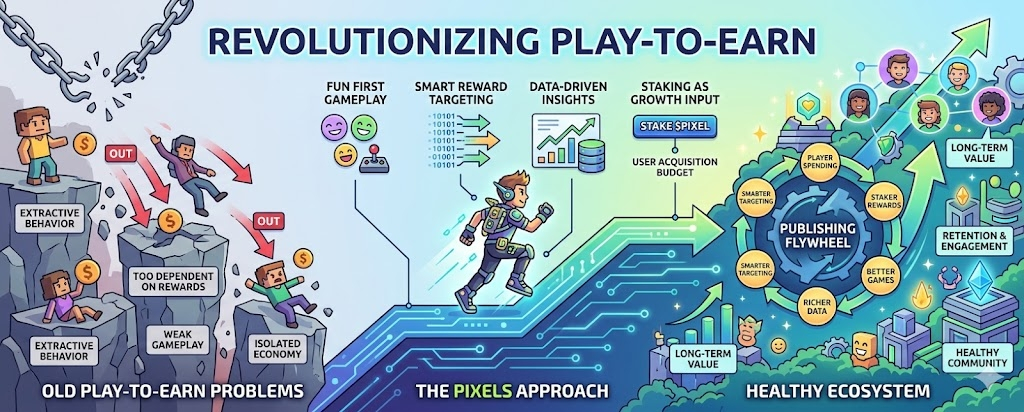
When I think about play-to-earn, I always come back to the same problem: the idea sounded powerful, but in practice, most projects could not hold up for long. At first, the model felt exciting because it promised to reward players for the time and effort they put into a game. But after the early hype faded, the weaknesses became much more obvious. A lot of projects became too focused on extraction, too dependent on rewards, and too weak on actual gameplay. That is why Pixels stands out to me. It is not just trying to repeat the same playbook with a better design or a new token cycle. From the way the project explains itself, it is trying to solve the deeper problems that made traditional play-to-earn unsustainable in the first place. For me, that is what makes Pixels worth discussing. The real question is not whether it can attract attention for a few weeks, but whether it can build a system where players, games, and rewards are aligned in a healthier way over time.
One of the biggest problems in old play-to-earn models was that rewards became the main reason people showed up. That may sound fine at first, but it creates a very fragile economy. If players are only there to earn, they usually leave the moment earning becomes less attractive. The game stops feeling like a game and starts feeling like a temporary income machine. Pixels seems to understand that clearly, which is why its first major pillar is Fun First. I think this is one of the smartest starting points the team could take. The whitepaper makes it clear that no matter how a platform wants to grow or monetize, there has to be an intrinsic reason for users to spend time there. In gaming, that reason is enjoyment. The design team is focused on building a game people genuinely want to play, not just a reward system people want to farm. To me, this is the first real step toward fixing play-to-earn. If the game itself does not work, then the token model will always be under pressure. But if the game is enjoyable, then rewards can support the experience instead of replacing it.
Another major weakness in traditional play-to-earn was poor incentive alignment. In many older models, the system rewarded activity without asking whether that activity actually created long-term value. As a result, the ecosystem often became crowded with extractive behavior. Players learned how to optimize rewards, but that did not always mean they were helping the game grow, stay healthy, or keep a strong community. Pixels is trying to approach this differently through Smart Reward Targeting. Instead of treating all player actions the same, the project says it uses a data-driven infrastructure to identify the behaviors that actually matter. That means rewards are supposed to go toward actions that support retention, better engagement, and stronger ecosystem value over time. I think this is a very important shift. It shows that Pixels is not just asking how to distribute tokens, but how to distribute them intelligently. In simple words, the goal is to reward the right behavior, not just the loudest or fastest behavior. That may sound like a technical change, but in reality, it changes the whole economic logic of the system.
The data side of this model is also what makes Pixels feel more serious to me than a lot of older GameFi structures. The project explains that purchases, quests, trades, and withdrawals are logged through its events system, which creates a growing first-party dataset across games. That data can then be used to study things like LTV curves, fraud scores, session depth, and churn vectors. I think this matters because one of the biggest reasons many play-to-earn systems failed was that they could not separate real value from temporary activity. Everything looked good while rewards were flowing, but the system was not actually learning enough about what kept players around. Pixels is trying to change that by turning player behavior into insight, and then turning that insight into smarter decisions. For me, that is one of the strongest parts of the model. Data here is not just something to display in a dashboard. It becomes part of the economic loop itself. It helps the ecosystem understand which players are contributing meaningfully and which incentives are working well enough to deserve continued support.
Another problem with older play-to-earn systems was that they often felt isolated and repetitive. A project would launch, distribute rewards, push growth for a while, and then slowly run out of momentum because it did not have a deeper engine behind it. Pixels is trying to fix that through what it describes as a Publishing Flywheel. This is one of the most interesting ideas in the whole model for me. The flywheel connects staking, user acquisition, player spending, revenue share, staker rewards, richer data, smarter targeting, and more games. In other words, the project is trying to build a loop where value is not used once and lost, but recycled through the system again and again. Better games generate richer player data. Richer data leads to smarter targeting. Smarter targeting lowers user acquisition costs. Lower user acquisition costs make the ecosystem more attractive for more high-quality games. That, in turn, brings in more players and more activity, which restarts the cycle at a stronger base. I like this because it moves the conversation away from one-off token rewards and toward a compounding growth model. Traditional play-to-earn often felt like a treadmill. Pixels wants its system to work more like a flywheel.
I also think Pixels is trying to solve another big issue that hurt many earlier projects: the disconnect between capital and actual ecosystem growth. In a lot of Web3 games, staking existed, rewards existed, and gameplay existed, but these pieces were not always tied together in a productive way. Pixels tries to connect them more directly. In its system, staking $PIXEL or $vPIXEL can convert into an on-chain user acquisition budget that games use for targeted in-game rewards instead of outside advertising. That is a very different use of staking from what we usually see. Here, staked value is not just parked for passive return. It becomes a live input into growth. Then when new or returning players spend inside the game, the revenue is recorded on-chain in the same loop that created the acquisition budget. For me, this is a much stronger economic design than simply paying people and hoping they stay. It creates a visible relationship between subsidy, player behavior, and ecosystem output. That kind of transparency and circular design could help fix the value leakage that damaged so many earlier play-to-earn economies.
At the end of the day, I do not think Pixels has solved play-to-earn just by saying the right things on paper. That would be too easy. But I do think it is trying to fix the biggest problems in a much smarter way than many projects before it. It is starting with fun instead of pure extraction. It is using data to improve reward targeting instead of throwing incentives everywhere. It is building a flywheel where staking, growth, spending, and insight all connect instead of working in isolation. And most importantly, it seems to understand that long-term value in gaming cannot come from rewards alone. For me, that is the biggest lesson. A real play-to-earn model has to make players want to stay even when rewards are not the only reason to log in. That is the challenge Pixels is trying to answer. Whether it succeeds will depend on execution, but the direction itself already feels more mature, more realistic, and much closer to what Web3 gaming actually needs.
