
Pixels makes sense the moment you stop staring at it like a token and start watching how people actually move through it.
That’s the trick.
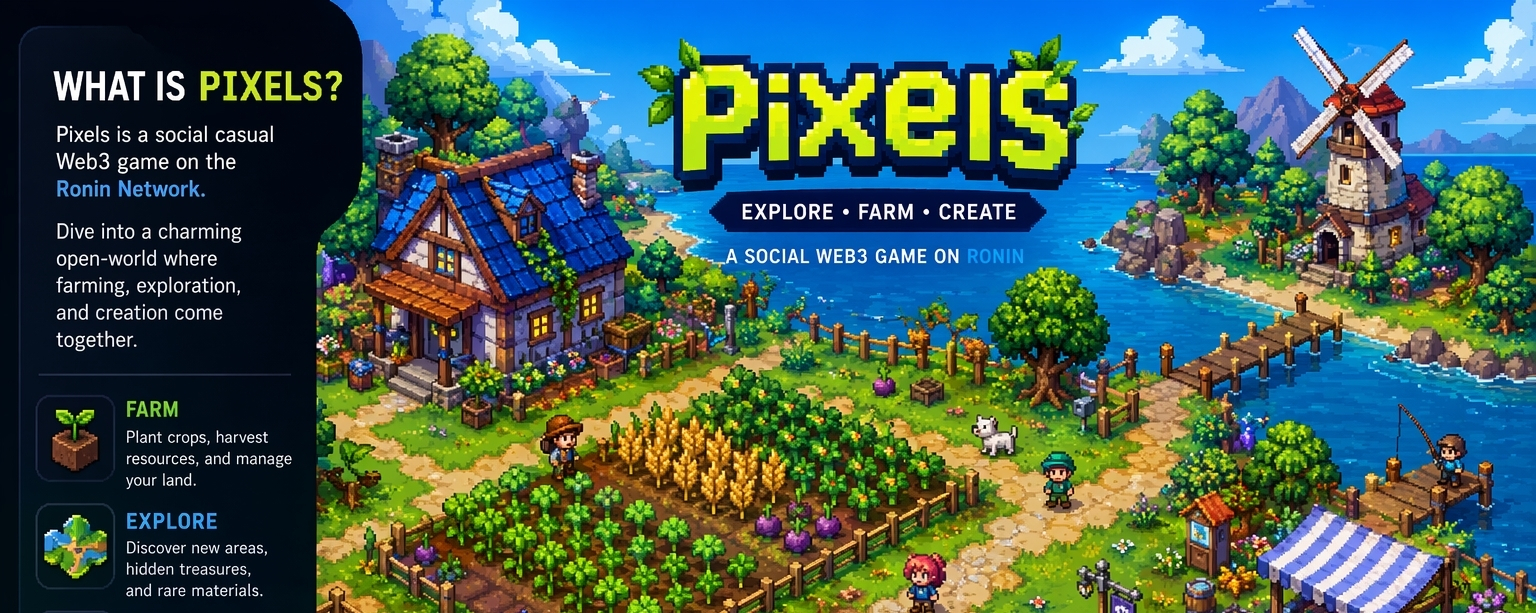
From a distance, it looks almost too gentle to matter. A pixel world. Farming plots. Resource runs. Crafting. Wandering. A social layer that doesn’t shove itself in your face. Nothing about it screams for attention, and that restraint is part of the project’s intelligence. Pixels doesn’t open by trying to impress you with scale or complexity. It lets you get your hands dirty first. Plant something. Gather something. Walk the map. Learn the rhythm. Before long, you’re not “testing a game” anymore. You’re checking on a place.
That shift is where the project earns its keep.
Because Pixels isn’t built around spectacle. It’s built around returning. That sounds simple, maybe even obvious, until you remember how many projects never figure it out. They can create a spike. They can manufacture noise. They can get people through the door. But creating a reason to come back when the fireworks are gone? That’s harder. Much harder. Pixels understands that better than most. Its core loop is made of small actions that wouldn’t look dramatic in a trailer and feel oddly satisfying when they pile up over time. Crops to tend. Materials to gather. Spaces to manage. Quests to clear. Progress that moves in inches instead of giant cinematic leaps.
And honestly, that’s why it works.
There’s a very human instinct buried in the design. People don’t always stay because something is thrilling. Sometimes they stay because it starts to feel familiar. Because they want to see whether the thing they were building yesterday looks a little better today. Pixels leans into that instinct instead of fighting it. It doesn’t treat slow progress like a weakness. It treats it like glue.
That choice gives the whole project a different texture.
The farming side, for example, isn’t there just because farming games are easy to understand. In Pixels, farming does more than decorate the world or give players busywork. It sets the tempo. It teaches patience without turning patience into boredom. You plant, wait, prepare, return, adjust. Those steps sound almost laughably modest on paper. But stack them over days and weeks and they create a rhythm that starts to feel personal. Ignore that kind of design and you end up with a game where every action feels disposable. Nothing lingers. Nothing sticks. Pixels avoids that by making routine feel earned rather than imposed.
That’s a very fine line, by the way. Plenty of projects try to build habit and accidentally build chores instead. Pixels usually stays on the right side of that line because the world around the loop has some life in it.
And that world matters.
A farming system on its own can turn stale fast if everything around it feels like painted cardboard. Pixels gets around that by giving the environment a purpose beyond scenery. Exploration isn’t some extra feature bolted on the side to make the page look fuller. It changes the feel of progression. The world opens up through movement, discovery, resource hunting, and the small frictions of figuring out where things are and what matters. That’s the difference between a map you use and a world you inhabit. One is functional. The other has a pulse.
Pixels isn’t huge in the way some games brag about being huge, but it understands something those games often forget: space only feels meaningful when it changes your decisions. If the world doesn’t alter how you gather, plan, travel, or prioritize, then it’s just decorative distance. Pixels does a better job than people give it credit for on that front. Its open structure supports the everyday loop instead of distracting from it.
Creation works the same way. Quietly. No drumroll.
A lot of games love talking about creativity when what they really mean is inventory management with better branding. Pixels feels more grounded than that. The crafting, building, and upgrading don’t come across as abstract systems floating above the experience. They’re folded into daily play. You gather because you need something. You build because it affects what you can do next. You improve your setup because staying still has a cost. It’s not theatrical creativity. It’s practical creativity. The kind that makes players feel like their effort is leaving fingerprints on the world.
That’s a more durable feeling than novelty, and it ages better.
Then there’s the social layer, which is easy to underestimate if you’re only looking at mechanics.
Games like this live or die on atmosphere. Not just systems. Atmosphere. The sense that other people exist in the world in a way that softens the edges of repetition. Pixels understands that a shared space doesn’t need to be chaotic to feel alive. It just needs presence. Familiar names. Movement. Interaction that feels optional but available. The project doesn’t try to bludgeon players into constant cooperation or nonstop competition. That would break the tone. Instead, it lets the social fabric sit in the background where it can do its real job: making the world feel inhabited.
That might sound subtle. It isn’t. Get that wrong and the consequences show up fast. Too little social energy, and the game starts feeling abandoned no matter how polished the mechanics are. Too much pressure, and the relaxed charm curdles into obligation. Pixels generally keeps a light hand here, which is one of the reasons the world still feels breathable.
And that brings us to the part people always rush toward: ownership, value, the whole Web3 angle.
Yes, it’s there. Of course it is. But what makes Pixels interesting isn’t that it has that layer. Plenty of projects have had that layer. The real question is whether the game can carry it without becoming hollow. That’s where a lot of these projects lose the plot. They become so fixated on the economic shell that the thing inside it starts to die. The world turns into a transaction hub wearing game art like a costume.
Pixels has generally been smarter than that.
It doesn’t force the deeper ecosystem logic into every second of play. That restraint matters more than the whitepapers usually admit. When a project makes every action feel monetized, players stop behaving like players. They start behaving like contractors. Every decision gets filtered through extraction. Is this worth it? What does this convert to? Should I hold? Should I sell? Once that mentality takes over, the mood changes. The world gets colder. You can feel it, even if nobody says it out loud.
Pixels has tried to preserve some distance from that trap. The game side still has room to breathe. The world is allowed to matter on its own terms. That doesn’t mean the economic layer disappears. It means it isn’t strangling the rest of the experience. Big difference.
And really, that may be the clearest sign that the project understands itself.
Because the strongest thing about Pixels isn’t the art, though the art helps. It isn’t the concept alone, and it isn’t the broader category it belongs to. It’s the fact that the project seems to understand a plain, slightly inconvenient truth: if people don’t enjoy being there, no economic design will save you. You can dress up a weak world with as many incentive structures as you like. It still won’t hold. People may pass through it. They won’t stay.
Pixels has lasted because it gives players reasons to stay that aren’t purely transactional. A rhythm. A sense of place. Progress that doesn’t need to scream to feel real. A social atmosphere that softens repetition instead of amplifying it. That combination gives the project an identity a lot of similar games never quite develop.
And identity, once you strip away the marketing gloss, is what keeps a project from becoming interchangeable.
It’s easy to describe Pixels in a neat, tidy sentence. Casual open-world game. Farming, exploration, creation, social play. Fine. That description is accurate enough. It just doesn’t capture why the project lingers. The appeal comes from how the parts lean on one another. Farming shapes tempo. Exploration gives that tempo room. Creation turns effort into visible change. Social presence makes repetition feel shared rather than lonely. The whole thing works best when you stop isolating the systems and notice the mood they create together.
That mood is the real product.
Which is why Pixels feels more durable than projects that rely on blunt force excitement. It doesn’t need every moment to be loud. It doesn’t need to constantly announce its own significance. It trusts the slow build. And that’s a risk, actually. Slow-burn projects have to be better crafted because they can’t hide behind adrenaline forever.
Pixels, at its best, feels like a project built by people who know that.
Not perfectly. Not flawlessly. But knowingly.
And maybe that’s what gives it weight. It doesn’t just want users passing through. It wants people forming habits inside the world. It wants progress to feel lived in. It wants routine to feel less like maintenance and more like attachment. That’s a difficult balance to strike, especially in a space that tends to confuse motion with depth.
Pixels doesn’t always shout its strengths. It just keeps circling back to the thing that matters most: making the world feel worth returning to.
That’s harder than hype, and it leaves a longer echo.