I tried Pixels not just as a player, but also by looking at how the game is designed. The way it welcomes new users shows a lot about how it works behind the scenes.
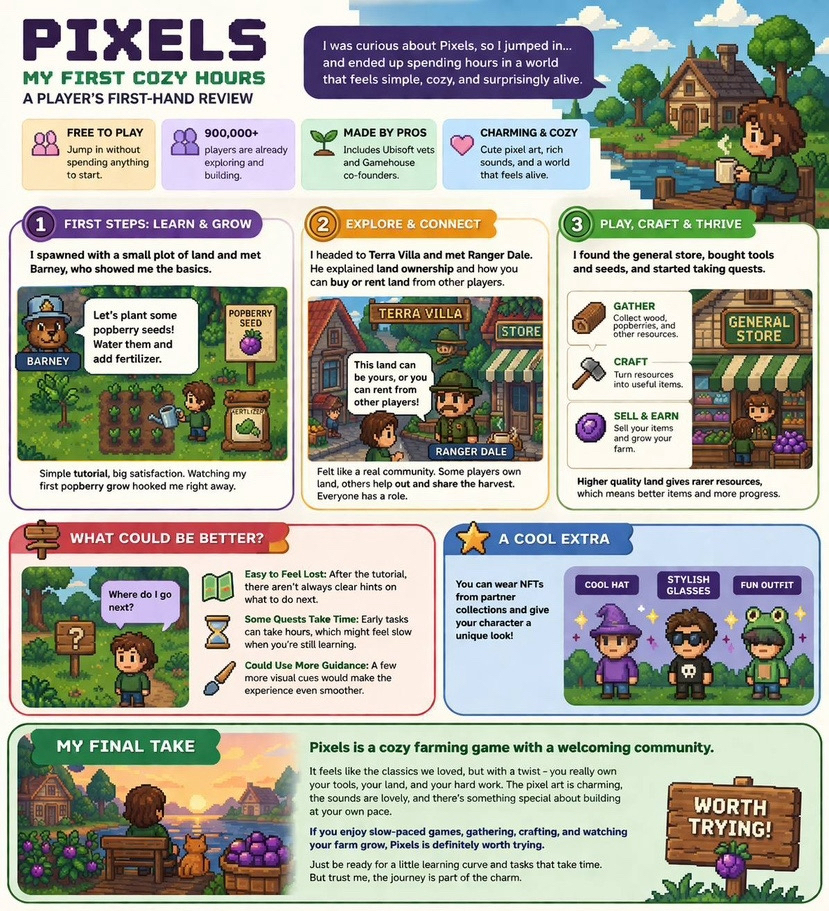
Getting started was very easy. I signed up with my email and started playing right away. There was no need to connect a wallet in the beginning, which is something many Web3 games usually force too early. Instead, Pixels lets you play first and understand the game before adding more complex systems later.
The early part of the game is very simple. I planted crops, watered them, and followed instructions from a guide character. These basic tasks are there to help new players learn without feeling confused or overwhelmed.
When I reached the main town, I saw more of how the game economy works. Some players own land, while others use it and share resources. It feels like a small online economy, but it is introduced in a way that is easy to understand.
The main gameplay loop is simple: collect resources, turn them into items, and sell or use them to progress. Your progress depends on what you have access to, like better land or tools.
I also noticed the game is well-made. Small details like sounds, animations, and smooth transitions make it more enjoyable and help keep players interested.
However, there are a few issues. After the tutorial, the game does not guide you as clearly, and sometimes it can be hard to know what to do next. Some early tasks also take time, which may slow down new players.
Overall, Pixels is designed to be calm and easy to start. It slowly introduces deeper systems instead of showing everything at once.
In short, Pixels is simple to begin, easy to play, and gradually becomes more complex. It focuses more on long-term play than fast action.