
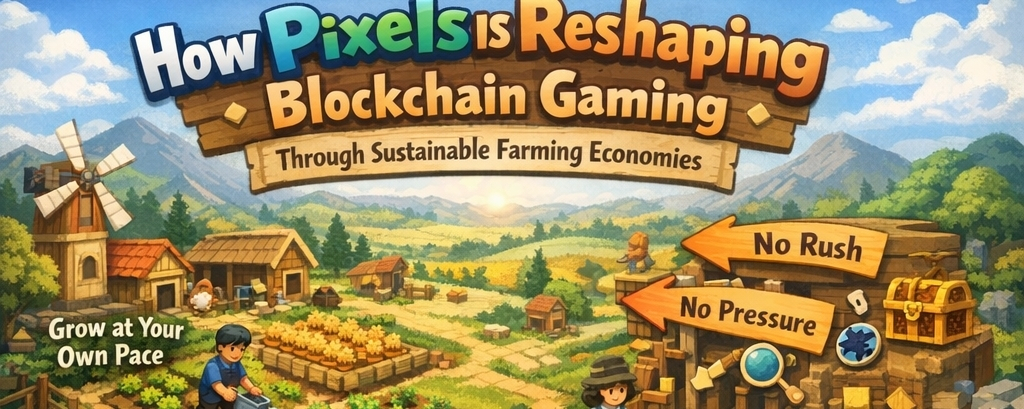
There’s a certain kind of quiet you don’t expect from a blockchain game.
You open it, and nothing is screaming at you. No flashing rewards, no urgency pulling you in ten directions. Just a patch of land, a few things to tend, and time moving at its own pace. It feels… unbothered. And honestly, that’s probably the first clue that Pixels is doing something different.
Because most digital economies—especially the ones tied to crypto—don’t know how to sit still. They push. Constantly. Earn this, stake that, optimize everything. It turns play into pressure without even realizing it. And for a while, people went along with it. Until it started to feel like work dressed up as entertainment.
Pixels doesn’t completely reject that world. It just doesn’t rush into it either.
You farm. You gather. You craft. Simple actions, nothing groundbreaking on paper. But the way it all connects feels less transactional than expected. You’re not just clicking for rewards—you’re moving through a system that slowly reveals itself. Not all at once. Not aggressively. Just enough to keep you curious.
And that curiosity matters more than people think.
Because when you’re curious, you stay longer. You experiment. You care a little.
That’s where the idea of a “digital farming economy” starts to shift. In most blockchain setups, the economy comes first. The gameplay is built around it, sometimes awkwardly. Pixels flips that balance just enough to make it feel natural. The economy exists, sure—but it doesn’t lead every interaction.
You don’t log in thinking about yield.
You log in because you want to check on something.
Maybe it’s your crops. Maybe it’s a small plan you had in mind the day before. Maybe it’s nothing specific at all. And that’s the point—it doesn’t feel forced.
There’s also this subtle sense of ownership that creeps in over time. Not the loud kind, where you’re constantly reminded that “this is yours” because it’s on-chain. It’s quieter than that. You arrange your space a certain way. You recognize it. You notice when something changes.
It becomes familiar.
And familiarity is what gives ownership weight.
Without it, assets are just items sitting in a wallet. With it, they start to feel like part of something you’ve shaped, even in small ways. Pixels leans into that feeling without overexplaining it. It lets you arrive there on your own.
The economy grows out of that.
You need resources, so you produce them. You trade because it makes sense, not just because there’s an opportunity to flip something quickly. The decisions feel grounded. Not purely financial, not purely strategic—just practical in a way that fits the world you’re in.
And when enough players start behaving like that, the economy begins to settle into something more stable. Not perfectly balanced, not immune to outside pressures—but less fragile than systems built entirely on speculation.
That doesn’t mean everything is smooth. There are still rough edges. There always are. Some mechanics feel like they’re still figuring themselves out. Some parts of the economy lean a bit too heavily in one direction before correcting. You notice these things if you stick around.
But it doesn’t break the experience.
If anything, it makes it feel a bit more real. Like something that’s still evolving rather than something pretending to be finished.
Another thing that stands out—maybe more than expected—is how people exist within the space. Not as competitors in a race for rewards, but more like neighbors passing through the same environment. You cross paths. You observe. Sometimes you interact, sometimes you don’t.
It’s low-pressure, almost casual.
And yet, that shared presence adds weight to everything. It reminds you that this isn’t just a system running in the background. It’s a network of people, each moving at their own pace, shaping the economy in small, overlapping ways.
That’s hard to design. And even harder to maintain.
Then there’s the pacing. It’s slow. Not in a frustrating way, but in a deliberate one. Things take time to grow, to change, to matter. And in a space where everything usually moves too fast, that slowness feels intentional.
You’re not chasing constant highs.
You’re settling into a rhythm.
Some days, nothing big happens. You log in, do a few things, log out. No massive gains, no sudden shifts. And strangely, that’s enough. It doesn’t feel like you’re falling behind, which is rare for anything tied to a digital economy.
Because most systems are built on urgency.
Pixels feels like it’s built on continuity instead.
And that difference—small as it sounds—might be what allows it to redefine how these economies function. Not by reinventing every mechanic, but by changing how they’re experienced.
It treats the economy as something that lives inside the game, not something that sits on top of it.
That distinction is easy to miss if you’re not paying attention. But once you notice it, it’s hard to ignore.
In the end, Pixels isn’t trying to prove a big point. It’s not loudly claiming to be the future of anything. It just quietly explores a different approach—one where value grows alongside experience, where ownership feels earned rather than advertised, and where players aren’t constantly pushed to maximize every second.
It’s slower. Softer around the edges. A bit unpredictable.
But maybe that’s exactly why it works.
