
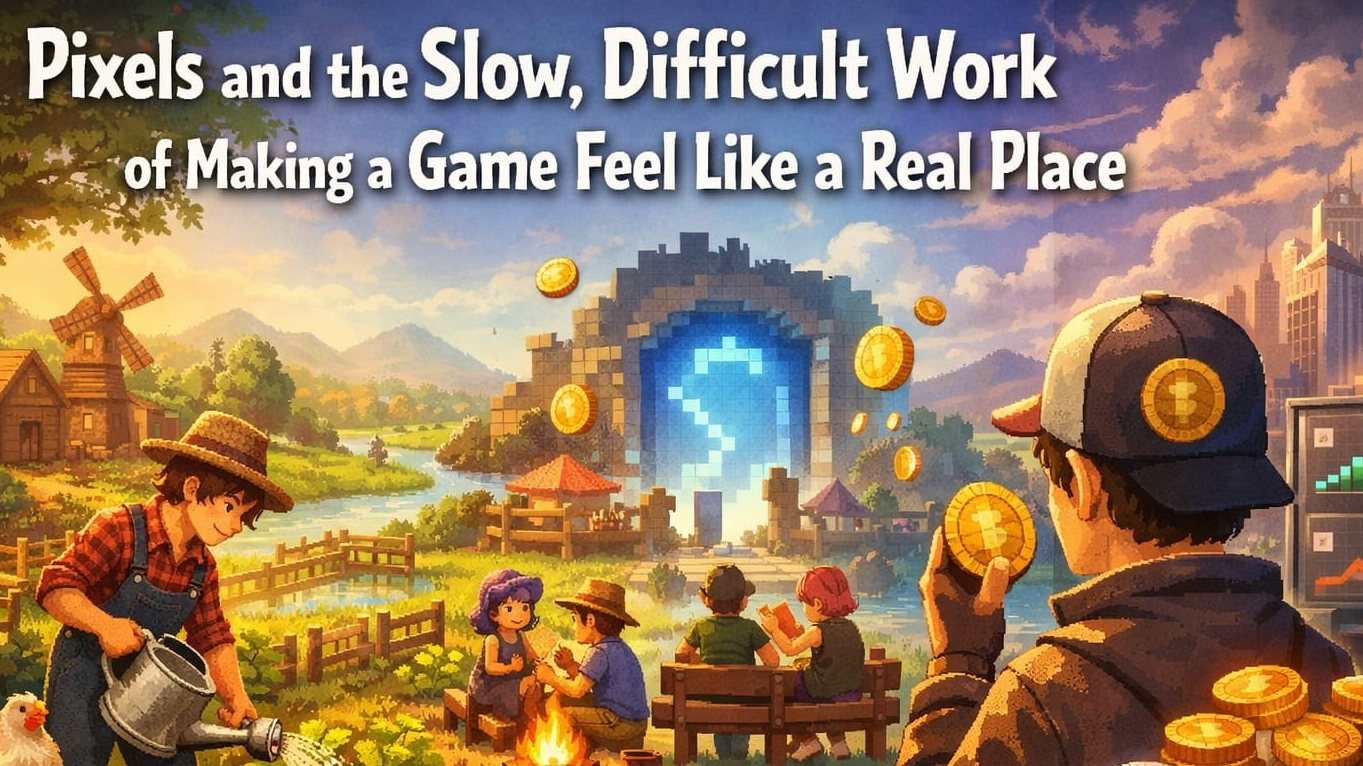
At first glance, it seems easy to categorize. A social farming game. Bright colors. Light mechanics. Web3 underneath. The usual mix of land, tokens, crafting, progression, and community. From far away, it can look like just another crypto game trying to make digital ownership feel playful.
But the closer you get, the less it feels like a farming game with tokens attached, and the more it feels like a project wrestling with a much deeper problem.
The real question around Pixels is not whether it can attract players for a season. Plenty of crypto games can do that. The real question is whether it can become a place people genuinely enjoy spending time in after the novelty fades, after the rewards feel normal, after the market stops doing emotional heavy lifting for the whole experience.
That is a much harder thing to build.
And to me, that is what makes Pixels worth thinking about in a serious way.
There is something honest about a project that has clearly been forced to learn. Pixels no longer feels like a team chasing the old fantasy that tokens alone can create a lasting world. It feels more like a team that has already seen what happens when incentives are too loose, when users arrive for the wrong reasons, and when activity looks healthy on the surface but has no real depth underneath. That shift matters. It gives the whole project a different tone. Less innocence. Less hype. More awareness of the fact that digital economies break in very human ways.
On paper, Pixels is trying to build a casual open world around farming, gathering, crafting, exploration, and social play. That sounds gentle, and in a way it is. The game wants to feel accessible. It does not present itself like a hard-core competitive arena or a highly technical blockchain product. It wants to feel lived in. Relaxed. Familiar. But behind that softness is a pretty demanding system. Because once a game has an economy, especially a tokenized one, it stops being just a game. It becomes something closer to a small country. You have production, inflation, status, incentives, traffic, bottlenecks, inequality, and behavior that changes the moment people believe there is money hiding inside the loop.
That is where the real work begins.
Pixels runs on Ronin, and that choice tells you a lot about what the project values. Ronin is built for speed and low transaction costs, which matters because games cannot afford to feel heavy every time a player takes a simple action. If moving items, trading, or interacting with the world feels slow or expensive, people leave. It is that simple. So Pixels is built on infrastructure designed to make blockchain fade into the background as much as possible.
That is good for usability, but it also comes with a familiar tradeoff. Systems like this tend to work better because they are more controlled. They are faster because they are not trying to maximize openness at every layer. So while Pixels benefits from a smoother environment, it also inherits the compromises that come with it. More performance often means less purity in decentralization. More convenience usually means trusting a smaller group of actors somewhere in the stack.
I do not think that makes the project dishonest. I think it makes it practical. But it is worth saying plainly. Pixels is not trying to be the most ideologically pure version of crypto. It is trying to be playable. And honestly, for a game, that is probably the right priority. Most players do not want a political theory. They want a world that works.
Still, once you accept that, the next question becomes more interesting: what exactly is Pixels trying to solve?
I do not think the answer is “make farming on-chain.” That is just the surface expression. Underneath that, Pixels seems to be working on something more structural. It is trying to figure out whether rewards can be used as a productive part of a game economy instead of becoming a constant leak in the system. That sounds abstract, but it is actually very human. If you keep handing value to users, does that value come back into the world in a healthy way? Does it deepen engagement, social behavior, identity, spending, progression, attachment? Or does it just pass through people’s hands and out the door?
That is the old wound in crypto gaming.
Too many projects treated rewards as proof of health. But rewards are not health. Sometimes they are just motion. Sometimes they are a temporary subsidy covering up the fact that the world itself is not strong enough to hold people. A lot of Web3 games learned this too late. Pixels at least seems to understand it now. And that makes the project feel more mature than many others in the space.
What I find interesting is that Pixels appears to be moving away from the simple “play, earn, repeat” mentality and toward something more measured. More careful. Less romantic. The team seems to understand that not all users are equally valuable to a game economy, and not all activity is worth rewarding. That may sound cold, but it is also realistic. A player who invests in the world, trades, returns, builds routines, and participates socially is very different from a user who shows up for extraction and disappears the moment the numbers weaken.
The hard part is designing a system that can tell the difference without turning itself into a machine that over-manages human behavior.
That, to me, is one of the central tensions inside Pixels.
On one hand, the project deserves credit for taking economy design seriously. It seems to understand that a healthy world needs balance. It needs sinks, which is just a plain way of saying there must be enough reasons for value to leave circulation or change form. It needs friction in the right places. It needs progression that does not collapse after the early game. It needs ways for tools, materials, upgrades, and effort to retain meaning over time. If everything is too abundant, nothing feels valuable. If rewards come too easily, the world stops feeling like a place and starts feeling like a route.
Pixels appears to be learning that lesson in a grounded way. Not through grand theories, but through ordinary design realities. Things need to wear down. Costs need to rise in meaningful ways. Experienced players need goals beyond simple accumulation. Social systems need to matter. Status needs expression. Crafting has to mean something. Time inside the world has to create shape, not just output.
That is not glamorous work, but it is the real work.
On the other hand, the more carefully a project tunes rewards and incentives, the closer it gets to something slightly uncomfortable. A system can become very good at optimizing behavior without becoming more lovable. It can become intelligent in all the wrong ways. It can learn how to keep people moving, spending, and returning while slowly draining away the softer reasons people fall in love with a game in the first place.
That risk feels real in Pixels.
Because underneath the cozy atmosphere, there is clearly a lot of machinery. A lot of thought about economic circulation, reward efficiency, token behavior, and user quality. None of that is bad by itself. In fact, it is probably necessary. But there is a line where a world stops feeling organic and starts feeling tuned. Players may not always have the language for that shift, but they can feel it. They can sense when a game is inviting them into a space and when it is quietly steering them through a system.
That may end up being one of Pixels’ biggest long-term tests. Can it stay human while becoming smarter? Can it stay playful while becoming more optimized? Can it build real texture, real culture, real memory, without turning every layer of activity into something measured mainly through economic usefulness?
Those are not small questions. They sit at the center of almost every modern online system, not just crypto games.
The token structure matters here too, but not in the dramatic way crypto people often talk about tokens. What matters is not just that Pixels has them, but how much work they are being asked to do. A durable economy usually needs different layers of value doing different jobs. Everyday flow. Premium access. Long-term alignment. Sinks. Utility. Some separation between what keeps the world moving and what absorbs speculation or governance. When one asset is supposed to carry the entire emotional, economic, and political burden of a game, things usually get messy fast.
Pixels seems to understand that better now than many projects did during the earlier wave of Web3 gaming. There is an effort here to structure the economy so that not every form of value immediately becomes sell pressure. That makes sense. If all rewards instantly turn into exits, the world slowly empties itself out. But there is also a delicate balance in trying to keep value circulating internally. If you make the economy too open, it leaks. If you make it too closed, users feel managed. That is the kind of tradeoff there is no perfect answer to. You just keep adjusting and hope the system still feels fair from the inside.
And fairness, in games, is rarely about equal outcomes. It is about whether the rules feel emotionally believable.
That may sound vague, but it matters more than many people admit. Players can live with imbalance if the world feels coherent. They can tolerate effort, scarcity, even friction, if those things make intuitive sense. What they struggle with is invisible manipulation or rules that seem to exist only to trap value in place. A digital economy has to feel like a world before it feels like a market. Once that order flips, the atmosphere changes. People start behaving differently. The spell breaks.
What I keep coming back to with Pixels is that it does not feel naive anymore. That is maybe the strongest thing I can say about it.
It feels like a project that has already learned the first painful lesson: ownership is not enough. Rewards are not enough. Activity is not enough. A world has to earn its own gravity. It has to give people reasons to care that are not reducible to extraction. It has to survive boredom, not just volatility. It has to make room for routine, identity, friendship, expression, and little private rituals that no dashboard can fully measure.
That is why I think the future of Pixels may matter less as a single game and more as a kind of evolving framework. The most realistic version of its long-term impact may not be that it becomes some permanent center of online life. Very few games do. The more plausible future is that it becomes a proving ground for how casual crypto-native worlds can be run with more discipline, more humility, and more economic realism than the earlier generation managed.
But even that future is not guaranteed.
Pixels still carries the familiar weaknesses of the category. It relies on infrastructure that makes sensible performance tradeoffs but does not eliminate trust concentration. It still depends heavily on design choices made by a core team rather than some truly neutral community process. It still walks a narrow path between sustainable incentive design and over-managed user behavior. And like every economy-first online world, it remains vulnerable to the simplest force of all: people getting bored.
That last risk should never be underestimated. A lot of crypto analysis spends too much time talking about token sinks, treasury flows, staking structures, and governance models, and not enough time talking about the fact that people leave when they stop feeling something. Not when the spreadsheet says they should. When the air goes out of the place. When the rituals stop mattering. When they no longer feel a reason to check in. A game can survive many technical flaws if it has emotional weight. It is much harder for it to survive the absence of emotional weight, no matter how polished the economy becomes.
So where does that leave Pixels?
For me, it leaves it in an honest middle ground. Not a miracle. Not a joke. Not a finished answer. Just a serious attempt to solve a problem that most of the sector described too lazily for too long. It is trying to build a world where tokens do not automatically poison play, where rewards do not automatically hollow out community, and where ownership means something because the place itself has shape and rhythm.
That is a worthwhile ambition. It is also much harder than it sounds.
The calmest way to look at Pixels is to see it as a live system still learning what kind of world it wants to be. Sometimes it feels like a game learning economic discipline. Sometimes it feels like an economy trying to become a game gently enough that players do not mind. Maybe the truth is that it is both. Maybe that is why it still feels unfinished in an interesting way.
In the end, I do not think Pixels should be judged by whether it perfectly fulfills the old Web3 promise. That promise was too easy, too clean, too willing to confuse assets with meaning. It should be judged by something more grounded: whether it can keep making the world feel worth returning to when the incentives become ordinary, when the market gets colder, and when people have no reason to stay except that the place still feels alive.
If it can do that, even imperfectly, then Pixels will have done something rare. It will have shown that crypto can support a world without becoming the whole point of it.
If it cannot, then it will join a long list of projects that discovered, too late, that a functioning economy is not the same thing as a living place.
That is the real question hanging over Pixels.
And honestly, it is a much more interesting question than whether the numbers go up.