
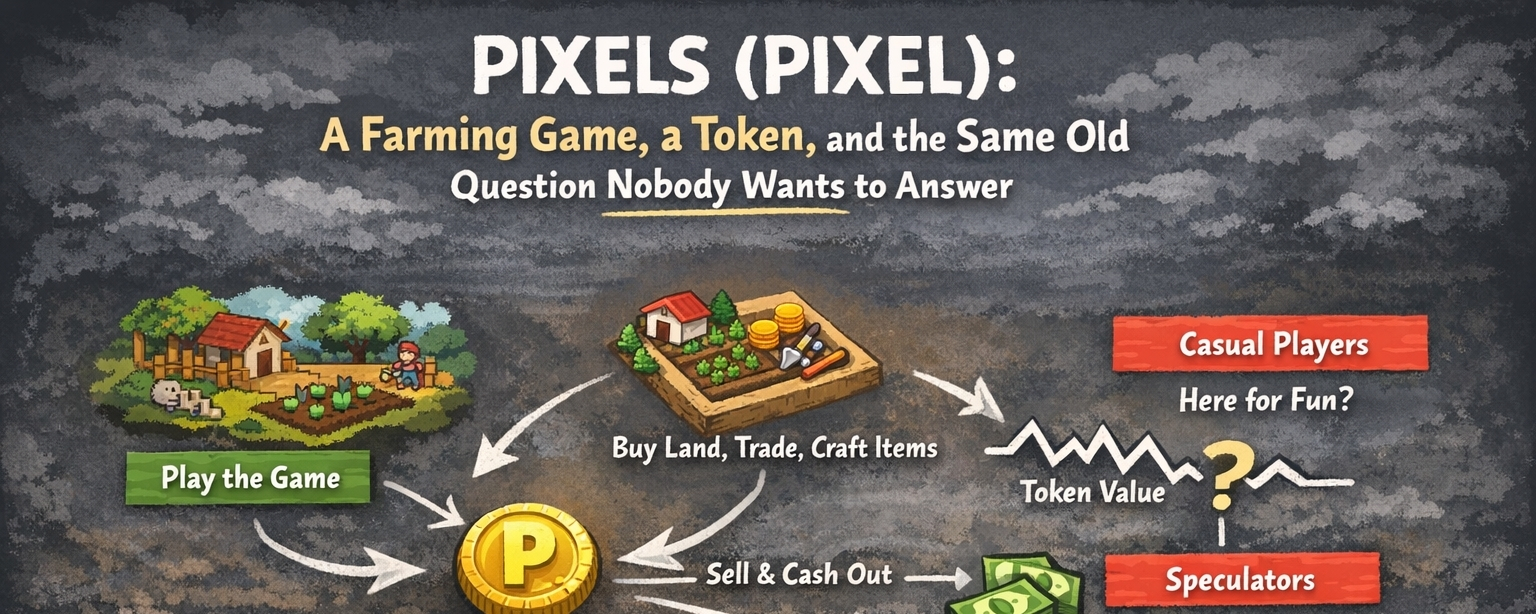
I’ve seen this setup before. Different logo, different crowd, same bones underneath. A token tied to a game, wrapped in just enough charm to make people forget they’re stepping into another economic experiment. This time it’s Pixels (PIXEL), sitting inside a soft-looking world called Pixels. Farming, trading, social chatter. Looks harmless. Almost innocent. That’s usually when you should pay attention.
PIXEL isn’t complicated. That’s part of the appeal. You earn it, spend it, move it around inside the game. Buy land, upgrade tools, craft things, flip assets. Standard loop. The only twist is that it runs on the Ronin Network, which—if you’ve been around—was dragged into the spotlight by Axie Infinity back when everyone thought clicking cartoon creatures could replace a paycheck. That didn’t end well.
Actually, that’s being polite. It ended exactly how these things tend to end. Early money in, late money out, and a lot of people stuck holding assets tied to a shrinking player base. The math isn’t complicated. It just gets ignored while prices are going up.
Now Pixels shows up with a softer pitch. No aggressive promises. No screaming about yields. Just a game that, on the surface, feels like it doesn’t care whether you’re here to make money or just kill time. That’s new. Or at least it looks new.
But strip it down and the same pressure points are still there. Tokens need demand. Demand needs users. Users need a reason to stay that isn’t purely financial. And that last part—yeah, that’s where things usually fall apart.
Let’s be honest. Most people aren’t here because they love pixel farming. They’re here because there’s a chance—however slim—that the token appreciates, or that grinding translates into something tangible. You can dress it up however you want, but money changes behavior. Always has.
The developers seem aware of that. You can see it in the pacing. Everything feels slower. Less frantic. Almost boring. And I don’t mean that as an insult. Boring is stable. Boring is predictable. Boring is what most of crypto has been missing while it chases the next spike. But boring doesn’t attract crowds, and without crowds, these economies don’t scale. That’s the tension sitting right under the surface.
And then there’s the infrastructure. Everyone loves to talk about chains and throughput and fees like it’s some grand innovation. It’s not. It’s plumbing. Necessary, sure, but nobody shows up because the pipes are well designed. Ronin does its job. Transactions are cheap, fast enough, less painful than older systems that made you click through endless confirmations like you were signing mortgage papers. That friction is reduced. Good. It should be. But let’s not pretend that solves the real problem.
The real problem is human. Attention spans, incentives, boredom, greed. The messy stuff no whitepaper ever models properly.
You can already see the cracks forming in the broader model. If too many players treat PIXEL like an income stream, they’ll extract more than they contribute. The economy inflates, rewards thin out, and suddenly the same people who were praising the system start calling it broken. It’s not broken. It’s behaving exactly as designed. People just don’t like the outcome.
On the other side, if the game leans too hard into being “just a game,” the financial crowd loses interest. Liquidity drops. Volume dries up. The token drifts. And without a strong market, even the players who don’t care about money start to feel like their time is being undervalued. Funny how that works.
So you end up in this awkward middle ground. Not quite entertainment, not quite finance. Something in between. Those hybrids rarely hold steady for long.
And yet… Pixels hasn’t collapsed. Not yet. It’s moving, slowly, picking up users who don’t seem obsessed with charts or token prices. That’s unusual. Maybe even a little uncomfortable for a space that thrives on noise and constant movement.
But slow growth comes with its own risks. Markets get impatient. Speculators move on. And once the attention shifts, it’s hard to pull it back without doing something dramatic—usually something that breaks the balance the system was trying to maintain in the first place.
There’s also the question nobody likes to ask out loud. What happens when the novelty wears off? When farming virtual land stops feeling fresh and starts feeling like routine? Because routine without strong incentives turns into obligation. And people don’t stick around for obligations they can walk away from.
I keep coming back to the same thought, and it’s not a comfortable one. The entire value of PIXEL hangs on whether enough people keep logging in. Not for a week. Not for a hype cycle. For months. Maybe years. That’s a high bar for any game, let alone one tied to a token that’s constantly being priced by an external market that doesn’t care about your crops or your crafting system.
Maybe it works. Maybe it doesn’t. I’ve learned not to bet too heavily on either outcome.
Because at the end of the day, you can dress this up however you want—call it a game, call it an economy, call it a social platform—but if the players stop showing up, the token doesn’t argue. It just fades.