
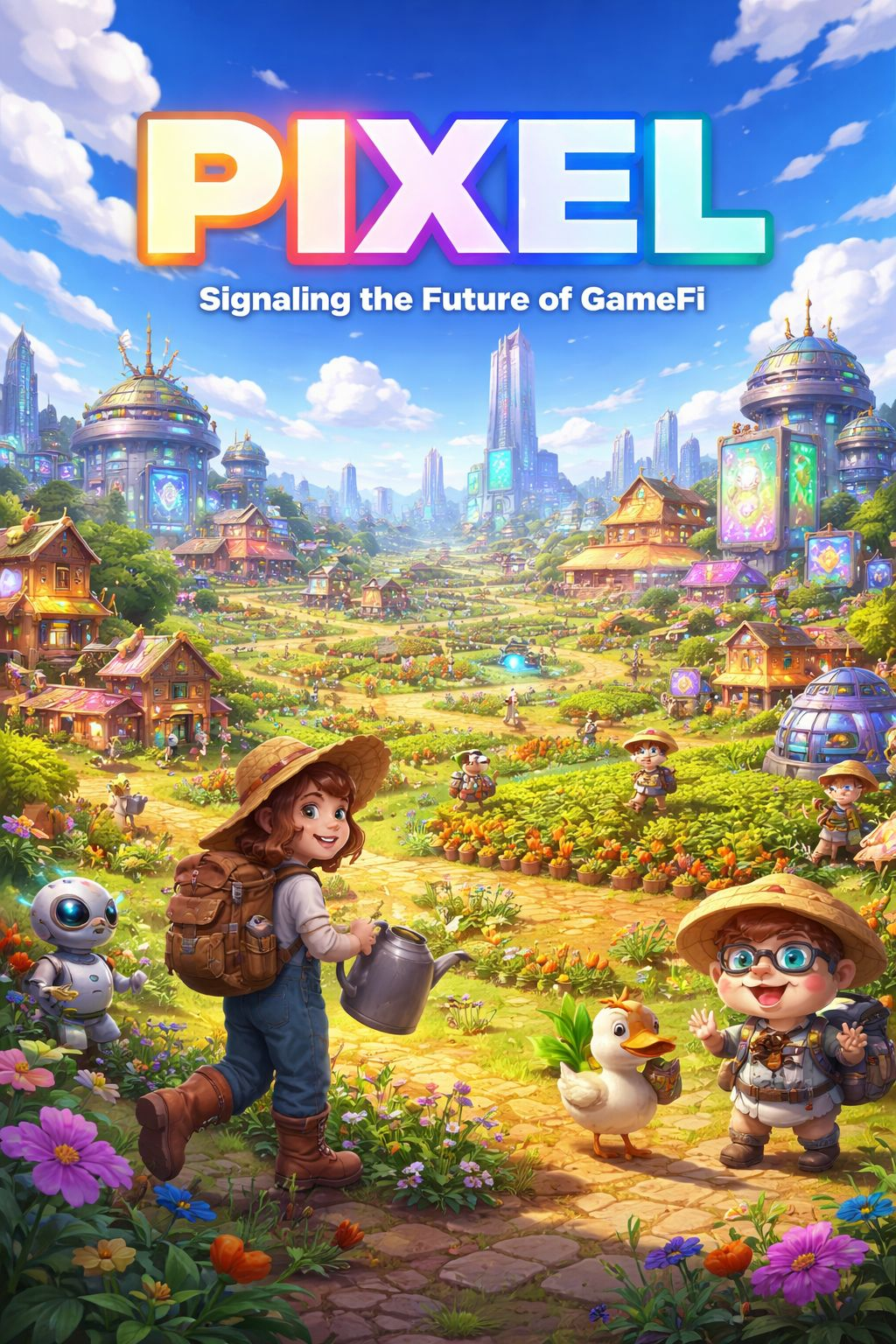
Where Pixels (PIXEL) is interesting
What makes Pixels (PIXEL) notable is not that it “solved GameFi,” but that it shifted what is being optimized:
1. From emissions → progression economies
Instead of purely rewarding participation, the system tries to anchor value in:
crafting loops
land productivity
resource sinks
time-gated progression
That matters because it moves the system closer to a labor-based economy rather than a pure reward printer.
2. “Soft financialization” inside gameplay
You pointed out something very accurate:
land ownership
guild structures
crafting economies
social reputation
These are not just game mechanics—they are proto-financial primitives.
But the key nuance is:
This only becomes stable if players value status, identity, and mastery more than short-term yield extraction.
Otherwise, it reverts back to speculation with extra steps.
3. Migration to Ronin Network
This move is more important than it looks.
Ronin functions as:
a distribution layer for gamers, not crypto traders
a lower-friction onboarding environment
a historically proven GameFi ecosystem (Axie legacy)
So the strategic benefit isn’t just scalability—it’s audience alignment: you’re no longer trying to turn DeFi users into gamers, but gamers into onchain users.
That reduces one of GameFi’s biggest failures: wrong user base composition.
The real question you raised: narrative durability vs internal economy
You’re essentially asking:
Can a game survive when the external narrative (AI, in 2026’s case) stops subsidizing attention?
This is the correct stress test.
Here’s the key distinction:
Projects that die when narrative fades
depend on inbound attention loops
rely on token speculation for retention
have weak internal sinks (little reason to hold assets)
economies are “open systems”
Projects that survive narrative shifts
generate local demand (players need items regardless of token price)
have meaningful progression constraints
create identity persistence (guilds, reputation, history)
function as “worlds,” not apps
Where Pixels (PIXEL) sits today
Based on your framing, Pixels is in a transition zone, not a resolved one:
Strengths
strong ecosystem embedding via Ronin
recognizable social + farming loop (low cognitive barrier)
increasing “world density” (crafting, guilds, land systems)
early signs of economy internalization
Weak points (typical GameFi pressure points)
still partially reliant on external attention cycles
token price perception still influences user behavior
content depth must continuously expand to retain high-agency players
risk of “meta optimization” (players optimizing economy, not gameplay)
The deeper structural tension you’re noticing
This is the core insight in your question:
GameFi oscillates between being a game economy and a financial system pretending to be a game.
And every cycle tries to move the boundary slightly:
Smart contracts → made ownership real
DeFi → made liquidity programmable
L2s → made scaling viable
GameFi (now) → trying to make persistent economic worlds viable
But the unresolved issue is:
Can a crypto game maintain economic meaning without speculative amplification?
Will AI kill or help this cycle?
Your intuition that AI dominates attention in 2026 is important—but AI does something subtle:
It competes for speculative attention
But it also reduces development cost for games dramatically
So paradoxically:
AI may reduce the “hype share” of GameFi
while increasing the quality ceiling of GameFi worlds
Meaning:
fewer projects get attention, but the surviving ones become much more complex and persistent
So—is this evolution or another cycle?
Probably neither extreme.
A more precise framing is:
GameFi is moving from token-driven economies → world-driven economies, but this transition is not synchronized across projects.
So you get:
some collapsing (old model)
some hybridizing (current stage)
a few slowly becoming persistent digital societies
Final answer to your question
away from pure emission economies
toward persistent, socially anchored in-game economies
embedded in specialized infrastructure like Ronin Network
and increasingly dependent on internal rather than narrative-driven value creation
Whether it survives the next narrative shift (AI → something else) depends less on crypto cycles and more on one thing:
whether players stay because the world is valuable, not because the token is moving.
That’s the actual inflection point GameFi has been chasing since the beginning.
@Pixels $PIXEL #pixel