
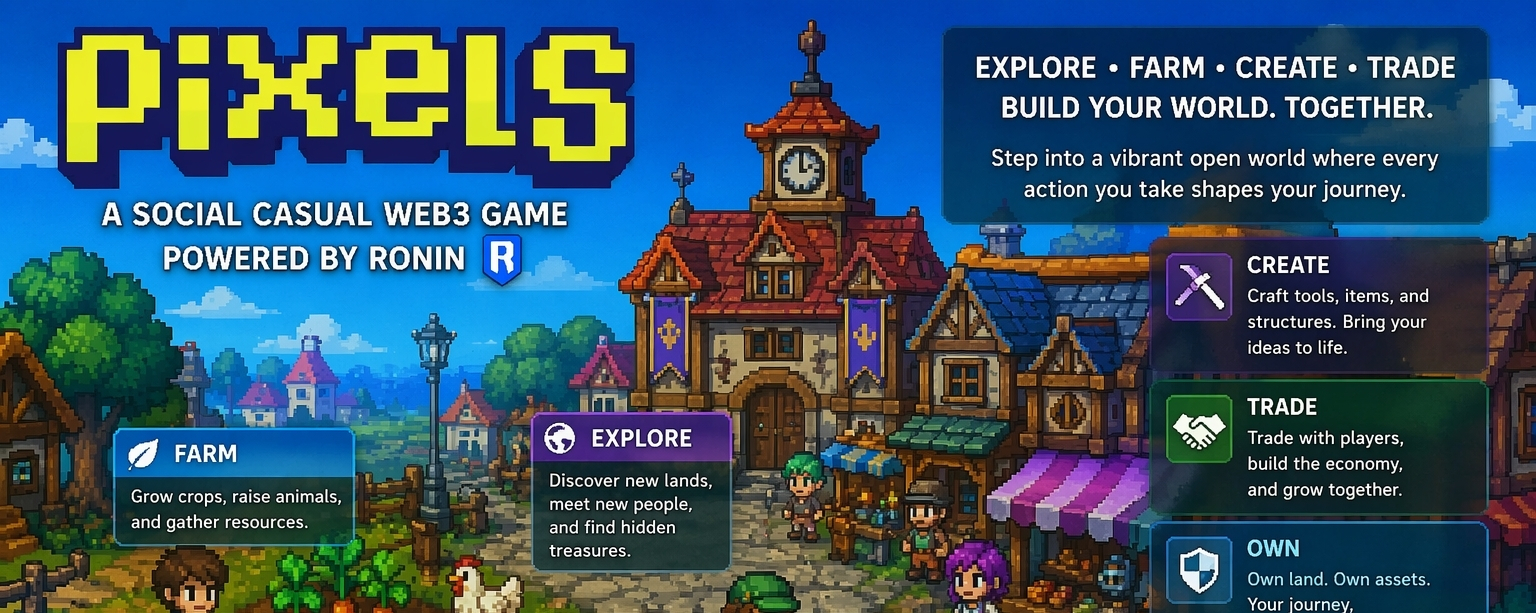
Pixels has a sneaky kind of charm.
Not the loud kind. Not the kind that bangs pots and pans in your face and begs to be called “the future.” The quieter kind. The kind you almost underestimate at first, then catch yourself thinking about later.
That’s part of what makes the project work.
On the surface, Pixels looks disarmingly simple: pixel art, farming, light exploration, a social layer that doesn’t shove itself into every corner of the screen. You plant. You gather. You craft. You move around the world at an easy pace. None of that sounds revolutionary when you say it out loud. Frankly, it sounds almost too familiar. But that’s exactly where the project gets clever. Pixels doesn’t try to win you over with spectacle. It wins on rhythm.
And rhythm, in a game like this, is everything.
A weak project makes repetition feel like labor. You log in, click through chores, and before long the whole thing starts to feel like a part-time job you never agreed to take. Pixels, when it’s doing its job well, makes repetition feel different. Softer. Stickier. There’s a cadence to it. The loop of planting, harvesting, crafting, and upgrading starts to feel less like grinding and more like tending to a place that slowly, almost stubbornly, becomes yours.
That’s not easy to fake.
Plenty of projects can manufacture early curiosity. They can throw together a nice trailer, a token hook, a few flashy promises. But building something people genuinely want to return to day after day? That’s a different beast. That comes down to whether the world has texture. Whether progress feels earned. Whether small actions carry enough weight that players don’t feel like they’re pouring time into a hole in the ground.
Pixels seems to understand this in its bones.
What gives the project real lift is that farming isn’t the whole story. It’s the doorway. Once you spend time inside the world, you start noticing how much of the experience is built around accumulation, routine, and presence. Your land matters because it reflects your decisions. Your progress matters because it changes how you move through the system. Efficiency matters because wasted motion adds up, and in games like this, wasted motion is death by a thousand paper cuts. If the loop is clumsy, players feel it in their hands before they ever put it into words.
Pixels avoids a lot of that friction.
It doesn’t flood the player with noise. It doesn’t over-explain itself to the point of suffocation. It gives you room to find the shape of the project on your own. That restraint is rarer than it should be. A lot of teams get nervous and start piling systems on top of systems, terrified that simplicity will be mistaken for shallowness. But simplicity, when it’s handled well, isn’t shallow at all. It’s disciplined. It means the team knows what to leave out.
And Pixels, for the most part, seems to know.
There’s also a social intelligence to the project that people sometimes gloss over. That’s a mistake. A world like this can’t survive on solo optimization alone. If all a player feels is private efficiency—just me, my crops, my route, my gains—the experience eventually collapses into sterile routine. A shared world needs the faint hum of other people inside it. Not as decoration. As atmosphere. As proof that the place has a pulse.
Pixels gets a lot of mileage out of that.
The presence of other players changes the emotional temperature of the game. Suddenly it’s not just a loop. It’s a place. You’re not merely managing resources in a sealed box; you’re participating in a world that feels inhabited. That distinction matters more than it sounds. A game can have strong mechanics and still feel dead if nobody’s presence registers. Pixels, at its best, gives off the feeling of a small digital town—busy, slightly scrappy, lived-in. People are building, gathering, moving, tending, trading. You feel that motion, even when you’re doing something as humble as watering crops.
That’s where a lot of the project’s staying power comes from.
And then there’s the tone. This part matters too, maybe more than people admit. Pixels doesn’t carry itself like a project trying to dazzle you with jargon and grand theory. It feels more comfortable than that. More self-aware. There’s something appealing about a world that doesn’t scream for attention every five seconds. It trusts the player to notice what’s good about it. That kind of confidence can backfire if the project has nothing underneath the hood, sure. But when it works, it creates a much stronger bond than hype ever does.
Because hype burns hot and stupid.
Atmosphere lingers.
What I find most compelling about Pixels is that it seems to understand a truth a lot of projects miss: players don’t build loyalty to systems alone. They build loyalty to places. That’s the difference between a world people visit and a world people inhabit. One gets a spike of interest. The other gets habits. Habits are where the real value is. If players begin folding your project into their routine—checking in, tending progress, refining their little corner of it—you’ve crossed into much rarer territory.
That’s when a project stops being “something to try” and starts becoming somewhere to return.
Of course, that’s also where the real pressure begins. Once players settle into a world, they notice every weak seam. They notice when updates feel thin. They notice when systems drift out of balance. They notice when the charm starts doing too much of the heavy lifting. A project like Pixels can’t afford to coast on aesthetic goodwill forever. Cozy only carries you so far. If progression gets muddy, if social systems lose their spark, if the daily loop starts feeling like dead air, players won’t write a formal complaint. They’ll just quietly stop showing up.
And silence is brutal.
Still, that’s exactly why Pixels remains interesting. Not because it’s flawless. Because it’s trying to solve the harder problem. It isn’t just chasing attention; it’s trying to build attachment. There’s a world of difference between the two. Attention is cheap. Attachment has to be earned, slowly, through dozens of small decisions that players may never consciously notice but absolutely feel.
That’s the craft of it.
So when people reduce Pixels to a farming project with a nice visual style, they’re missing the more revealing story. The real story is that it has the temperament of a world designed for repeat visits. It understands pacing. It understands that softness can be a strength. It understands that a project doesn’t always need to be louder to be stronger. Sometimes it just needs to feel lived in, responsive, and steady enough that players start treating it less like a novelty and more like a familiar street they don’t mind walking down again.
That’s a rare trick.
And the projects that manage it usually stay with people longer than the flashy ones.