
I’ll be honest. The first time I saw Pixels and the PIXEL token popping up on my timeline, I rolled my eyes a little. Another farming game. Another token launch. Another short cycle of hype and liquidity rotation. I have been around long enough to see how these stories usually play out.
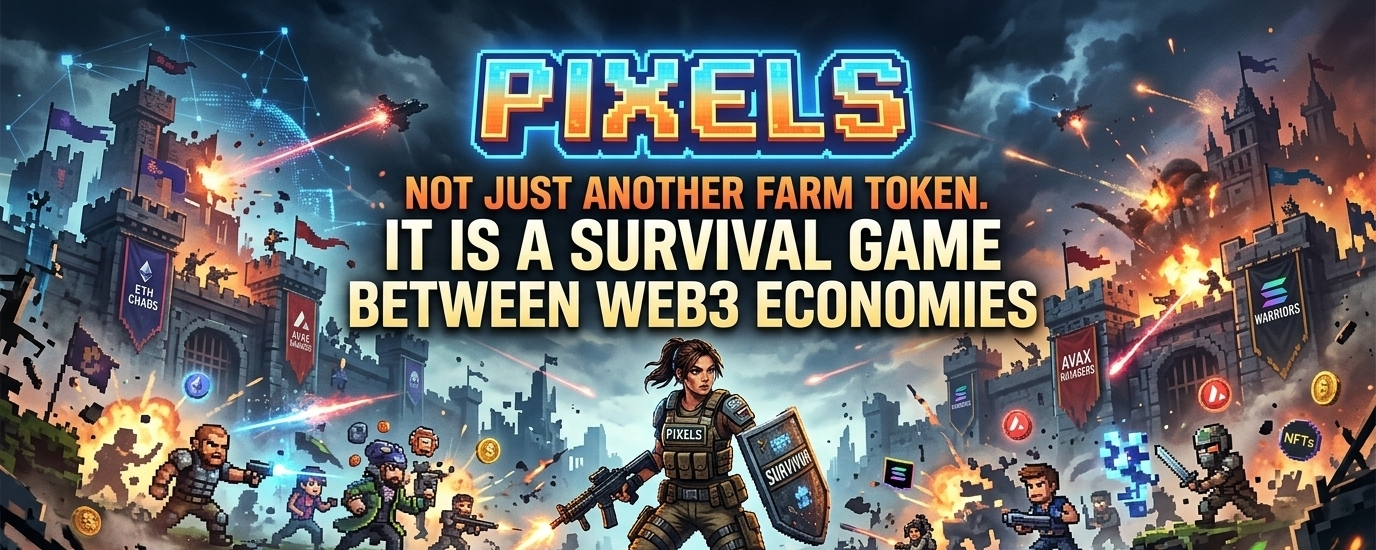
But after spending more time looking into Pixels, and watching how it moves inside the Ronin ecosystem, I started to feel like I misread it. It is not just a farm game trying to survive. It is competing in something much bigger. It feels like straight PVP between games not players.
Pixels is a social casual Web3 game built on the Ronin Network. On the surface it looks simple. Farming, exploring crafting, interacting with other players in an open world. Bright visuals. Low barrier to entry. Nothing intimidating. You plant crops, gather resources build trade and slowly expand your presence.
That sounds basic. And maybe that is the point.
From my perspective a lot of Web3 games overcomplicated themselves. Heavy tokenomics diagrams. Layers of NFTs. Promise of metaverse scale economies. But very few focused on whether people actually wanted to log in daily. Pixels seems to have started with behavior first. What makes someone return tomorrow.
One thing that stood out to me is how tightly it connects to Ronin. Ronin already has a strong gaming-native community thanks to Axie’s early days. Wallet infrastructure, users who understand NFTs, and a culture that is more about playing than flipping jpegs. Pixels did not have to invent that from zero. It plugged into an existing onchain gaming network.
That changes the game theory.
In Web2, games compete for attention. In Web3, they compete for liquidity wallets, and mindshare inside the same chain. When a new game launches on Ronin it is not just fighting other Web3 games globally. It is fighting for the same capital and time from Ronin users. That is where the PVP between games really begins.
It feels like each game is now an economy node. Tokens NFTs land in-game items. They are all fighting to be the place where users park value and spend time. If players believe a game will last they stake their attention there. If not liquidity drains fast. We have all seen that happen.
Pixels interestingly leaned into social loops instead of pure speculation loops. Farming and resource gathering may sound slow but slow systems are harder to break. They encourage routine. And routine is powerful in crypto. Just look at staking or airdrop farming. People love daily actions.
I have noticed that the open-world design also makes ownership feel more visible. When you build or farm in Pixels, it is tied to your wallet identity. That small psychological shift matters. It is not just a save file on a server. It is something attached to your address. That makes quitting slightly harder.
Another layer here is token access. The PIXEL token is not just a trading instrument. It connects to governance utility and in-game progression. Of course traders will trade it. This is crypto. But when a token is woven into daily gameplay instead of only serving as a reward faucet the sell pressure dynamic shifts a bit.
It reminds me of how DeFi protocols evolved. Early yield farms were mercenary. Liquidity in rewards out dump move on. Later designs tried to create stickiness through ve token models and long-term alignment. Web3 games are going through a similar maturation. Pixels feels like part of that second wave.
Still, nothing is guaranteed. Games live and die by engagement. If players stop caring, no token model can save it. That is the brutal truth. The difference now is that players can see onchain signals. Wallet activity NFT transfers token flows. Transparency adds a strange kind of accountability.
From where I stand, Pixels is less about being the biggest game in crypto and more about being sustainable within its own ecosystem. If it keeps users inside Ronin, keeps them transacting crafting trading, and socializing, it wins its PVP match for now.
And maybe that is what Web3 gaming actually needs. Not massive metaverse promises. Just tight communities simple loops and economies that do not implode after the first liquidity event.
I started off thinking Pixels would be another quick cycle. Now I see it as a small but interesting experiment in how games compete onchain. Not just for fun, but for survival in a shared economic layer.
If this model works, it could change how we evaluate gaming tokens. Less about hype candles. More about daily active wallets and whether people genuinely want to log in again tomorrow. And honestly, that feels like a healthier direction for crypto as a whole.
