

Okay confession time. For most of 2024 and half of 2025, I thought Pixels was a joke.
Not the game itself. The idea of it as an investment. I watched the token bleed from over 90 cents down to where it sits now, around half a penny. I watched crypto Twitter mock the chart. I nodded along. Pixels was the GameFi cautionary tale. Another farming game with a dying token. Move on. Next rotation.
Then something weird happened. The game kept running. The player count held. Updates shipped every month. The team kept building while the price kept sliding. And at some point last year, I started asking myself the uncomfortable question: what if I was wrong about this one?
I loaded the game back up. Here is what I found, and why I think Pixels has quietly become one of the most misread projects in Web3 gaming.
The Game Itself Is What Most Analysts Never Bother With
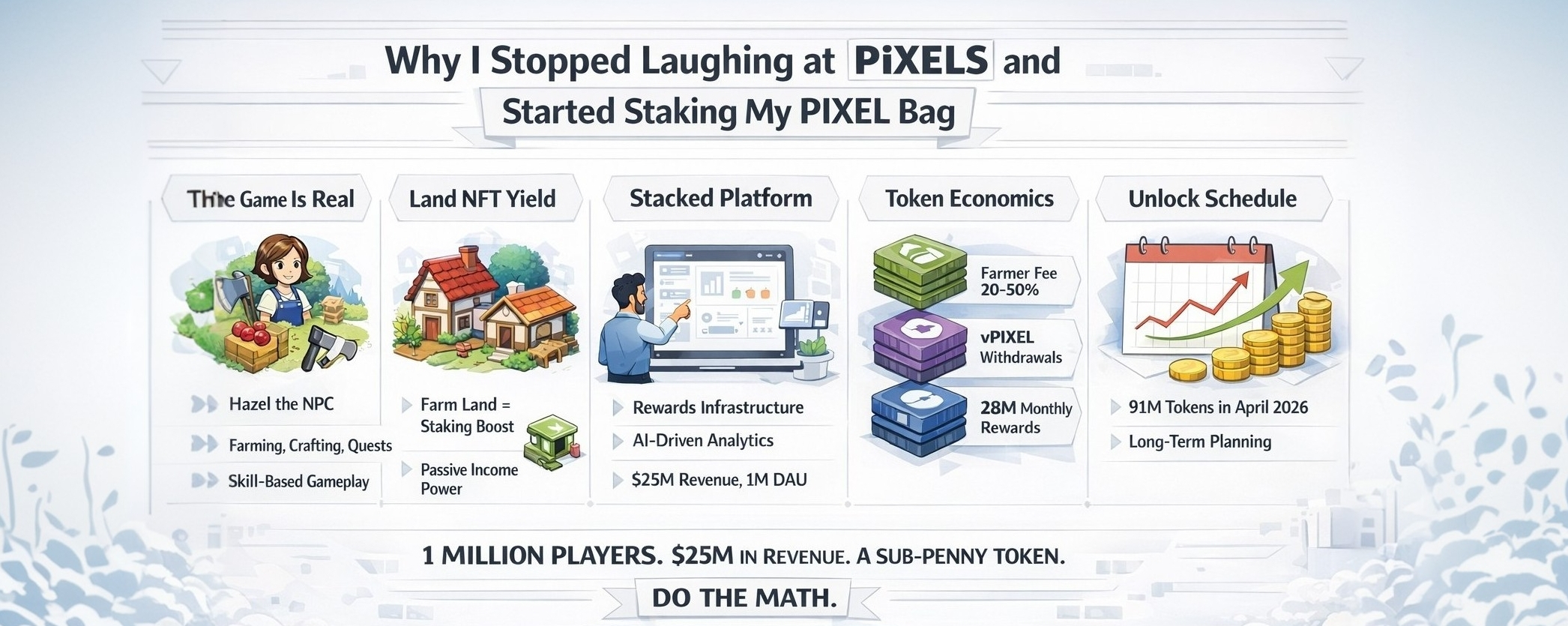
Most crypto people who write about PIXEL have never played Pixels. You see this immediately when you read their takes. They talk about the token, the charts, the unlocks. They never mention Hazel at the task board. Or the way the Winery needs 24 Popberries, 10 Cooking Mix, and 3 Honey to exist on your land. Or the fact your axes degrade and disappear after a certain number of swings.
These details matter because they tell you how the economy works at ground level.
The core loop pulls you through skills one at a time. Start at zero. Plant Popberries. Chop trees marked with spray paint. Mine Clayum Matrix. Deliver orders at Buck's Galore. Level up farming, cooking, winemaking, stoneshaping, textile crafting. Each skill opens new recipes, new quests, new rewards. Tools break and force you back to the store. Energy regenerates slowly and pushes strategic decisions about when to harvest versus when to sell.
From my experience, this is the opposite of every failed P2E game I have touched. There is no "set it and forget it" extraction loop. There is no way to bot your way to high-level PIXEL rewards because those orders demand items you have to progress through skill gates to produce. I think the team figured out something the rest of Web3 gaming still refuses to learn: if your token rewards require skill, bots lose money trying to farm them.
The Land NFT Economy Is Where Pixels Gets Interesting
Most people look at Pixels and see a farming game. I see a property market dressed up as a farming game.
Every plot of land in Pixels is an NFT. Small NFT Houses come upgraded with Tier 4 stoves, cave basements, private pools. Large NFT Houses add Solariums for decorative flowers. You modify wallpaper, flooring, bedding, paintings. You access the Infinifunnel (a premium utility for managing production) from inside your NFT house.
Here is where it ties into the token. Owning a Farm Land NFT gives you a 10% staking power boost on up to 100,000 PIXEL per land. Land owners who stake earn a disproportionate share of the monthly 28 million PIXEL reward pool distributed across staking pools.
I sat down and worked out the math last month. A land holder with a properly sized PIXEL stake captures meaningfully more ecosystem rewards than a passive holder of the same amount of PIXEL. The land market on secondary exchanges reflects this. Land prices have held up better than the token itself, because the land has yield attached.
In my view, this is the quiet thesis nobody talks about. PIXEL without land is a token. PIXEL plus land is a cash-flowing asset. The market prices them separately, and I think the relationship is mispriced.
Stacked Is The Move That Flipped My Thinking Completely
For context, Pixels launched Stacked externally in March 2026. I want to explain why I think this reframes the whole project, because the crypto media coverage has been mostly surface-level.
Stacked is a rewards infrastructure platform. Game studios integrate through an SDK. The system tracks player behavior, segments users into cohorts, deploys targeted incentive offers, and runs it through an AI layer you query in plain language. Ask it why your lapsed spenders are churning. It analyzes the data and suggests targeted offers.
Internal numbers from Pixels are wild. A Stacked-powered campaign targeting players who had not spent money in over 30 days generated a 178% lift in conversion to spending and a 131% return on reward budget. Those are performance marketing numbers. Real SaaS metrics. Not crypto hype metrics.
The Pixels ecosystem hit over $25 million in revenue and 1 million daily active users while the team built this system internally. Luke Barwikowski described Stacked as "the Appsflyer of P2E" at the YGG Play Summit in November 2025. He stood on that stage and pitched rewards infrastructure to a room of people who had given up on Web3 gaming. Now the product is live.
Here is why this matters for PIXEL holders. The token used to rise and fall with one farming game. Now it powers rewards across a multi-game ecosystem (Pixels, Pixel Dungeons, and the mobile title Chubkins), with external studios potentially coming online through Stacked integrations. Every new integration creates new demand for PIXEL as a rewards settlement layer. The token stopped being a GameFi currency. It started becoming gaming middleware.
I think the market prices Stacked at close to zero right now. I do not think that pricing holds through 2026 if external studios start integrating.
The Economics Have Real Flow Mechanics Most Gaming Tokens Lack
I want to walk through the token design because it rewards attention.
Three mechanics drive PIXEL utility. The Farmer Fee takes 20% to 50% of direct PIXEL withdrawals and redistributes the fees to PIXEL stakers. Fast extraction funds long-term holders. The vPIXEL system lets players withdraw rewards fee-free for in-game spending, keeping sell pressure off the market while preserving utility. The multi-game staking pool distributes around 28 million PIXEL monthly across pools tied to each ecosystem game, weighted by total PIXEL staked per pool.
Layer on the RORS metric (Return on Reward Spend). The team openly tracks whether every dollar of rewards generates more than two dollars of ecosystem value back. When RORS drops below 2, rewards get tightened. When it stays above, the economy compounds. Luke has referenced this metric repeatedly in AMAs as the operational discipline keeping the economy healthy.
From my perspective, this is mature token design. Most GameFi tokens have one utility (in-game purchases) and one sink (spending). PIXEL has structured flows connecting withdrawal behavior, staking rewards, land ownership, and cross-game participation. The tokenomics reward the behavior you want (holding, staking, playing) and penalize the behavior you do not want (fast extraction, speculation without participation).
The Honest Part About The Supply Overhang
I would be lying if I said PIXEL has clean tokenomics on the supply side. It does not.
Total supply is 5 billion. Around 3.38 billion tokens circulate today. Unlocks keep hitting on schedule. The April 2026 unlock alone releases roughly 91 million tokens, or 1.8% of total supply, split across multiple stakeholder groups.
That ongoing dilution is the primary reason PIXEL trades where it does. It is not bearish fundamentals. It is continuous new supply entering the market faster than organic demand absorbs it. When PIXEL spiked 192% in 24 hours on $388 million in volume back in March 2026, the momentum faded once the next unlock cycle reset sentiment.
Here is how I size this mentally. Short-term trades in PIXEL get destroyed by the unlock calendar. Positions sized to the remaining vesting schedule, with a 12 to 18 month thesis on Stacked adoption, have a cleaner risk profile. This is not a coin you flip on a daily chart. It is a fundamentals-driven hold for people who do the work of tracking integrations, staking flows, and ecosystem revenue.
Before I put a single dollar back into PIXEL, I mapped every scheduled unlock through 2027. I suggest everyone reading this does the same.
Why The Team Earned My Trust Back
The hardest thing to judge in crypto is team quality. Pretty much everyone ships a website and a Discord. Almost nobody ships through four bear markets, corrects public mistakes, and rebuilds broken systems without running away.
Pixels migrated from Polygon to Ronin. Killed BERRY as an on-chain token, paid holders a fixed conversion (1000 BERRY to 7.6175 PIXEL), and moved the soft currency off-chain to end the inflation problem. Rolled back a broken reputation system, admitted the bug publicly, and re-released the fix. Shipped Chapter 3: Bountyfall on October 31, 2025. Hosted the Neon Zone event in Manila. Then launched Stacked externally on schedule in March 2026.
From my view, that track record matters more than any single feature. Teams who stay show up. Teams who do not, vanish when the market pressure gets heavy. Pixels has stayed through conditions worse than most crypto projects will ever face.
I am positioned in PIXEL because I think the project outlasts the cycle, Stacked generates external studio revenue within 18 months, and the token reprices as the unlock schedule tapers and ecosystem demand compounds. None of this is guaranteed. All of it is possible based on what the team has already delivered.
Here is what I want to leave you with. If a project has 1 million daily active users, $25 million in revenue, live rewards infrastructure ready for external studios, and a token sitting at sub-penny prices, what exactly is the market waiting for? And once the answer arrives, how much of the move happens before the rest of crypto notices?
