It’s funny how something as simple as planting digital carrots can end up feeling… oddly meaningful.
Not in a dramatic way. No “this changes everything” energy. More like a quiet realization that sneaks up on you after a few sessions. You log in, do your usual routine, and somewhere in between watering crops and checking your inventory, it clicks—this isn’t just a loop to pass time. It’s doing something a bit more than that.
That’s where Pixels starts to separate itself.
---
At first, it doesn’t try to impress you. And honestly, that helps.
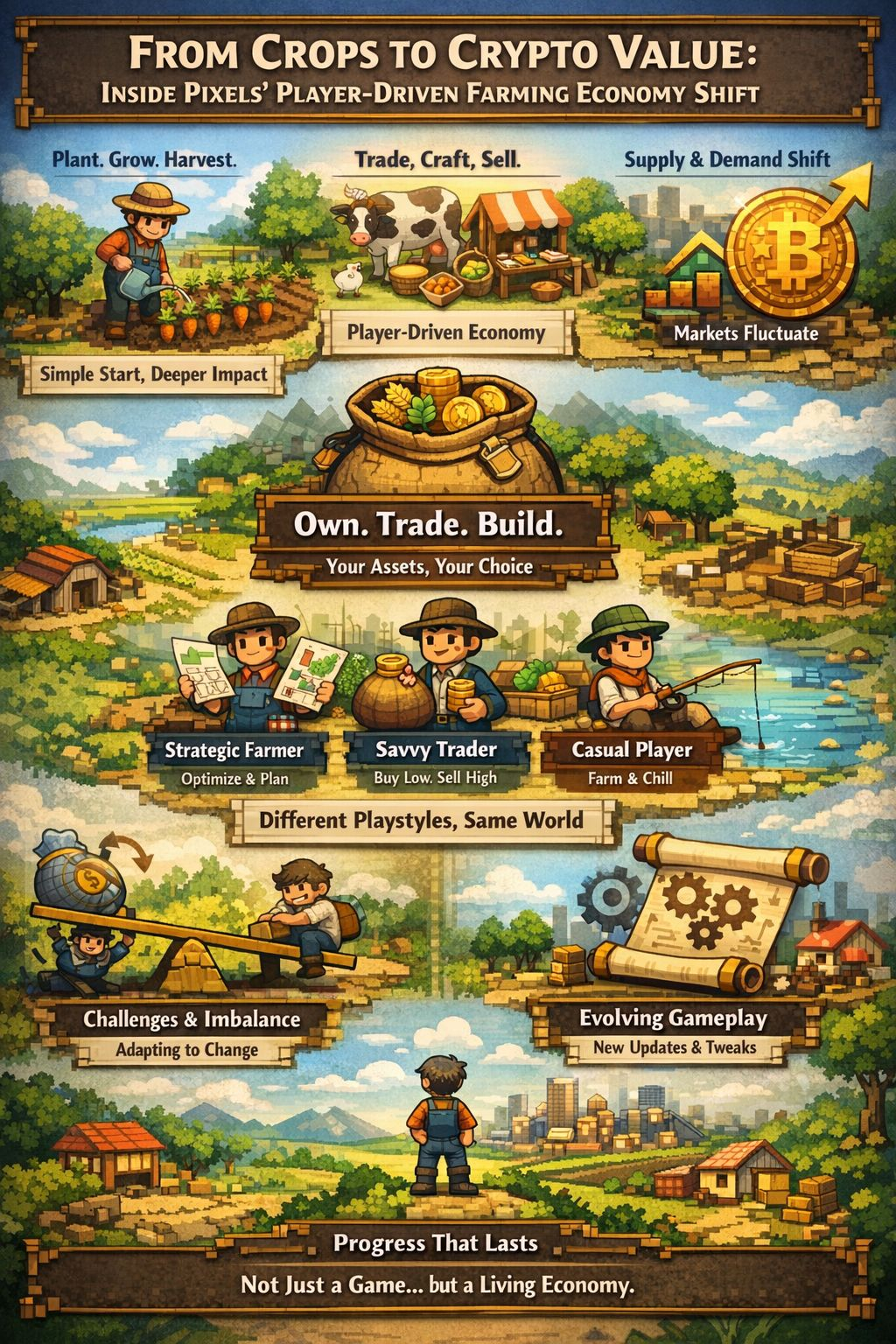
There’s no overwhelming complexity thrown at your face. You get land. You plant things. You wait. You harvest. It’s familiar enough that your brain doesn’t resist it. But that simplicity is doing some heavy lifting behind the scenes.
Because every action feeds into something larger.
Not in an obvious, “here’s a massive economy dashboard” kind of way. It’s quieter. You just notice that the things you collect don’t feel disposable. They have use. They move. Other players want them. Sometimes more than you expected.
And suddenly, farming isn’t just a mechanic anymore—it’s production.
---
What makes this interesting isn’t the farming itself. Games have done that for years. It’s what happens after you harvest.
Your crops aren’t just sitting in a virtual silo waiting to rot or be converted into XP. They exist in a system where supply and demand actually matter. Not perfectly, not always fairly—but enough to feel real.
Some days, a crop you ignored turns out to be valuable. Other times, something you focused on floods the market and drops in value. There’s no announcement telling you what’s smart. You figure it out slowly, through small wins and small mistakes.
It feels less like following instructions and more like… adapting.
---
Ownership plays a big role here, but not in the loud, overhyped way people usually talk about it.
It’s not constantly reminding you that “you own your assets.” It just lets you experience it.
You farm something, and it’s yours to use, trade, or hold. That’s it. No big speech attached. But over time, that changes how you treat your time in the game. You’re not just grinding for the sake of progress—you’re building something that sticks around, at least in some form.
And that feeling is subtle, but it matters.
Because in most games, your effort fades the moment you log out. Here, it lingers a bit.
---
There’s also this quiet layer of player behavior that starts to emerge.
Not everyone plays the same way, even if they start the same way.
Some people go all-in on efficiency. They plan their farms like they’re solving a puzzle no one else sees. Others drift toward trading, figuring out where value moves and trying to stay one step ahead. And then there are players who just… vibe. They farm what they like, trade occasionally, and don’t overthink it.
All of them fit into the system somehow.
That’s what makes it feel alive. Not balanced in a perfect sense—but active, shifting, slightly unpredictable.
---
Of course, it’s not without friction.
There are moments where things feel uneven. When certain strategies dominate for too long, or when newer players feel like they’re arriving late to something already optimized by others. That gap can be noticeable.
And there’s always that lingering question in the background—how long can this kind of loop stay meaningful?
Farming is calming, sure. But repetition has a limit. Even the most satisfying systems need change to stay interesting. Pixels seems aware of that, though. Updates roll in. Mechanics evolve. Sometimes they land well, sometimes they don’t. It’s a work in progress, and it feels like one.
---
What’s surprising, in the end, is how unforced it all feels.
Pixels doesn’t push the idea that you’re part of some grand economic experiment. It doesn’t try to convince you that every action is important.
You just play.
You plant something. You come back later. It grows. You decide what to do with it.
And somewhere in that loop, without much noise, your time turns into something that carries a bit more weight than expected.
Not life-changing. Not revolutionary.
Just… not empty.
And for a farming game, that’s already doing more than most.