
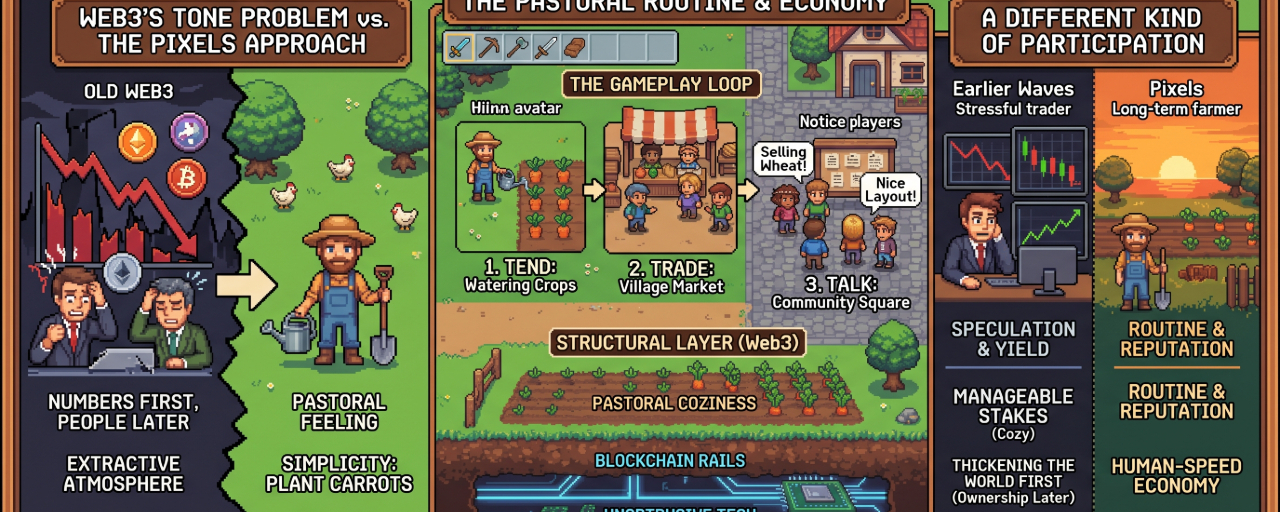
Web3 has a tone problem. For years, it has spoken in the language of white papers and token charts, of volatility and velocity. Even when the intentions were creative, the atmosphere often felt extractive. Numbers first, people later. Pixels takes that inheritance and does something disarmingly simple with it: it asks you to plant carrots.
The interface is spare. A toolbar. A backpack. A map. If there’s a wallet connected in the background, it’s not clamoring for attention.That familiarity is deliberate.
Pixels runs on blockchain rails, and many of its itemsland, resources, cosmeticsexist as digital assets with real ownership attached. That fact could easily dominate the experience. Instead, it sits quietly beneath the surface. You can spend an hour watering crops and chatting in town without once thinking about token standards or marketplaces. The technology is structural. The feeling is pastoral.
The distinction matters. Web3 projects have often struggled to convince people that ownership alone is meaningful. Owning a sword or a parcel of land means little if the world around it feels thin. Pixels thickens the world first. The ownership comes after.
Walk through the central square and you’ll see players clustered near a notice board, their pixelated avatars shifting a few squares at a time. Some are advertising crops for sale in chat. Others are comparing farm layouts. A few simply stand there, idle, as if occupying space is reason enough. The economy is presentthere are trades happening, values negotiated—but it unfolds at human speed. No flashing alerts. No countdown clocks.
On your own farm, decisions accumulate. Do you sell your wheat immediately for quick liquidity, or hold it to craft feed that will raise higher‑value livestock later? Do you invest in decorative fencing that won’t increase output but will make the property feel finished? These are economic choices, but they’re framed through routine rather than speculation. You feel them in the time it takes to water a field, not in the swing of a chart.
That grounding changes the emotional temperature. In earlier waves of blockchain gaming, much of the conversation centered on yield. Players calculated returns with the intensity of day traders. When token prices fell, entire communities thinned out overnight. Pixels seems aware of that history. It doesn’t pretend the financial layer isn’t there, but it refuses to make it the main character.
There are constraints, of course. Transaction fees exist. Yet the design cushions the blow. When markets wobble, the crops still grow on schedule. The chickens still wander. The loop remains intact.
The open world reinforces that steadiness. Dirt paths curve through forests where forageable items respawn quietly over time.But it gives the sense that the world would persist even if you weren’t optimizing it. That persistence is what makes ownership feel less abstract. You’re not holding a token in a vacuum; you’re tending a place.
What’s most striking is how little the game insists that you understand its infrastructure.For veterans of Web3, that subtlety may feel almost radical. The point isn’t to marvel at the rails. It’s to ride them without thinking.
That choice carries risk. By downplaying the financial upside, Pixels may attract players more interested in atmosphere than arbitrage. Growth could be slower. Speculative surges might be rarer. But the tradeoff appears intentional.
Others specialize in certain goods and become known, by username, as reliable suppliers. Reputation forms not through leaderboard dominance but through repeated, visible interaction. In a space often caricatured as anonymous and transactional, that visibility feels almost old‑fashioned.
None of this means Pixels has solved Web3’s contradictions. Digital ownership still exists within regulatory gray areas. Asset values can swing sharply. The tension between play and profit never disappears entirely. Yet the game demonstrates that the tone of a system can be altered without rewriting its codebase. You can build on blockchain and still prioritize mood, routine, and neighborly friction.
Cozy is an overused word in games, often deployed to describe soft colors and gentle soundtracks. Here, it describes something more structural. The stakes feel manageable. The scale feels human. When you log off, you’re thinking about whether your pumpkins will be ready tomorrow, not whether a market will spike overnight.
Pixels doesn’t argue that Web3 should replace traditional gaming, or that digital assets are inherently transformative. It makes a quieter claim through design: technology can sit in the background while people focus on tending, trading, and talking. In doing so, it reframes what participation looks like. Not a rush. Not a gamble. A routine.